
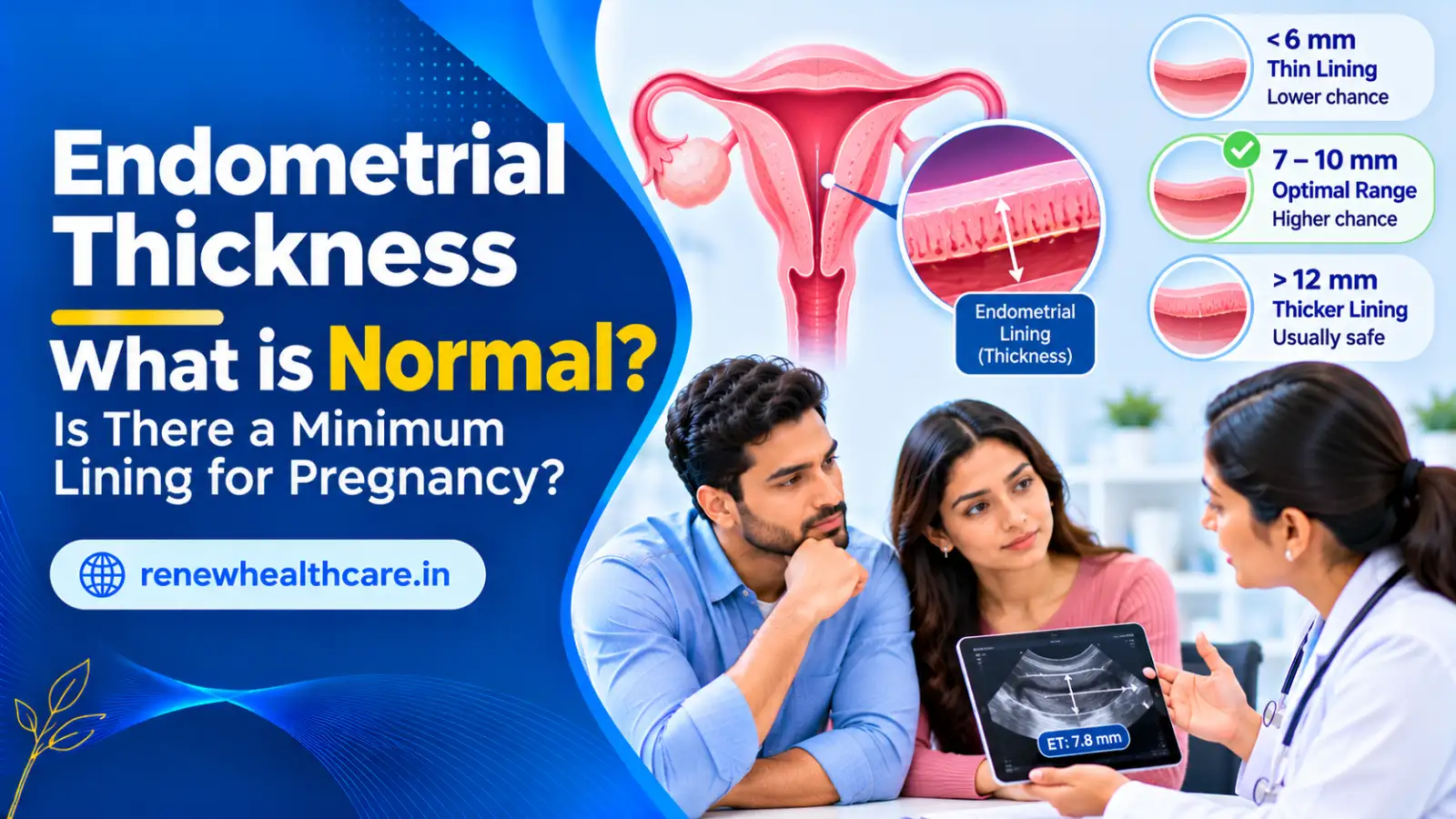
The thickness of the uterine lining is an important factor doctors consider during fertility assessments and IVF treatment. If your ultrasound report shows an endometrial thickness of 6 mm, 7 mm or 14 mm, you may wonder whether it is suitable for pregnancy.
The endometrium is the inner lining of the uterus. It changes throughout the menstrual cycle and prepares for a possible pregnancy. However, there is no single measurement that is considered normal for every woman. The interpretation depends on the menstrual-cycle day, whether ovulation has occurred and whether the woman has reached menopause.
In IVF studies, live-birth rates generally increase with endometrial thickness before reaching a plateau. A thinner lining may be associated with lower average chances, but pregnancy can still occur.
At Renew Healthcare, fertility assessments and treatment decisions are considered according to each patient's medical history and individual requirements. You can also explore the available fertility and healthcare services.
1. What Is Endometrial Thickness?
The endometrium is the inner lining of the uterus. It changes throughout the menstrual cycle in response to hormones.
During the first part of the cycle, oestrogen helps the lining grow. After ovulation, progesterone supports its development and prepares it for a possible pregnancy. If pregnancy does not occur, the lining sheds during menstruation.
Endometrial thickness is generally measured through a transvaginal ultrasound scan. The measurement is taken from the front to the back of the lining in a side-on view of the uterus.
The lining is usually thinnest during menstruation and becomes thicker as the cycle progresses. Therefore, a measurement should always be interpreted alongside the menstrual-cycle day.
There is no single universally accepted millimetre range that applies to every phase of the menstrual cycle.
For further information, read about hysteroscopy and IVF.
2. What Is the Normal Endometrial Thickness for Pregnancy?
One of the most common questions during fertility consultations is how thick the uterine lining should be for pregnancy.
The answer depends on the type of fertility treatment and the timing of the measurement.
Research involving approximately 96,000 embryo transfers found that live-birth rates increased with endometrial thickness and then levelled off. The observed plateau was approximately:
Fresh embryo transfers: 10–12 mm.
Frozen embryo transfers: 7–10 mm.
The same analysis found a marked reduction in live-birth rates when the lining measured below 6 mm.
A separate analysis of more than 40,000 embryo transfers also found lower live-birth rates among women with thinner linings.
| Endometrial thickness | What IVF research suggests |
|---|---|
| Below 6 mm | Live-birth rates were markedly lower in the studied populations, but pregnancies still occurred |
| 6–6.9 mm | Lower average live-birth rates than at 8 mm or more |
| 7–7.9 mm | In one large study, outcomes were not significantly different from the 8 mm or more group in frozen cycles |
| 7–10 mm | Live-birth rates in frozen transfers generally approached a plateau |
| 10–12 mm | Live-birth rates in fresh transfers generally approached a plateau |
These figures are based primarily on IVF research. They should not be treated as guaranteed thresholds for natural conception or IUI.
The Canadian Fertility and Andrology Society guideline advises counselling that a lining below 8 mm in fresh cycles or below 7 mm in frozen cycles may be associated with lower pregnancy and live-birth chances. This recommendation is based on low-certainty evidence.
You can also read about the frozen embryo transfer cycle and what happens on embryo transfer day.
3. Can You Get Pregnant with a Thin Endometrium?
Yes, pregnancy can occur even when the endometrial lining is thinner than commonly used IVF thresholds.
A thin lining may be associated with lower average live-birth rates, but it does not mean pregnancy is impossible.
A study analysing more than 40,000 embryo transfers reported the following live-birth rates:
| Endometrial thickness | Fresh transfer | Frozen transfer |
|---|---|---|
| 8 mm or more | 33.7% | 28.4% |
| 6–6.9 mm | 24.6% | 23.7% |
| 5–5.9 mm | 18.1% | 15.0% |
These figures describe outcomes in the studied IVF populations. They are not an individual prediction.
Age, embryo quality, uterine-cavity conditions and other fertility factors can also influence pregnancy outcomes.
It is important not to interpret one ultrasound measurement as a final answer about your chances of conceiving.
Read more about thin endometrium and available treatment evidence.
4. What Causes a Thin Endometrial Lining?
A thin endometrial measurement may need further evaluation, particularly when it persists across repeated scans.
The measurement alone does not identify the underlying cause. A clinician may consider whether there is a problem involving the uterine cavity or another factor affecting the lining.
For selected patients, further assessment may include:
Repeating the ultrasound scan to confirm the measurement.
Reviewing the menstrual-cycle day and type of treatment cycle.
Considering a saline sonogram or hysteroscopy to examine the uterine cavity.
Reviewing previous uterine procedures and relevant medical history.
The Canadian Fertility and Andrology Society guideline suggests repeating a thin measurement. It also states that a cavity assessment using hysteroscopy or saline sonography may be performed to look for a possible cause.
A cavity check is not automatically necessary for every thin measurement. The decision should depend on the individual clinical situation.
Previous uterine procedures may also be relevant when reviewing a patient's history. Learn more about Asherman syndrome after a D&C and hysteroscopy and IVF success.
5. What Treatments Help Improve a Thin Endometrial Lining?
When a scan shows a thin endometrium, the first step is to understand the measurement and consider whether further assessment is needed.
Different medicines and fertility add-ons have been studied, but increasing the thickness on a scan does not necessarily mean that live-birth chances improve.
| Treatment or approach | What the evidence suggests |
|---|---|
| Repeat ultrasound | Suggested by the Canadian guideline to confirm a thin measurement |
| Hysteroscopy or saline sonogram | May be considered to assess the uterine cavity |
| Frozen embryo transfer in a later cycle | May be offered in selected fresh-cycle situations; evidence is limited |
| Sildenafil | One small trial found increased thickness but no difference in pregnancy outcomes |
| Aspirin and luteal oestradiol | The Canadian guideline suggests against their routine use for this purpose |
| PRP and G-CSF | ESHRE 2023 does not recommend intrauterine use as routine add-ons |
| Dietary supplements | Current evidence does not establish a high-certainty benefit for improving pregnancy or live-birth outcomes |
Is PRP effective for thin endometrium?
Platelet-rich plasma (PRP) has been studied as a possible treatment for thin endometrium.
Some research reports an increase in lining thickness or clinical pregnancy outcomes. However, the available meta-analyses do not agree, and the quality of evidence is limited.
A 2026 analysis of seven randomised trials reported a possible increase in clinical pregnancy, but the result lost statistical significance when individual studies were removed. Live birth was not pooled in that analysis.
Another 2024 analysis reported a positive live-birth result, but the evidence still needs stronger confirmation.
ESHRE's 2023 recommendations do not recommend intrauterine PRP or G-CSF as routine fertility add-ons.
Can supplements increase endometrial thickness?
Dietary supplements are sometimes promoted as ways to improve uterine lining thickness. However, current research has not established a high-certainty benefit for improving pregnancy or live-birth outcomes.
Do not start prescription medicines, hormonal treatment or supplements without discussing them with your doctor.
For further reading, see thin endometrium: what actually works.
6. Does a Thick Endometrium Affect Pregnancy Chances?
A thicker endometrial lining does not automatically indicate a problem.
The lining normally becomes thicker as the menstrual cycle progresses. Therefore, the cycle day and whether ovulation has occurred are important when interpreting an ultrasound report.
In the IVF research discussed above, live-birth rates generally reached a plateau rather than continuously declining as the lining became thicker.
One small study involving 380 fresh ICSI cycles also found no statistically significant difference in live-birth outcomes above or below 15 mm. However, the study was too small to rule out a modest difference.
Endometrial thickness alone cannot diagnose a condition.
Heavy, irregular or between-period bleeding should be discussed with a gynaecologist, regardless of the measurement. Bleeding after menopause needs prompt medical assessment.
You can read more about heavy or irregular periods and hysteroscopy for abnormal uterine bleeding.
7. What Does Endometrial Thickness Mean After Menopause?
Endometrial thickness is interpreted differently after menopause.
A measurement used in women who are still menstruating should not automatically be applied to someone who has reached menopause.
Earlier American College of Obstetricians and Gynecologists (ACOG) guidance described a 4 mm measurement in the specific context of evaluating postmenopausal bleeding. This figure should not be treated as a universal threshold for every woman after menopause.
Persistent or recurrent postmenopausal bleeding requires appropriate assessment, including consideration of tissue sampling, regardless of the measured thickness.
ACOG issued a focused update in April 2026. The full text of that update was not available in the source review, so the latest recommendations should be verified by the medical reviewer before publication.
If you experience bleeding after menopause, consult a qualified gynaecologist promptly rather than relying on an ultrasound measurement alone.
8. What Should You Do If Your Endometrial Lining Is Thin?
If your ultrasound report shows a thin endometrial lining, avoid making decisions based on one measurement alone.
What you should do
Note the menstrual-cycle day when the scan was performed.
Confirm whether the measurement was taken during a fresh, frozen, natural or programmed cycle, as applicable.
Ask whether the scan should be repeated.
Discuss whether a uterine-cavity assessment is appropriate.
Ask your doctor what the next step will be if the lining remains thin.
What you should avoid
Cancelling a treatment plan based only on one scan result without discussing it.
Starting prescription oestrogen or sildenafil without medical advice.
Paying for fertility add-ons without understanding the evidence.
Buying supplements based on claims that they can guarantee a thicker lining or improve pregnancy chances.
If a planned treatment cycle has not reached the clinic's required threshold, discuss whether a repeat scan, further assessment or a later transfer is appropriate.
A useful question to ask during your consultation is:
"This measurement was taken on cycle day X during a Y cycle. What does it change about my treatment plan, and what happens if the lining remains thin?"
For related information, read about the frozen embryo transfer cycle and fertility testing.
9. Frequently Asked Questions About Endometrial Thickness
What is the normal endometrial thickness for pregnancy?
There is no universal measurement that guarantees pregnancy. IVF studies show that live-birth rates generally rise and then level off at around 7–10 mm in frozen cycles and 10–12 mm in fresh cycles. These are observed patterns, not fixed rules.
Is a 6 mm endometrium enough for pregnancy?
Pregnancy can occur with a 6 mm lining. However, IVF studies have reported lower average live-birth rates at 6–6.9 mm than at 8 mm or more. The result should be interpreted in the context of the individual treatment cycle.
Can I conceive naturally with a thin endometrium?
It is possible, but reliable thickness thresholds for natural conception have not been established in the evidence reviewed here. Persistent thin measurements may warrant a gynaecological assessment to look for a possible cause.
What is normal endometrial thickness after menopause?
There is no single figure that applies to every woman after menopause. The earlier 4 mm ACOG figure relates specifically to postmenopausal bleeding. Any postmenopausal bleeding should be medically assessed.
Does a thick endometrium reduce pregnancy chances?
Not necessarily. IVF research suggests that live-birth rates tend to plateau as the lining becomes thicker. However, abnormal bleeding or other symptoms need separate clinical evaluation.
Do PRP, sildenafil or G-CSF improve endometrial thickness and pregnancy chances?
Some small studies have reported increases in lining thickness, but reliable improvements in live-birth outcomes have not been established. ESHRE 2023 does not recommend intrauterine PRP or G-CSF as routine add-ons. Discuss the evidence and risks with your fertility specialist.
10. Conclusion
Endometrial thickness is one part of fertility assessment, but it is not a standalone measure of whether pregnancy will happen.
The meaning of a measurement depends on the menstrual-cycle day, the type of fertility cycle and the patient's medical history.
IVF studies show that live-birth rates generally rise with increasing lining thickness before reaching a plateau. A thinner lining may be associated with lower average outcomes, but it does not make pregnancy impossible.
If your scan shows a thin or unusually thick lining, discuss the result with your doctor. The priority should be understanding the reason behind the measurement and deciding whether any further assessment is needed, rather than chasing a number or relying on unproven add-ons.
For information about fertility-related care, visit Renew Healthcare or explore the Services page.
Medical Review: Dr. Arnab Kundu — View Doctor Profile
Medical Disclaimer: This article is intended for general educational purposes only and does not replace individual medical advice, diagnosis or treatment. Please consult a qualified healthcare professional regarding your own medical condition and fertility concerns.