Key Takeaways
- A few small blood clots are usually nothing to worry about when your flow is heavy.
- If you are dealing with heavy bleeding with large blood clots during period, it could be a sign that something is going on like fibroids or hormonal issues.
- Simple tweaks to your lifestyle can really help keep symptoms under control. If the problem continues or affects your fertility, it’s best to consult a specialist. You can check out one of the best fertility clinic in Kolkata for proper diagnosis and treatment.
In This Article
Lots of women notice blood clots when they are having their period and worry if something is wrong.
However, if the clots are big or you are losing blood too quickly, it could be a sign that something's going on in the background.
This article is all about what period blood clots are, why you get them, and when you should get help.
What Are Period Blood Clots - What's Going On In There?
Every month when you get your period, your uterus sheds its lining. Your blood gets all mixed up with tissue and proteins and there are these things called anticoagulants that help keep it all flowing smoothly.
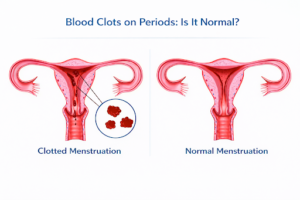
But when your flow is heavy, the blood starts to pool in your uterus or down in your vagina. It clots before it comes out of you and that's what you see when you look at jelly like clots during your period. These are generally normal period blood clots.
These clots are usually small (about the size of a pea or a quarter) and harmless and they tend to appear as some kind of gel-like substance, often bright or dark red.
This whole process helps prevent you from losing too much blood.

Common Causes of Blood Clots During Period
Heavy flow is one of the main causes of clots. But there are a few other factors that can trigger this too.
Heavy periods and blood clots (Menorrhagia)
Menorrhagia, menstrual blood clots or heavy menstrual bleeding is when your periods are just way too heavy. You might be passing clots during your period pretty frequently.
Menorrhagia affects about 1 in 5 women and up to 30% of women worldwide.
Hormonal Imbalance And Irregular Cycles
When your
hormones are out of balance it causes trouble with your progesterone and estrogen levels. As a result, your lining gets thicker and starts to shed more heavily. PCOS can be a contributing factor.
Fibroids, Adenomyosis, PCOS, and other medical conditions
- Fibroids are super common non-cancerous growths.
- Adenomyosis is when your uterine lining starts to grow into the wall of your uterus.
- PCOS causes irregular thick-lining with heavy period clots.
- Other causes include thyroid issues or bleeding disorders.
These can all make your uterus bigger or block your flow, which means your blood pools and clots.
Warning Signs You Should Not Ignore
Some of these signs are a clear indication that you need medical help.
Severe cramps, fatigue, or dizziness
While they often come with some serious flow days, they are not the root of the problem. Pain that just won't be shifted by over the counter medication could be telling you there's something else going on.
Signs of anemia due to heavy blood loss
If your body is running low on iron, you might be feeling like:
- Weak
- Pale
- Breathless or Tired
How To Manage Heavy Periods With Blood Clots
You can take care of this at home, but be sure to seek advice from your gynecologist before doing anything.
Lifestyle and home care tips
- Drink plenty of water and eat foods rich in iron.
- Use a heating pad to get some relief from cramps.
- Keep track of your cycles to spot any patterns that might be worth investigating.
Medical treatments for heavy blood clots during period
Here are some common treatments that a gynecologist may want to discuss with you, after evaluating your health and having a good understanding of your medical history, including concerns such as understanding blood clots, period meaning, and other menstrual health issues.
You should always check in with a qualified gynecologist before starting, altering or in any way deviating from any treatment.
When to get your gyno involved with period blood clots
If you're experiencing clots that are big and persistent then it's probably a good idea to get yourself checked out by a doctor.
Same goes if you have got heavy bleeding, really bad pain or anemia signs and that's when you should get some help asap. And it can't be stressed enough that getting checked out early can make all the difference.
For people with fertility worries or related concerns you should look into things like
preconception counselling, and consult the best fertility clinic in Kolkata for expert services such as
IUI treatment in Kolkata.
Understanding what's going on with your period and those blood clots in particular can be super empowering. Just remember that most of the time, this is totally normal but if your symptoms seem unusual, be sure to pay attention and get some medical advice.

Frequently Asked Questions
Are period blood clots normal during menstruation?
Yes, blood clots are pretty common during heavy flow days for loads of women. They form naturally to stop you losing too much blood. However, you should consider seeing a doctor if:
- Clots are bigger than a 2-3 cm coin
- You are soaking through a pad or tampon every hour
- periods are lasting longer than 7-8 days
- You are experiencing any severe pain , dizziness or extreme fatigue
Why do blood clots during period happen ? (period clots reason)
Blood clots during period happen when you are having a heavy flow and the blood has nowhere else to go but to pool and coagulate a bit before leaving the body. Your body just needs a bit of help to keep up with all that blood being shed.
What do big period blood clots mean and when should I worry about period blood clots?
When you are passing big clots (bigger than a quarter) in every cycle, or noticing blood clots with tissue during period, it usually means you are losing too much blood and something might need to be looked at. Some women also report seeing period blood clots in toilet, which can be a sign of heavier-than-normal flow.
Worry if this is happening all the time, you are going through pads or tampons every hour or so, and you are in a lot of pain.
What causes heavy periods with blood clots ?
The main causes for this are hormonal imbalances, fibroids, adenomyosis, PCOS, polyps, endometriosis, thyroid issues, or bleeding disorders.
When should you see a doctor for heavy blood clots during period?
See a doctor if you are passing big clots in every cycle, you are constantly changing your pads/tampons, you have severe cramps or you are feeling tired, dizzy or pale.
Popular Searches
Egg Freezing Process In Kolkata |
Ivf Centre In Jamshedpur |
Laparoscopy For Infertility Cost |
Surrogacy Centre In Kolkata
Popular Blogs
Sperm Health: How To Improve Motility And Count Naturally |
Understanding The Two-Week Wait: Emotional And Physical Aspects |
What Are The Five Stages Of Ivf Treatment |
Can Diet Improve Male Fertility? A Look At Fertility Superfoods |
Role Of Vitamins In Sperm Improvement |
How Lifestyle Changes Are Affecting Male And Female Fertility