
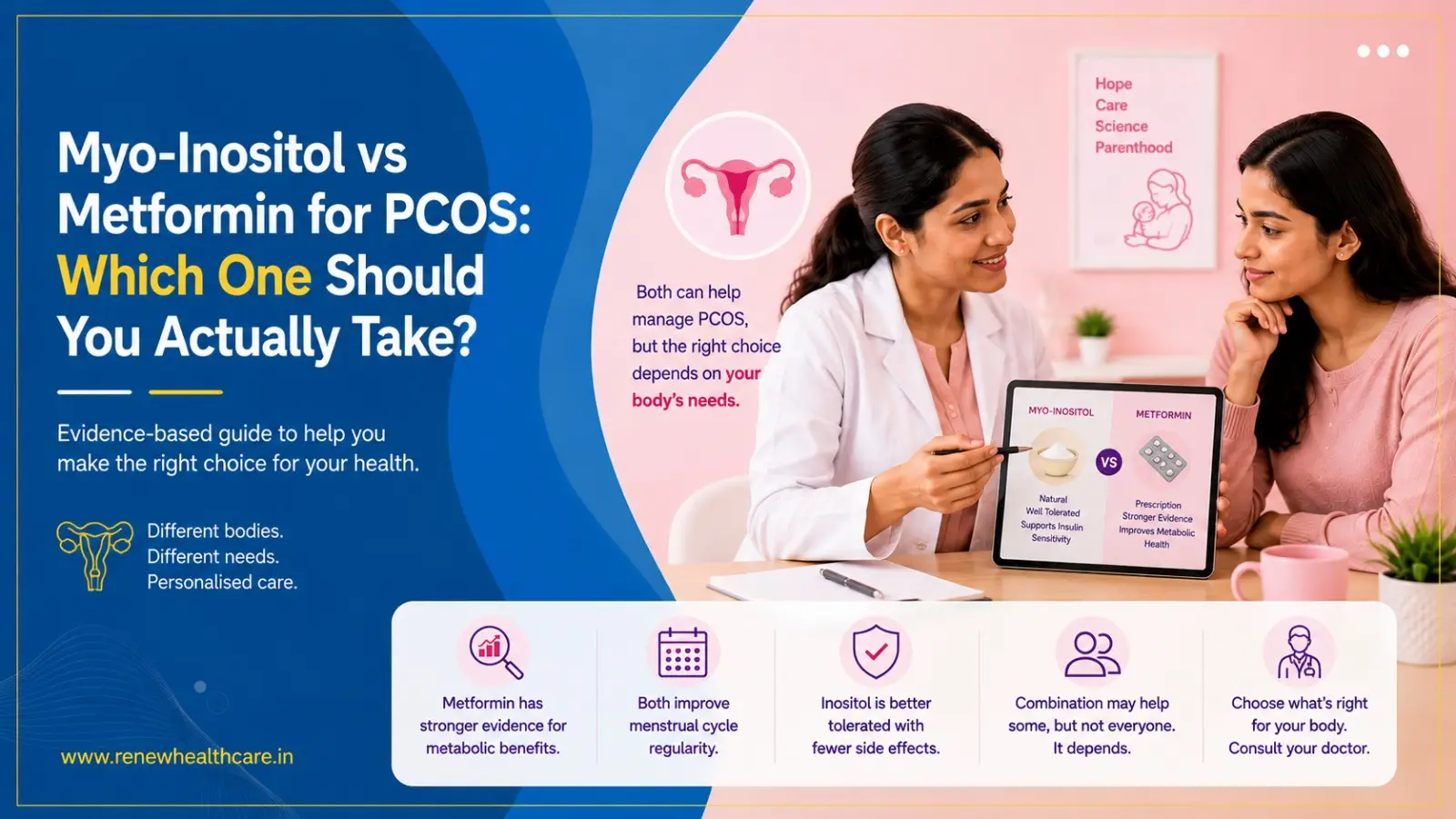
By Dr. Neha Yadav — Infertility Specialist & IVF Consultant, Salt Lake, Kolkata
"Just take inositol, it's natural" is advice I hear patients repeat before they have even had their insulin levels checked. The honest answer is less Instagram-friendly: for PCOS, the right choice depends on what your body actually needs — not which supplement trended this month.
Key Takeaways
- Metformin has stronger trial evidence for improving fasting glucose, weight and HDL; myo-inositol shows minimal metabolic effect but far fewer side effects.
- Both improve menstrual cycle regularity to a similar degree in head-to-head trials.
- A 2025 meta-analysis found that combining inositol with metformin is not proven better for everyone — benefit may depend on your PCOS phenotype.
- Neither is a fertility guarantee — both are insulin-sensitising tools, not treatments that bypass an individualised diagnosis.
Why Insulin Matters in PCOS
PCOS involves hyperandrogenism, insulin resistance and disrupted LH/FSH signalling, which together impair follicular maturation and ovulation. Insulin-sensitising therapy — metformin, myo-inositol, or both — can improve ovulatory frequency and hormonal balance in many patients. Evidence for a direct implantation or endometrial receptivity benefit is weaker and less consistent: improved ovulation does not guarantee improved implantation outcomes.
How They Actually Differ
Metformin is a prescription drug that reduces how much glucose your liver releases and improves how your cells respond to insulin. Myo-inositol is a naturally occurring insulin-signalling molecule, sold as a supplement, that helps cells use insulin more efficiently without altering liver glucose output. Both target the same root problem in most PCOS — insulin resistance — through different mechanisms.
| Factor | Metformin | Myo-inositol |
|---|---|---|
| Evidence base | Large, long-standing RCT base | Growing, but smaller trials |
| Metabolic effect | Improves glucose, weight, HDL | Minimal in direct trials |
| Cycle regularity | Comparable benefit | Comparable benefit |
| Side effects | Nausea, GI upset (common) | Well tolerated, rare GI upset |
| Needs prescription | Yes | No, but should still be doctor-guided |
Myth vs. Fact
| Myth | Fact |
|---|---|
| Inositol is natural, so it always works better than metformin. | Head-to-head trials show metformin outperforms inositol on metabolic markers; natural is not the same as more effective. |
| Taking both together is always the best strategy. | A 2025 meta-analysis found no routine benefit of combining them across all PCOS patients — it may help select phenotypes only. |
What To Do Instead of Guessing
- Get HOMA-IR, fasting insulin and glucose tested before choosing either option.
- Ask which PCOS phenotype you have — hyperandrogenic and non-hyperandrogenic patients respond differently.
- If metformin causes GI intolerance, discuss extended-release forms or a supervised switch to inositol.
- Re-evaluate at three to six months with repeat bloodwork, not by how you "feel".
Quick FAQ
Can I take myo-inositol without a prescription?
It is available over the counter, but PCOS is heterogeneous — have your phenotype and metabolic profile confirmed first.
Does either improve IVF outcomes?
Both may support ovulatory function, but neither is a substitute for a personalised stimulation protocol — evidence for direct IVF outcome improvement remains limited.
Find the Path That Fits Your PCOS Profile
Not sure which option suits you? Book a consultation with Dr. Neha Yadav in Salt Lake, Kolkata for insulin-resistance testing and a personalised plan.
References
Sobral et al. Inositol with metformin versus metformin monotherapy in PCOS: a meta-analysis of RCTs. Reproductive, Female and Child Health, 2025.
Ravn P, et al. Myo-inositol vs. metformin in women with PCOS: a randomised controlled clinical trial. Metabolites, 2022.
Effects of inositol in women with PCOS: an umbrella review of meta-analyses. Frontiers in Endocrinology.