
Medically reviewed by Dr. Arnab Kundu, MBBS, DGO, DNB (Obs & Gynae) — Infertility Specialist, IVF Expert & Gynaecologist at Renew Healthcare, Ballygunge–Gariahat, Kolkata
Last updated: September 2026
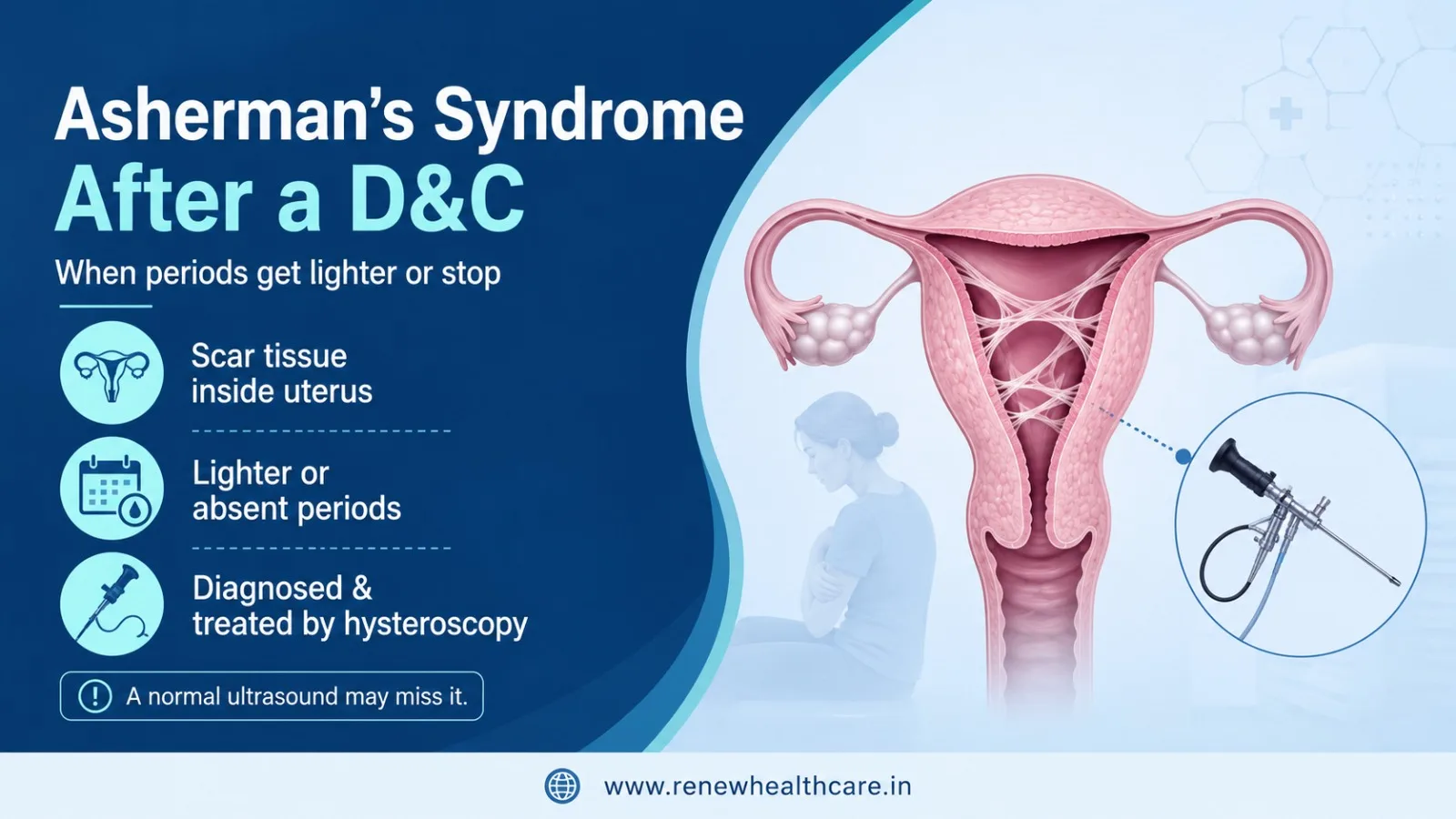
In brief: Asherman's syndrome is scar tissue inside the uterus, most often forming after a D&C (dilation and curettage), especially one done for a miscarriage or after delivery. Its calling card is periods that become much lighter or stop entirely after such a procedure — sometimes with cyclical pain, sometimes with infertility as the only clue. It is diagnosed and treated by hysteroscopy, and outcomes are genuinely good in milder cases. The tragedy is how often it goes unlooked-for.
The pattern that should ring a bell
A woman has a D&C after a miscarriage. In the months that follow, her periods — previously normal — shrink to a day of brown staining, or vanish. She is told this is stress, or hormones, or breastfeeding, or nothing. A year later she is being investigated for infertility, and nobody has connected the two facts sitting side by side in her own history.
If your periods changed noticeably after a uterine procedure, that sequence is the story. Say it in exactly those words at your consultation: "My periods became much lighter after my D&C." That one sentence should trigger the right investigation.
What Asherman's syndrome actually is
The inside of the uterus is lined by endometrium — the tissue that thickens each cycle and sheds as a period, and the bed an embryo implants into. When the deeper layer of this lining is injured, the healing walls can stick to each other, forming bands of scar tissue called adhesions. Patches of lining are replaced by scar that neither bleeds nor accepts an embryo.
Depending on how much of the cavity is involved, the result ranges from a few thin bands to a cavity almost sealed shut — which is why symptoms range from slightly lighter periods to no periods at all.
What causes it
- D&C after miscarriage or delivery — the classic setting; the pregnancy-softened uterus is more vulnerable, and repeat procedures raise the risk substantially.
- Surgery inside the cavity — fibroid or polyp removal, caesarean-related procedures.
- Genital tuberculosis — a major, under-recognised cause of intrauterine scarring in India, sometimes producing severe Asherman's with no procedure history at all.
- Severe uterine infection.
Worth stressing: most D&Cs do not cause Asherman's. The procedure is common and usually uneventful. But usually is not always, and the possibility deserves awareness — particularly after repeated procedures.
The symptoms, in order of loudness
- Markedly lighter periods or absent periods after a uterine procedure — the signature.
- Cyclical pelvic pain without much bleeding — the body attempting a period behind an obstruction.
- Infertility — scar tissue displacing the implantation surface, or physically blocking the cavity and tubal openings.
- Recurrent miscarriage — a scarred, poorly vascularised cavity supports pregnancy badly.
- Sometimes nothing at all, discovered only during a fertility workup.
How it is diagnosed — and how it is missed
Here is why it gets missed: an ordinary ultrasound can look normal. Adhesions are flat, and unless the lining is measured carefully (a persistently thin endometrium is a clue) a routine scan sails past them.
The tests that actually show it:
- Hysteroscopy — a thin camera through the cervix, viewing the cavity directly. The gold standard, and also the treatment platform.
- Saline infusion sonography (SIS) — ultrasound with fluid outlining the cavity; a good non-surgical look.
- HSG — often reveals filling defects or a shrunken cavity, sometimes as an incidental finding during tubal testing.
If you have the classic history and a normal ultrasound report, the ultrasound has not excluded Asherman's. Ask directly: "Has my uterine cavity actually been looked at — by hysteroscopy or saline sonography?"
Treatment: what can realistically be achieved
Treatment is hysteroscopic adhesiolysis — cutting the adhesions under direct vision through the cervix, no incisions, usually as a day procedure. The goals are a restored cavity shape, reappearance of menstruation, and an endometrium capable of implantation.
Two honest caveats belong beside the optimism.
First, re-scarring is the central challenge. Freshly separated walls like to stick again, so surgeons use various measures after surgery — hormone therapy to regrow lining, and sometimes temporary devices to keep walls apart. Follow-up checks matter as much as the operation.
Second, results track severity. Mild disease treated by an experienced hysteroscopic surgeon does well — periods and fertility frequently return. Severe disease, with most of the lining destroyed (including post-tuberculous scarring), may improve only partially despite repeat surgery, and pregnancies that do occur after significant Asherman's need obstetric attention, as placental problems are more common. This is a condition where the experience of the surgeon genuinely changes the outcome — it is reasonable to ask how often a centre performs adhesiolysis.
Where the cavity cannot be adequately restored, conversations move to the honest alternatives — and that discussion is exactly the kind that should happen with full information rather than drift.
Frequently Asked Questions
My periods almost stopped after a D&C. Is that definitely Asherman's?
Not definitely — hormonal causes, breastfeeding and other explanations exist. But the combination is suspicious enough that your cavity should be looked at directly rather than reassured away.
Can I get pregnant with Asherman's syndrome?
Many women conceive after treatment, particularly with milder disease. Untreated significant scarring lowers the chance and raises miscarriage risk — which is why finding and treating it beats not knowing.
Is the surgery painful or risky?
Hysteroscopic adhesiolysis is typically a short day procedure under anaesthesia. Risks exist — including recurrence, and rarely perforation — and drop with surgical experience.
How soon after treatment can we try?
Usually after a check confirms the cavity has healed open and the lining is rebuilding — often a few months. Your surgeon's protocol governs; ask for the plan before the operation, not after.
Could TB really be the cause? I was never very ill.
Yes — genital tuberculosis can smoulder without dramatic illness and declare itself only as scarring and infertility. In India it belongs on the list whenever severe Asherman's appears without a procedural history.
Does Asherman's affect IVF too?
Yes — IVF cannot bypass a scarred implantation surface the way it bypasses blocked tubes. The cavity has to be addressed first, which is why this diagnosis changes the treatment order.
The bottom line
Asherman's syndrome is what it looks like when the uterus heals shut — and its signature, periods shrinking after a D&C, is sitting in plain sight in the patient's own history. It is findable with a camera, treatable through the cervix, and mild cases do well. If your story matches, do not accept reassurance built on a normal ultrasound: ask for the cavity to be looked at.
Get your cavity properly assessed
Dr. Arnab Kundu at Renew Healthcare, Ballygunge–Gariahat, Kolkata — hysteroscopic diagnosis and treatment of intrauterine adhesions, TB-aware evaluation, and honest counselling on what restoration can achieve.
Book a consultation: +91 6292 269 060 | renewhealthcare.in | Renew Healthcare, 18C Mandeville Gardens, Ballygunge, Gariahat, Kolkata 700019
This article is for general education and does not replace individual medical advice. Please consult a qualified specialist about your own situation.