
By Dr. Neha Yadav — Infertility Specialist & IVF Consultant, Salt Lake, Kolkata
Sunita's transfer had been cancelled twice. Both times, her lining measured under 6 mm on the day her clinic wanted to move an embryo. "Just take more estrogen," she had been told — but the number barely moved. What she needed was not more reassurance. She needed to know which of the many treatments floating around forums and clinic brochures were actually backed by evidence, and which were expensive guesses. That is the honest answer this article tries to give.
Key Takeaways
- A thin endometrium is usually defined as under 7 mm, though there is no single global consensus threshold — RCOG, ASRM and ESHRE do not converge on one exact number.
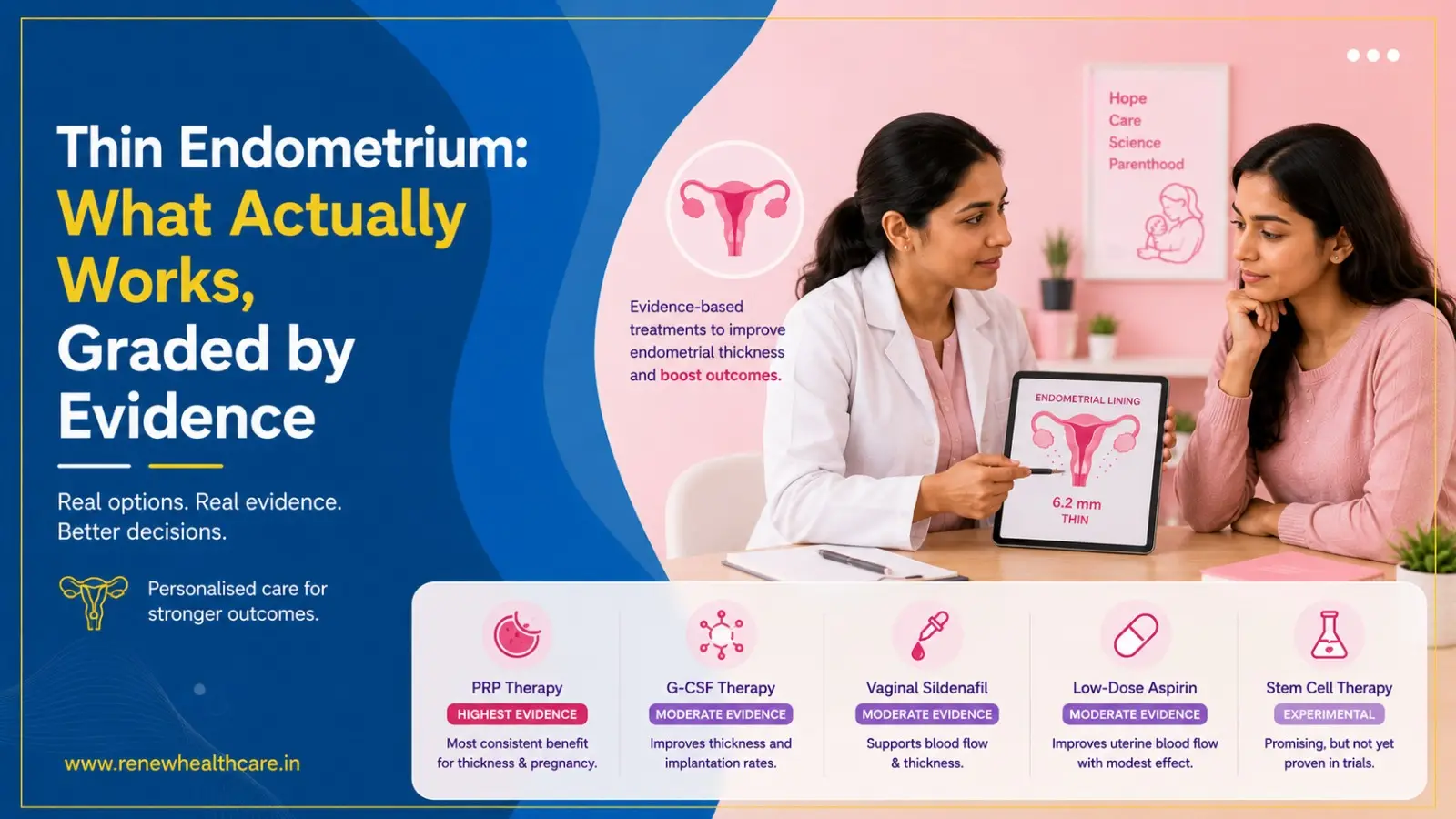
- Across the largest 2025 network meta-analyses, intrauterine PRP shows the most consistent benefit for both thickness gain and clinical pregnancy rate.
- G-CSF and vaginal sildenafil also have moderate-quality evidence; aspirin has a large trial base but a modest effect.
- Stem-cell and regenerative approaches remain experimental — promising in case reports, not yet proven in randomised trials.
- Thickness alone does not decide outcomes; blood flow pattern, cause of thinning, and individual response all matter.
What "Thin" Actually Means — And Why the Definition Is Blurry
Most fertility literature treats an endometrial lining under 7 mm, measured near the time of ovulation or trigger, as thin. But this number is a convention, not a biological law. Different studies, and different professional bodies, have used varying cutoffs, and no single global guideline has settled on one universal figure. That matters clinically: a lining of 6.5 mm with an excellent triple-line pattern and good blood flow can still result in a healthy pregnancy, while a thicker lining with poor perfusion sometimes does not.
Causes of thin endometrium vary — prior uterine surgery or infection (Asherman-type scarring), chronic endometritis, long-term clomiphene use, poor uterine blood flow, and in some cases no identifiable cause at all. Identifying the underlying driver, where possible, shapes which treatment is worth trying first.
The Treatments, Graded Honestly by the Evidence
This is where most patient-facing content oversimplifies. Not every option has equal proof behind it. Below is a grading based on the most recent network meta-analyses and systematic reviews (2024–2025), which pooled data across randomised controlled trials rather than relying on any single study.
| Treatment | What it is | Evidence grade | What the data shows |
|---|---|---|---|
| PRP (intrauterine platelet-rich plasma) | The patient's own concentrated platelets infused into the uterine cavity | Moderate — consistent across meta-analyses | Ranked highest for both thickness gain and clinical pregnancy rate in the largest 2025 network meta-analysis of 18 RCTs |
| G-CSF (granulocyte colony-stimulating factor) | Growth-factor infusion or injection to stimulate endometrial growth | Moderate | Second-best performer for thickness gain; improves implantation and live birth rates in several RCTs |
| Vaginal sildenafil | PDE-5 inhibitor used locally to improve uterine blood flow | Moderate, but a smaller effect size than PRP | Significant thickness improvement, but the pregnancy-rate benefit is less consistent than with PRP or G-CSF |
| Low-dose aspirin | Oral antiplatelet, taken to improve endometrial and ovarian blood flow | Moderate — large trial base, modest effect | Improves thickness and pregnancy rate compared with no treatment, but the effect is smaller than PRP |
| Growth hormone (rhGH) | Injectable adjunct, occasionally used off-label | Low to moderate — fewer, smaller trials | Some pregnancy-rate benefit shown, but the evidence base is thinner than for PRP or G-CSF |
| Stem cell and regenerative therapies | Experimental cell-based endometrial regeneration | Very low — case series only | Promising in small case reports; not yet validated in RCTs and not standard of care |
A 2025 network meta-analysis of 18 RCTs found PRP ranked highest for improving clinical pregnancy rate, with G-CSF and aspirin also performing well for thickness gain. A separate systematic review comparing sildenafil, PRP and G-CSF found all three improved endometrial thickness, but only PRP showed a statistically significant rise in biochemical pregnancy rate. This is a meaningful distinction — thickness improving is not the same as pregnancy chances improving, and PRP is currently the only intervention with reasonably consistent evidence for both.
Where the Evidence Is Still Genuinely Uncertain
It would be dishonest to present this as settled science. Sample sizes in most trials remain small — often under 100 patients per arm. Protocols for PRP preparation, G-CSF dosing and timing of administration differ between studies, making direct comparison difficult. Long-term safety data, particularly for PRP and stem-cell approaches, is limited. And crucially, no trial has been large enough to tell us definitively which specific patient — by cause of thinning, by age, by prior response to estrogen — benefits most from which intervention. Where a clinic tells you a treatment is a guaranteed fix, that confidence is not coming from the data.
Myth vs. Fact
| Myth | Fact |
|---|---|
| A thin endometrium always means IVF will fail. | Thickness is one predictor among several. Many pregnancies occur below the traditional 7 mm cutoff, especially when blood flow and pattern are favourable. |
| Estrogen alone always fixes a thin lining. | Response to estrogen varies widely between patients; a subset of women remain thin despite high-dose or prolonged estrogen. |
| PRP and G-CSF are guaranteed fixes. | Both show the strongest evidence to date, but trials are still small and heterogeneous — they improve the odds, not certainty. |
A Practical, Evidence-Weighted Approach
- Get a clear cause-based work-up first — hysteroscopy or saline sonography to rule out scarring or chronic endometritis before adding therapies.
- If estrogen response is genuinely poor, PRP or G-CSF are the options with the strongest current evidence — discuss which fits your history and clinic protocol.
- Do not chase thickness in isolation — ask about blood flow pattern and endometrial appearance alongside the millimetre reading.
- Be cautious of any therapy marketed as guaranteed, including PRP, since even the best-evidenced options are adjuncts, not certainties.
- Ask your specialist which of these treatments has actually been used in your clinic's own patient outcomes, not just in published trials.
Frequently Asked Questions
Is 7 mm a hard cutoff below which IVF definitely fails?
No. It is a commonly used reference point, not a strict biological threshold. Pregnancies occur below 7 mm, particularly when blood flow and pattern are favourable.
How many PRP or G-CSF cycles are usually needed?
Protocols vary by clinic and by trial; most studies use one to three infusions per cycle. There is no single validated protocol — this is one of the evidence gaps discussed above.
Is PRP safe?
Since PRP uses the patient's own blood, major safety concerns are uncommon in the trials to date, but long-term data on larger populations is still limited.
Should I try multiple treatments together?
Combination approaches are used clinically, but head-to-head trials comparing combinations against single therapies are limited — this should be an individualised decision with your specialist.
Talk Through Your Own Lining History
If repeated thin-lining cycles have you weighing these options, Dr. Neha Yadav's clinic in Salt Lake, Kolkata offers individualised, evidence-based work-ups to identify the right approach for your history — not a one-size-fits-all protocol. Book a consultation to discuss your specific case.
References
Network meta-analysis on the efficacy of different interventions for treating thin endometrium (18 RCTs, search through December 2024). Frontiers in Endocrinology, 2025.
Efficacy of adjuvant therapies (sildenafil, PRP, G-CSF) in improving endometrial function. BMC Pregnancy and Childbirth, 2025.
Network meta-analysis of four immunomodulatory therapies (hCG, PRP, G-CSF, PBMC) for thin endometrium. Gynecological Endocrinology, December 2024.
Definition and clinical significance of thin endometrium — discussed in ESHRE Human Reproduction proceedings, 2025; no universal consensus threshold confirmed.