
Medically reviewed by Dr. Neha Yadav
Your fertile window is the six days ending on the day of ovulation. The two days before ovulation are particularly important for conception.
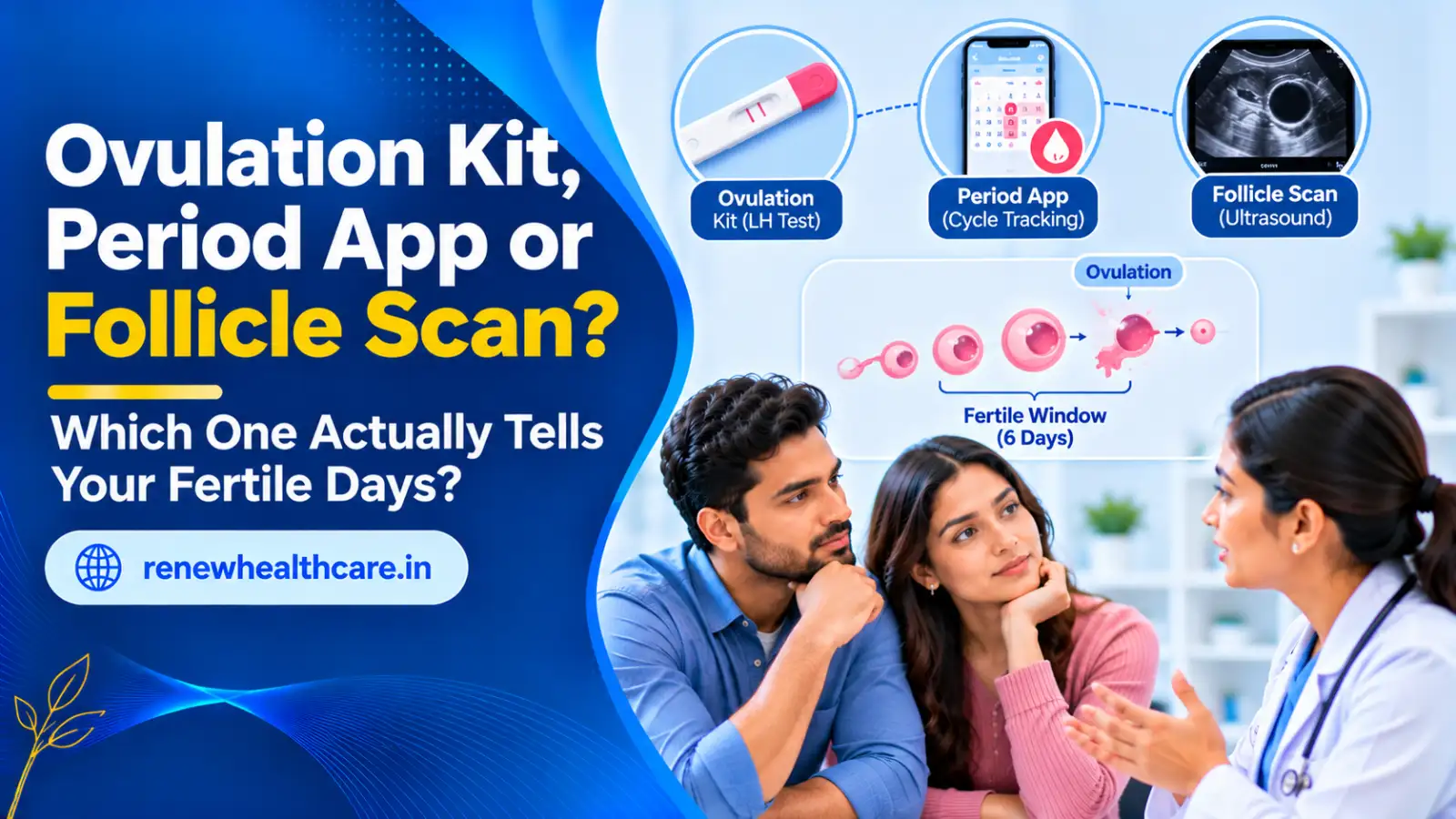
A period-tracking app estimates ovulation based on your previous cycles. A urinary ovulation kit detects the luteinising hormone (LH) surge that usually occurs before ovulation. A follicle-monitoring scan allows a doctor to observe the developing follicle and assess whether it has ruptured.
These methods provide different kinds of information. However, not everyone trying to conceive needs all of them. Understanding what each method can and cannot tell you can help you choose a practical approach.
What Is the Fertile Window?
The fertile window is the six-day period ending on the day of ovulation. Pregnancy is most likely when intercourse takes place during this window, particularly during the two days before ovulation.
A study involving 221 women across 625 menstrual cycles found that conceptions occurred within this six-day window. The estimated probability of conception increased from approximately 10% five days before ovulation to around 33% on the day of ovulation.
One common misconception is that ovulation always happens on day 14. In reality, ovulation timing varies between women and can change from one cycle to another.
In a study of 949 women, only 15% actually had a 28-day cycle, although approximately one-third believed they did. Even among women with 28-day cycles, day 16 was the most likely ovulation day in only one in five women.
This is why relying entirely on a fixed calendar date may not accurately identify your fertile days.
Ovulation Kit vs Period App vs Follicle Scan
Each method has a different purpose. Some estimate ovulation, while others detect hormonal changes or directly monitor follicle development.
1. Period Tracking Apps and Ovulation Calculators
Period-tracking apps use information about your previous menstrual cycles to estimate your next period and likely ovulation date.
They can be useful for recording cycle dates and identifying patterns. However, they cannot confirm whether ovulation is happening in the current cycle.
Research has found that cycle-tracking apps may identify the correct ovulation day in no more than 21% of cycles. Another evaluation of fertility websites and mobile applications found that only a small number predicted the exact fertile window correctly for a standard 28-day cycle.
What they can tell you:
Your recorded menstrual cycle dates.
Your estimated next period.
An approximate ovulation date based on previous cycles.
What they cannot tell you:
Whether ovulation will happen on the predicted date.
Whether the egg has actually been released.
Whether your current cycle follows the same pattern as previous cycles.
Apps are useful for tracking, but their predictions should not be treated as confirmation of ovulation.
2. Urinary Ovulation Test Kits
Ovulation test kits detect luteinising hormone (LH) in urine. The LH surge usually occurs before ovulation, and the egg is generally released within the following two days.
For many women with regular cycles, an LH kit can help identify when the fertile window is approaching.
How to use an ovulation kit:
Check the instructions to determine which cycle day you should begin testing.
If your cycles vary, consider starting earlier because the LH surge may occur sooner than expected.
Test once daily at a consistent time, following the kit's instructions.
Avoid drinking excessive amounts of fluid immediately before testing.
A positive result generally means the test line is as dark as or darker than the control line. A faint line is not usually considered positive.
After the first positive result, have intercourse that day and over the following day or two.
You generally do not need to keep testing repeatedly after the first positive result.
An important limitation: A positive LH test indicates that the hormone surge has been detected. It does not prove that the egg has been released. In some cycles, the follicle may not rupture despite the hormonal signal.
Also, the accuracy percentage printed on a kit usually refers to its ability to detect LH under specified testing conditions. It does not mean that the kit has a 99% chance of predicting pregnancy or confirming ovulation.
3. Basal Body Temperature Tracking
Basal body temperature (BBT) is your body's resting temperature, measured immediately after waking.
Temperature may rise after ovulation because of progesterone. By recording your temperature each morning, you may identify a pattern suggesting that ovulation has already occurred.
However, this method has an important limitation: it generally provides information after ovulation rather than predicting the fertile window in advance.
The NICE fertility guideline advises against using basal body temperature charts to confirm ovulation.
4. Cervical Mucus Monitoring
Cervical mucus changes throughout the menstrual cycle.
As ovulation approaches, it may become clearer, wetter, slippery and stretchy. This type of mucus helps sperm move through the reproductive tract and is associated with the more fertile days of the cycle.
It is a free method that can help you recognise changes in your cycle, although it requires practice.
Cervical mucus monitoring cannot identify the exact day of ovulation or confirm that an egg has been released.
5. Follicle Monitoring Ultrasound
A follicle-monitoring scan, also called a follicular study, uses ultrasound to observe the development of ovarian follicles.
It can help a doctor assess:
Whether a follicle is developing.
The size and growth of the dominant follicle.
Whether the follicle appears to have ruptured.
The timing of ovulation during a monitored treatment cycle.
Unlike a period app, a scan provides information about what is happening in the ovaries during that particular cycle.
However, regular scans are not automatically necessary for everyone trying to conceive. For women with regular cycles who have been trying for less than a year without fertility treatment, there is no trial evidence showing that monthly ultrasound monitoring increases pregnancy rates.
Follicle monitoring is more relevant when ovulation is uncertain, during certain fertility treatments, or when a doctor needs to assess follicular development.
Do You Need an Ovulation Kit or a Follicle Scan?
The right approach depends on your menstrual cycle, medical history and whether you are receiving fertility treatment.
If You Have Regular Menstrual Cycles
If your periods are regular and you are not receiving fertility treatment, intercourse every two to three days throughout the cycle is generally sufficient to cover the fertile window.
You may use an LH kit if you want to identify the approaching fertile days more closely, particularly when work, travel or other commitments make timing difficult.
Routine monthly follicle scans are generally not necessary in this situation.
If You Have Irregular Periods
Irregular cycles make calendar-based predictions less reliable.
An ovulation app may repeatedly give inaccurate dates, while an LH kit may require many tests and may not always provide a clear result.
Irregular or absent periods can also indicate that ovulation is not happening regularly. In this situation, a fertility evaluation may be more useful than repeatedly trying different apps.
Your doctor may recommend blood tests and ultrasound monitoring to understand whether ovulation is occurring.
You can also read about irregular periods and their possible causes for fertility.
If You Have PCOS
Polycystic ovary syndrome (PCOS) can affect ovulation and hormone levels.
Some women with PCOS have higher baseline LH levels. As a result, urinary ovulation kits may sometimes show confusing or repeated positive results without reliably identifying a true ovulatory surge.
If you have PCOS and your test strips repeatedly show positive results, it is worth discussing ovulation assessment with your doctor.
You can also learn more about trying to conceive naturally with PCOS.
If You Are Taking Letrozole or Clomiphene
When ovulation-inducing medicines are prescribed, your doctor may recommend ultrasound monitoring.
The purpose is to assess how the ovaries respond to treatment, including whether a follicle develops and whether too many follicles are growing. This is particularly relevant because multiple follicular development can increase the possibility of a multiple pregnancy.
Whether scans are needed during a letrozole cycle depends on your individual treatment plan. Your doctor can decide the appropriate monitoring schedule.
What Can an Ovulation Kit Not Confirm?
An LH kit is useful, but it does not provide a complete picture of reproductive health.
A positive result does not necessarily confirm that:
The follicle has ruptured.
An egg has been successfully released.
The fallopian tubes are open.
Sperm parameters are normal.
Fertilisation or implantation will occur.
One condition that can explain a hormonal surge without the expected release of an egg is luteinised unruptured follicle syndrome (LUF). In this situation, the follicle may undergo hormonal changes but does not rupture as expected.
A doctor may recommend further assessment if ovulation remains uncertain.
When Should You Stop Tracking and Get a Fertility Evaluation?
Tracking fertile days can be helpful, but it should not delay an appropriate fertility evaluation.
General guidance suggests:
Under 35 years: Consider an evaluation if pregnancy has not occurred after 12 months of regular unprotected intercourse.
35 years and above: Seek evaluation after six months of trying.
At 36 years or older: NICE guidance recommends referral at presentation.
At any age: Seek advice sooner if you have irregular or absent periods, known PCOS, endometriosis, a history of pelvic infection or tuberculosis, or a known fertility concern involving either partner.
A fertility evaluation should consider both partners. A semen analysis is an important part of the initial assessment and should not be unnecessarily delayed.
If you are unsure whether you need an ovulation kit, blood tests or a follicular study, discuss your cycle history with a fertility specialist.
You can explore the available fertility services at Renew Healthcare.
Frequently Asked Questions
1. When Are the Best Days to Get Pregnant?
The fertile window includes the six days ending on ovulation day. The two days before ovulation are particularly important. Since ovulation does not always happen on day 14, fixed calendar dates cannot reliably identify the fertile window for everyone.
2. How Long After a Positive Ovulation Test Does Ovulation Happen?
Ovulation usually occurs within two days after the LH surge is detected. The day of the first positive result and the following day or two are useful times to have intercourse.
3. How Accurate Are Period Apps for Predicting Ovulation?
Period apps estimate ovulation using previous cycle information. Research has found that some apps identify the correct ovulation day in no more than 21% of cycles. They are useful for recording periods but cannot confirm ovulation in the current cycle.
4. Do Ovulation Kits Work If I Have PCOS?
They may be less reliable for some women with PCOS because baseline LH levels can be elevated. This can result in repeated or confusing positive readings. If you have difficulty interpreting your results, discuss other methods of assessing ovulation with your doctor.
5. When Is a Follicular Study Needed?
A follicular study may be recommended when ovulation is uncertain, during certain ovulation-induction treatment cycles, or when ultrasound monitoring is required as part of fertility treatment. Women with regular cycles who are trying naturally do not automatically need monthly scans.
6. Which Is Better: An Ovulation Kit, App or Follicle Scan?
There is no single method that everyone needs. Regular intercourse every two to three days is sufficient for many couples trying naturally. An LH kit can help identify the approaching fertile window, while a follicle scan provides more direct information about follicular development. The appropriate method depends on your circumstances.
Conclusion
Your fertile window is the six days ending on ovulation day, but identifying it is not always as simple as following a period app.
Apps estimate ovulation from previous cycles, urinary LH kits detect the hormonal surge, cervical mucus provides natural signs of fertility, and follicle scans allow a doctor to monitor follicular development.
If your cycles are regular and you are trying naturally, intercourse every two to three days may be enough. If your periods are irregular, you have PCOS, or you are receiving fertility treatment, a more individualised assessment may be helpful.
The goal is not to use every available tracking method. It is to understand whether you are ovulating and identify the right next step if pregnancy is not occurring.
Medical Review: Dr. Neha Yadav — View Doctor Profile
This article is for general educational purposes and does not replace individual medical advice. Please consult a qualified fertility specialist about your own situation.