
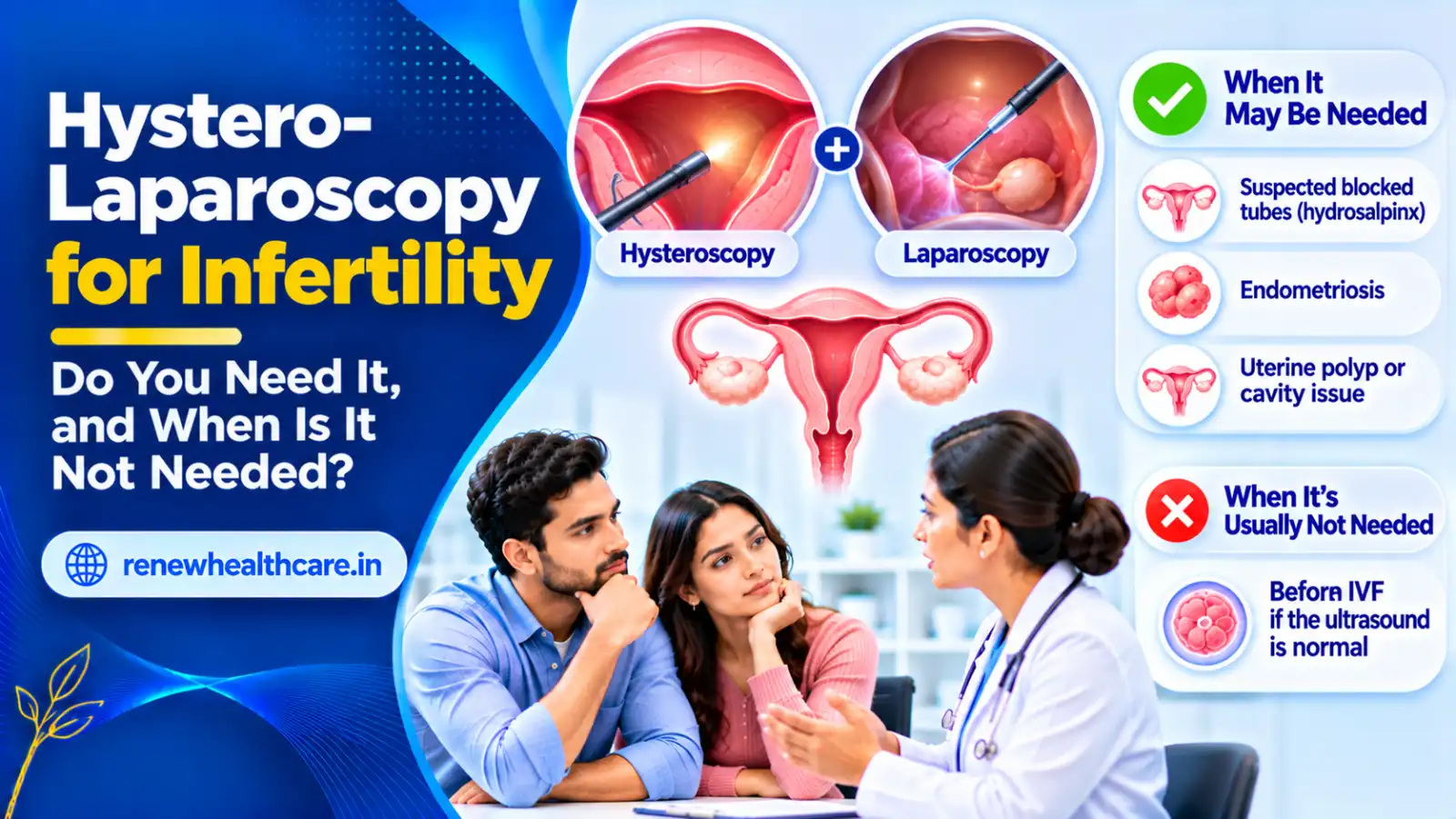
When fertility investigations do not provide a clear answer, a doctor may suggest a procedure called hystero-laparoscopy. For couples trying to conceive, this can raise an important question: is the procedure necessary, or can treatment continue without it?
Hystero-laparoscopy combines two procedures. Hysteroscopy uses a thin camera to examine the inside of the uterus, while laparoscopy uses small abdominal incisions to examine the uterus, fallopian tubes, ovaries and pelvic area.
It can help investigate specific problems, such as suspected endometriosis, damaged fallopian tubes or a fluid-filled tube. However, it is not required for every woman experiencing infertility. Research has not shown a live-birth benefit from routine hysteroscopy before IVF when the uterine ultrasound is normal.
The decision should depend on your medical history, scan findings and whether the procedure is likely to change your treatment plan.
What is hystero-laparoscopy?
Hystero-laparoscopy combines hysteroscopy and laparoscopy, allowing a specialist to examine different parts of the female reproductive system during the same sitting.
Hysteroscopy: examining the inside of the uterus
During hysteroscopy, a thin camera is passed through the cervix to examine the uterine cavity.
It can help identify abnormalities inside the uterus, such as polyps or other structural changes. In selected cases, treatment may also be performed during the same procedure.
Learn more about hysteroscopy and its role in IVF.
Laparoscopy: examining the pelvis and reproductive organs
Laparoscopy is a keyhole surgical procedure. Small incisions are made in the abdomen so that a camera can examine the outside of the uterus, fallopian tubes, ovaries and pelvic lining.
A dye test, called chromopertubation, may also be performed to check whether dye passes through the fallopian tubes.
Depending on the findings and the consent obtained beforehand, treatment may sometimes be carried out during the same sitting. Examples include removing a damaged tube, treating endometriosis or addressing a uterine polyp through hysteroscopy.
Any additional procedure that may be performed should be discussed with the patient and consented to separately.
When can hystero-laparoscopy help?
Hystero-laparoscopy is most useful when there is a specific medical question that other investigations have not adequately answered.
| Clinical situation | What the evidence suggests |
|---|---|
| Suspected hydrosalpinx before IVF | Investigating and treating the affected tube may improve clinical pregnancy outcomes |
| Previous pelvic infection or ectopic pregnancy | Laparoscopy may be considered when tubal disease is suspected |
| Suspected endometriosis | Laparoscopy may help diagnose and treat selected cases |
| Abnormality identified on a uterine scan | Hysteroscopy may help examine or treat the abnormality |
| Normal uterine scan before first IVF | Routine hysteroscopy has not shown a live-birth benefit |
| Unexplained infertility with normal imaging | Routine hysteroscopy and laparoscopy are not recommended by ESHRE |
The procedure should be selected according to the suspected condition, rather than being treated as a standard requirement for everyone undergoing fertility treatment.
Is hysteroscopy necessary before IVF?
Not always. This is an important point because some women are advised to undergo hysteroscopy even when their uterine ultrasound appears normal.
Two large randomised controlled trials examined whether routine hysteroscopy improves IVF outcomes in women with normal uterine ultrasound findings.
The inSIGHT trial: before the first IVF cycle
The inSIGHT trial included 750 women preparing for their first IVF cycle who had a normal transvaginal ultrasound.
The study reported:
Live birth in 57% of women who underwent routine hysteroscopy.
Live birth in 54% of women who proceeded directly to IVF.
The difference was not statistically significant. The study therefore did not establish a live-birth advantage from routinely performing hysteroscopy before the first IVF cycle.
The TROPHY trial: after previous IVF failures
The TROPHY trial examined 702 women under the age of 38 who had experienced two to four unsuccessful IVF cycles and had a normal uterine ultrasound.
The live-birth rate was 29% in each group, whether or not hysteroscopy was performed before the next IVF attempt.
This trial also did not demonstrate a benefit from routinely adding hysteroscopy when imaging was normal.
What do fertility guidelines recommend?
The European Society of Human Reproduction and Embryology (ESHRE) advises against routine hysteroscopy when a uterine cavity ultrasound is normal in unexplained infertility. It also advises against hysteroscopy to look for abnormalities that have not been identified through routine imaging.
The NICE fertility guideline, published in March 2026, similarly advises against hysteroscopy before IVF unless a uterine abnormality is suspected.
These recommendations do not mean hysteroscopy is never useful. If a scan identifies a possible abnormality or symptoms suggest a problem, further examination may be appropriate.
When is laparoscopy useful for endometriosis?
Endometriosis is a condition in which tissue similar to the lining of the uterus grows outside it. It may affect the ovaries, pelvic lining and other structures, and can be associated with fertility difficulties.
When endometriosis is suspected, ultrasound or MRI may be used as part of the initial evaluation.
The ESHRE 2022 guideline suggests considering laparoscopy when imaging is negative but empirical treatment has failed or is unsuitable.
The potential benefit of surgery depends on the stage of disease and the woman's fertility goals.
Endometriosis surgery when trying to conceive naturally
For selected women with stage I or II endometriosis who are trying to conceive naturally, operative laparoscopy may be considered.
A Cochrane analysis found that laparoscopic treatment probably increased viable intrauterine pregnancy compared with diagnostic laparoscopy alone. The reported odds ratio was 1.89, based on three trials involving 528 women.
However, the included trials did not report live-birth outcomes for this comparison. An improvement in pregnancy outcomes should therefore not be presented as proof of a higher live-birth rate.
Should endometriosis be operated on before IVF?
The decision is different when IVF is planned.
ESHRE advises against routine surgery before assisted reproduction for stage I or II endometriosis when the purpose is to improve live birth, because the benefit is unclear.
It also advises against routine surgery for an ovarian endometrioma before assisted reproduction. No benefit in live birth has been demonstrated, and surgery is likely to reduce ovarian reserve.
For a broader explanation, read about endometriosis and fertility.
Can hystero-laparoscopy help with blocked fallopian tubes?
Fallopian tubes play an important role in natural conception because they allow the sperm and egg to meet. Damage or blockage may interfere with this process.
However, not all tubal problems are the same. A blocked tube and a fluid-filled tube require different considerations.
What is hydrosalpinx?
Hydrosalpinx is a condition in which a fallopian tube becomes blocked and fills with fluid.
It can be relevant before IVF because the condition may affect treatment outcomes.
A Cochrane review involving 11 trials and 1,386 women found that removing a hydrosalpinx through salpingectomy before IVF probably increased clinical pregnancy. The reported relative risk was 2.02 in the analysis comparing salpingectomy with no tubal surgery.
However, the review did not report live-birth outcomes for salpingectomy in that comparison.
A 2025 network meta-analysis of nine trials found no statistically significant live-birth difference between the different hydrosalpinx treatment methods. It did find an increase in ongoing pregnancy following salpingectomy compared with no treatment.
These findings suggest that treatment may improve certain pregnancy outcomes, but a proven live-birth advantage has not been established by the available evidence.
Salpingectomy or tubal occlusion?
Two approaches may be discussed before IVF:
Salpingectomy: Surgical removal of the affected fallopian tube.
Tubal occlusion: Blocking the affected tube to prevent its contents from entering the uterine cavity.
A Cochrane review could not establish a clear live-birth difference between removal and occlusion based on the available evidence. NICE recommends offering either option for hydrosalpinges before IVF.
The choice should depend on the type of tubal damage, the woman's medical circumstances and the surgeon's assessment.
What if the tube is blocked but not fluid-filled?
A blocked fallopian tube without hydrosalpinx presents a different treatment question.
Tubal repair surgery may be considered in selected situations, but the evidence supporting meaningful success rates is limited. The American Society for Reproductive Medicine's 2021 committee opinion notes that adequate trials comparing tubal repair with IVF are lacking.
Before proceeding, ask the specialist what published outcomes are available for the specific type and location of tubal damage.
For more information, read about tubal blockage and its treatment options.
What about HSG and other tests for fallopian tubes?
Hystero-laparoscopy is not the only way to investigate tubal patency.
An HSG test uses contrast dye and X-ray imaging to assess the uterine cavity and whether the fallopian tubes appear open. HyCoSy is another scan-based method used to evaluate tubal patency.
The NICE guideline recommends HSG as the first-line test for women without known pelvic comorbidity. Laparoscopy with dye may be considered when there is a suspected pelvic condition, such as previous pelvic infection, ectopic pregnancy or endometriosis.
This means that an operation is not automatically required simply to check whether the tubes are open.
Read more about the HSG test and its role in fertility evaluation.
What are the risks of hystero-laparoscopy?
Like any surgical procedure, hystero-laparoscopy has potential risks. These may relate to the camera entry, the surgical treatment performed or the anaesthesia.
The available RCOG consent documents, published in December 2008, reported serious complications of diagnostic laparoscopy at approximately two in every 1,000 women and death at three to eight in every 100,000.
The documents describe possible complications including:
Injury to the bowel, bladder, uterus or major blood vessels.
Wound bruising.
Shoulder-tip pain.
Wound infection.
Complications related to anaesthesia.
Diagnostic hysteroscopy under general anaesthesia has similar overall complication figures in the cited RCOG consent advice.
These figures come from older UK guidance, and risks may increase when additional treatment is performed or when other risk factors are present. They should not be treated as a current India-specific estimate.
The inSIGHT trial reported one case of endometritis, an infection of the uterine lining, among women who underwent hysteroscopy.
Your surgeon should explain the risks of the exact procedure planned, including any additional treatment that may be performed, and provide recovery advice based on your circumstances.
When might you not need hystero-laparoscopy?
A procedure should have a clear purpose. If the available investigations do not suggest a problem that requires direct examination or treatment, routine surgery may not be helpful.
Hystero-laparoscopy may not be necessary when:
The uterine ultrasound is normal and there are no symptoms or other findings suggesting a uterine abnormality.
There is no suspected pelvic disease or relevant history that makes laparoscopy necessary.
The tubes appear open and there is no clinical reason to suspect tubal damage.
The only reason for the procedure is that IVF is planned.
The only reason is previous IVF failure despite normal uterine imaging.
ESHRE does not recommend routine laparoscopy for unexplained infertility. It also advises against routine hysteroscopy when imaging shows a normal uterine cavity.
If the procedure is recommended, ask what the surgeon expects to find and how the findings would change your treatment.
Once a suspected problem has been investigated or treated, repeating the procedure without a new clinical question should also be discussed carefully.
Questions to ask your fertility specialist before the procedure
Before consenting to hystero-laparoscopy, it is reasonable to understand what the procedure is expected to achieve.
Consider asking:
What specific problem are we investigating?
Could an ultrasound, HSG or HyCoSy answer the same question?
Is there evidence of hydrosalpinx, endometriosis or another pelvic abnormality?
What treatment might be performed during the same sitting?
Will any additional procedure require separate consent?
What happens if the findings are normal?
What are the expected risks and recovery requirements in my case?
One particularly useful question is:
“Which finding would change my treatment plan, and what do we do if the camera shows nothing?”
Frequently asked questions
What is hystero-laparoscopy in simple words?
Hystero-laparoscopy combines hysteroscopy, which examines the inside of the uterus, with laparoscopy, which examines the outside of the uterus, fallopian tubes, ovaries and pelvic area. It can help investigate specific causes of infertility and may allow treatment during the same sitting.
Does everyone with infertility need hystero-laparoscopy?
No. ESHRE advises against routine laparoscopy for unexplained infertility and against hysteroscopy to investigate abnormalities that have not been identified through routine imaging. The procedure should be recommended when there is a specific clinical reason.
Can laparoscopy open blocked fallopian tubes?
It depends on the location and type of tubal damage. Repair surgery is a separate decision from simply diagnosing a blockage. For hydrosalpinx before IVF, salpingectomy or tubal occlusion may be offered. Ask your specialist about the evidence for the proposed procedure and its expected outcomes.
Does hysteroscopy before IVF improve success?
Not routinely when the uterine ultrasound is normal. The inSIGHT and TROPHY trials did not demonstrate a significant live-birth benefit from routine hysteroscopy in the groups they studied. Hysteroscopy may still be appropriate when a uterine abnormality is suspected.
Should endometriosis be operated on before IVF?
Not routinely. ESHRE advises against routine surgery before assisted reproduction for stage I or II endometriosis when the goal is to improve live birth. It also advises against routine surgery for ovarian endometriomas before assisted reproduction because a benefit has not been demonstrated and ovarian reserve may be reduced.
How much does hystero-laparoscopy cost?
The cost depends on the hospital or clinic, the procedures performed and whether additional treatment is required. Ask for an itemised estimate covering the surgical procedure, anaesthesia, investigations and any additional treatment.
The bottom line
Hystero-laparoscopy is a diagnostic and sometimes therapeutic procedure, but it is not a routine requirement for every woman experiencing infertility.
It may be useful when there is a suspected hydrosalpinx, endometriosis, tubal disease or a uterine abnormality that needs further examination or treatment.
However, two large randomised trials did not demonstrate a live-birth benefit from routine hysteroscopy before IVF when the uterine ultrasound was normal. Major guidelines also advise against routine invasive investigations when there is no specific indication.
Before agreeing to the procedure, understand which medical question it is intended to answer, what treatment might follow and what the next step will be if no abnormality is found.
Medical Review
Medically reviewed by Dr. Arnab Kundu.
View Dr. Arnab Kundu's profile at Renew Healthcare.
This article is intended for general educational purposes and does not replace individual medical advice. Please consult a qualified specialist about your own situation.