
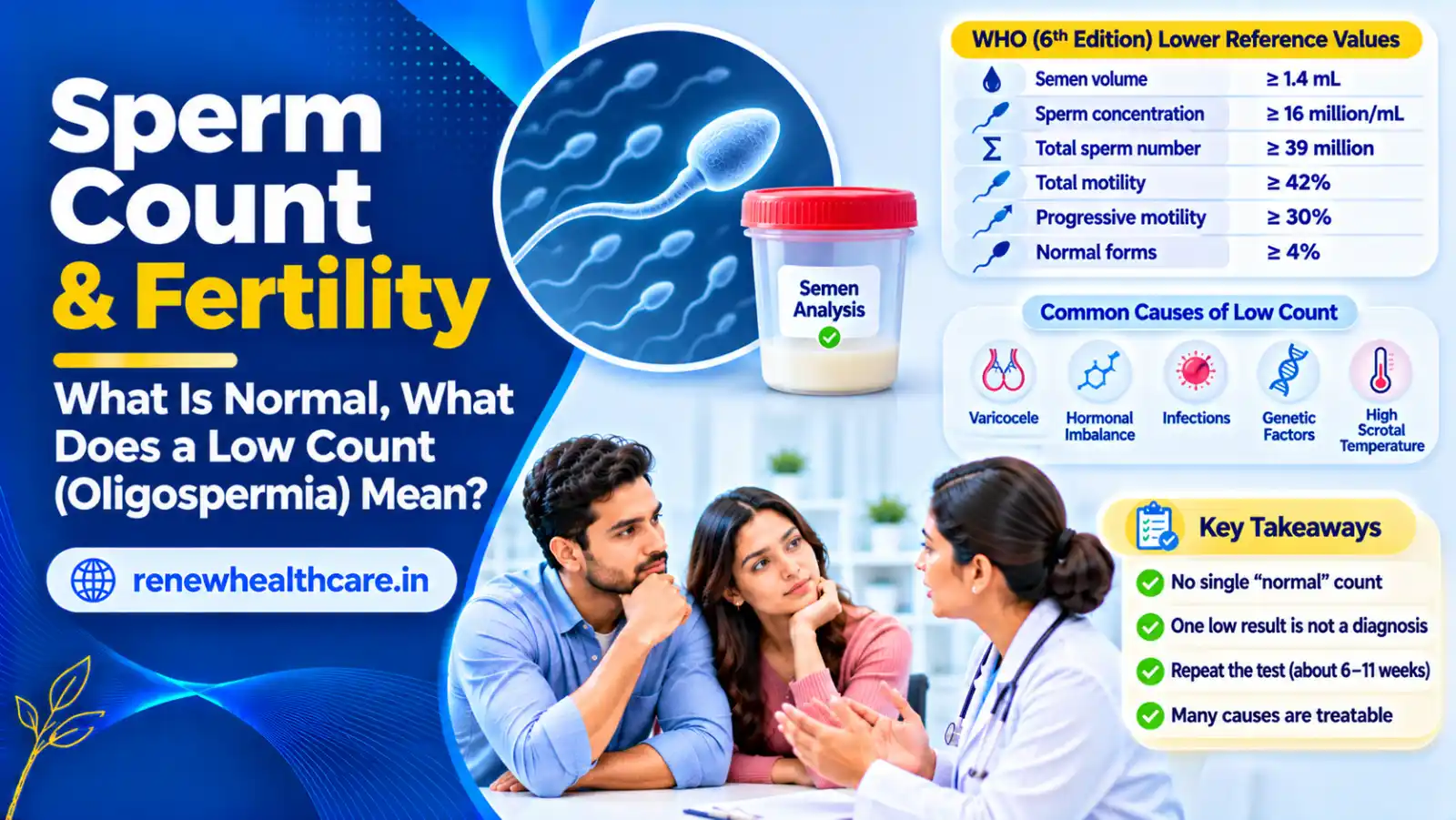
A semen analysis report showing a low sperm count can be worrying, especially when you are trying to conceive. But one result does not tell the whole story. Sperm concentration is only one part of male fertility, and a low reading does not automatically mean that natural pregnancy is impossible.
The World Health Organization (WHO) sixth-edition reference values list 16 million sperm per mL as the lower reference value for sperm concentration. However, this is not a dividing line between fertile and infertile men. It represents the fifth centile among men whose partners conceived within 12 months.
Understanding what the numbers mean, why results need repeating, and which investigations or treatments have supporting evidence can help couples make informed decisions.
What does a low sperm count mean?
Oligozoospermia, also commonly called oligospermia, means that the sperm concentration in semen is lower than the reference value.
For example, if a semen analysis reports 12 million sperm per mL, the result is below the WHO sixth-edition lower reference value of 16 million per mL. It may be described as a low sperm concentration.
However, this single figure should not be treated as a final fertility diagnosis. Some men with lower sperm concentrations can father children, while men with values above the reference range may still experience difficulty conceiving.
The European Association of Urology (EAU) also emphasises that semen analysis alone cannot reliably distinguish fertile from infertile men. The reproductive health of both partners needs to be considered.
What is a normal sperm count according to WHO?
The WHO sixth-edition reference values provide a broader picture of semen quality rather than focusing only on sperm concentration.
| Semen parameter | WHO sixth-edition lower reference value | What it measures |
|---|---|---|
| Semen volume | 1.4 mL | Amount of semen produced |
| Sperm concentration | 16 million/mL | Number of sperm in each millilitre |
| Total sperm number | 39 million per sample | Total sperm in the ejaculate |
| Total motility | 42% | Percentage of sperm that move |
| Progressive motility | 30% | Percentage moving forward |
| Normal forms | 4% | Percentage with normal shape |
These figures are fifth-centile reference values. They were derived from data involving more than 3,500 men from 12 countries whose partners conceived within 12 months.
This means that approximately one in twenty men in the reference population fell below each individual lower reference value by definition. The values do not establish a strict boundary between fertility and infertility.
Older semen analysis reports may use 15 million sperm per mL, which was the reference value in the WHO 2010 edition. The sixth edition uses 16 million per mL.
The EAU guideline also describes counts below 5 million per mL as severe oligozoospermia. The overall report, clinical examination and reproductive history remain important when interpreting any result.
Why one low sperm count result is not enough
Semen parameters can vary between samples. A result may be affected by biological variation and other factors surrounding sample collection.
The EAU strongly recommends at least two consecutive semen analyses when the first result is abnormal. The WHO 2025 infertility guideline suggests repeating an abnormal analysis after a minimum of 11 weeks, although this recommendation is conditional and based on very low-certainty evidence.
The Australian male infertility guideline advises a second analysis approximately six weeks after the first.
The difference in recommended timing reflects the guidance of different organisations. Your specialist and laboratory can help determine an appropriate interval based on your circumstances.
Sperm production also takes time. In a small isotope study involving 11 men with normal sperm counts, labelled sperm appeared in the ejaculate after an average of approximately 64 days. This suggests that a recent illness or lifestyle change may take around two months to become visible in a semen analysis. This is an observation from a small study, not a guarantee of how quickly an individual's results will change.
Before interpreting an abnormal result, it is therefore important to establish whether it is a one-time finding or a consistent pattern.
What causes a low sperm count?
Low sperm concentration can have several possible causes. These may involve the reproductive organs, hormones, genetics or other medical and environmental factors.
Possible causes include:
Varicocele: Enlarged veins around the testicles can be associated with abnormal semen parameters.
Hormonal disturbances: Changes in reproductive hormones can affect sperm production.
Genetic factors: Certain chromosomal changes or Y-chromosome microdeletions may affect sperm production.
Infections: Some infections can affect the male reproductive system.
Structural problems: Conditions affecting the reproductive tract may interfere with sperm production or delivery.
Raised scrotal temperature: Temperature-related factors may affect sperm production.
Medical treatment and exposure: Certain treatments or gonadotoxic exposures can affect reproductive function.
Immune factors: These may contribute in selected cases.
In approximately 30–40% of men, no identifiable male-factor cause is found, according to the EAU guideline.
A low sperm count should therefore lead to an appropriate evaluation rather than an assumption about its cause.
Which tests are useful when sperm count is low?
The purpose of testing is to confirm the semen finding, identify potentially treatable causes and understand the reproductive health of both partners.
1. Repeat semen analysis
If the first semen analysis is abnormal, a repeat test is important. It helps establish whether the low concentration is persistent.
The laboratory's collection instructions should be followed carefully. The WHO reference population used an abstinence period of two to seven days.
2. Medical history and physical examination
A specialist may review medical history, previous illnesses, medications, reproductive history and other relevant factors. A physical examination can help identify possible structural or testicular abnormalities.
3. Hormone testing
The EAU strongly recommends hormonal evaluation in men with oligozoospermia or azoospermia. This includes:
Total testosterone
Follicle-stimulating hormone (FSH)
Luteinising hormone (LH)
These tests help assess hormonal factors that may be associated with reduced sperm production.
4. Genetic testing in very low sperm counts
Genetic investigations may be considered when sperm concentration is very low.
The EAU recommends karyotype testing and genetic counselling in selected men with severe oligozoospermia. It recommends Y-chromosome microdeletion testing at particularly low sperm concentrations, including at or below 1 million per mL.
The guideline contains different thresholds for karyotype testing in different sections, so the decision should be made by the treating specialist rather than applying one number to everyone.
5. Assessing the female partner
Fertility is a couple-level issue. A semen report should not be used in isolation to estimate the chances of pregnancy.
The female partner's age, ovarian reserve and reproductive health can influence the choice and timing of treatment.
What treatments can help improve a low sperm count?
Treatment depends on the underlying cause. Some conditions may be treatable, while others may require a discussion about assisted conception.
It is important to distinguish between improvements in semen parameters and evidence of improved pregnancy or live-birth outcomes. A treatment that changes a laboratory result does not necessarily guarantee a pregnancy.
Treating a varicocele in selected men
Varicocele treatment may be considered in men with a palpable varicocele, abnormal semen parameters and otherwise unexplained infertility, particularly when the female partner has good ovarian reserve.
The EAU recommendation is limited to appropriately selected cases. Surgery is not automatically recommended for every man with a low sperm count.
Read more about varicocele and its role in male infertility.
Addressing testosterone and anabolic steroid use
Men taking testosterone treatment or anabolic steroids should discuss their use with a qualified specialist if they are trying to conceive.
The EAU strongly advises against testosterone treatment for men seeking fertility because external testosterone can suppress the hormonal signals needed for sperm production.
Read more about testosterone injections, gym steroids and male fertility.
Lifestyle factors
Weight, tobacco use and alcohol consumption are relevant to male reproductive health.
Research has found associations between higher body mass index and an increased likelihood of oligozoospermia or azoospermia. Studies have also reported lower average sperm concentrations among smokers.
However, an association does not prove that changing a particular lifestyle factor will restore sperm count or increase live births. Healthy lifestyle changes can be discussed as part of an overall fertility plan, but they should not replace medical evaluation.
You can read more about obesity and male infertility and the effects of smoking and alcohol on sperm quality.
Antioxidants and vitamin supplements
Antioxidant supplements are often promoted as a way to improve sperm quality. However, the evidence for a meaningful improvement in live-birth outcomes remains uncertain.
A Cochrane review found a possible increase in live births in its overall analysis, but the certainty of evidence was very low. After excluding studies with a high risk of bias, the estimated effect was smaller and no longer clearly demonstrated a benefit.
A large trial involving folic acid and zinc supplementation in 2,370 couples found no difference in live-birth rates between the supplement and placebo groups.
The EAU advises against routine antioxidant use in idiopathic male infertility, while the WHO 2025 guideline makes no recommendation for or against antioxidant supplements.
Supplements should not be treated as a guaranteed solution. Their use should be discussed with a specialist, particularly when other investigations are still needed.
FSH injections
FSH injections may be considered in selected men with idiopathic oligozoospermia and normal FSH levels. The EAU recommendation is weak.
A Cochrane review reported a possible improvement in spontaneous pregnancy in some studies, but the evidence for live birth was very limited and included only one small trial.
FSH treatment is prescription-based and is not suitable for every man with a low sperm count.
Other medicines
Clomiphene-type medicines, aromatase inhibitors and probiotics are sometimes discussed in the context of male infertility. However, the EAU does not recommend their routine use for idiopathic cases.
Similarly, antibiotics should not routinely be prescribed just because white blood cells are found in semen when an infection has not been identified. The EAU cites a lack of evidence that treating this finding alone improves conception.
Herbal products marketed as sperm boosters should also be approached cautiously. The evidence reviewed for this article did not establish that such products improve pregnancy outcomes.
For more information, see these articles on treatment options for low sperm count and ways to support sperm health and motility.
Can a man with a low sperm count still father a child?
Yes. A low sperm count does not automatically mean that natural conception is impossible.
The WHO reference values are not strict fertility cut-offs. Some men with results below these values can father children, while some men with results within the reference range may still experience infertility.
The likelihood of pregnancy depends on several factors, including the overall semen profile, the cause of the abnormal result, the reproductive health of the female partner and the time available for treatment.
If natural conception is difficult, a specialist may discuss assisted reproductive options such as intrauterine insemination (IUI) or intracytoplasmic sperm injection (ICSI), depending on the couple's evaluation.
Learn more about IUI and male infertility and what intracytoplasmic sperm injection (ICSI) involves.
When should couples seek fertility evaluation?
The EAU recommends evaluating a couple after 12 months of regular, unprotected intercourse without conception.
An earlier assessment may be appropriate when the female partner is older or when either partner has a known reproductive health concern. The appropriate timing depends on the couple's circumstances.
If a semen analysis is abnormal, the next steps may include:
Confirming the result with a repeat semen analysis.
Reviewing medical history and conducting a physical examination.
Checking relevant reproductive hormones.
Considering genetic testing when sperm concentration is very low.
Assessing the female partner's reproductive health.
Discussing treatment options based on the identified cause and the couple's circumstances.
A useful question to ask during the consultation is: “Is this one abnormal result or a consistent pattern, and what will we change if the repeat result is the same?”
The aim is to make decisions based on the complete evaluation rather than continuing tests or supplements without a clear reason.
Frequently asked questions
What is a normal sperm count?
The WHO sixth edition lists 16 million sperm per mL as the lower reference value for sperm concentration and 39 million as the lower reference value for total sperm number per sample. These are fifth-centile values, not strict boundaries between fertility and infertility.
Is 15 million sperm per mL considered low?
The WHO 2010 reference value was 15 million per mL. The sixth edition uses 16 million per mL. However, the difference between these figures should not be treated as a definitive fertility diagnosis. The complete semen report and repeat testing are important.
Can a man with a low sperm count have a baby naturally?
Yes, natural conception can happen even when sperm concentration is below the WHO reference value. The chances depend on the overall reproductive health of both partners and the cause of the low count.
Can a low sperm count be reversed?
It depends on the underlying cause. Selected conditions, such as a clinically significant varicocele, may be treatable. Stopping testosterone treatment under medical supervision may also be important when it is affecting sperm production. However, no treatment can guarantee that sperm count will return to a particular level.
Do sperm booster supplements work?
Evidence for supplements is uncertain. Some studies suggest possible benefits, but the certainty of evidence for live birth is very low. A large trial of folic acid and zinc found no improvement in live-birth rates. Supplements should not replace appropriate testing or treatment.
When should I repeat a semen analysis?
If the first result is abnormal, a second semen analysis is generally recommended. The EAU advises at least two consecutive analyses. The Australian guideline suggests approximately six weeks, while the WHO 2025 guideline suggests a minimum of 11 weeks. Your specialist can advise on the timing for your situation.
The bottom line
A low sperm count is a finding that needs interpretation, not a final verdict on fertility. The WHO sixth-edition reference value is 16 million sperm per mL, but this figure is not a strict dividing line between men who can and cannot father children.
An abnormal result should generally be confirmed with repeat testing. The next step is to look for possible causes through an appropriate medical history, examination and selected investigations.
Some causes are treatable, but the evidence for many supplements and medicines remains limited. A treatment plan should consider the complete reproductive health of both partners and focus on outcomes that matter to the couple.
Medical Review
Medically reviewed by Dr. Arnab Kundu.
View Dr. Arnab Kundu's profile at Renew Healthcare.
This article is intended for general educational purposes and does not replace an individual medical consultation. Please consult a qualified specialist for advice based on your medical history and test results.