
By Dr. Neha Yadav · Infertility & IVF Specialist · Salt Lake, Kolkata
Most patients tell me the same thing about transfer day: they braced for a big procedure and got a five-minute one instead — then spent the drive home wondering if it was “enough.” It was. Here is exactly what happens in that room, and what the evidence actually says about the rituals built up around it.
Key Takeaways
- The transfer itself takes 5–10 minutes; bladder filling, positioning, and ultrasound setup stretch the visit to about 30–45 minutes.
- A comfortably full bladder straightens the uterus for ultrasound guidance and is linked to modestly higher pregnancy odds in pooled trial data.
- Bed rest afterward does not improve outcomes — multiple randomized trials and meta-analyses show no benefit; immediate mobilization is acceptable.
- Soft, ultrasound-guided catheters placed in the mid-uterine cavity are the current evidence-based standard; sedation is usually unnecessary.
- A “mock transfer” before your real cycle, mapping the cervical canal in advance, is a recommended step that reduces surprises.
What Actually Happens, Minute by Minute
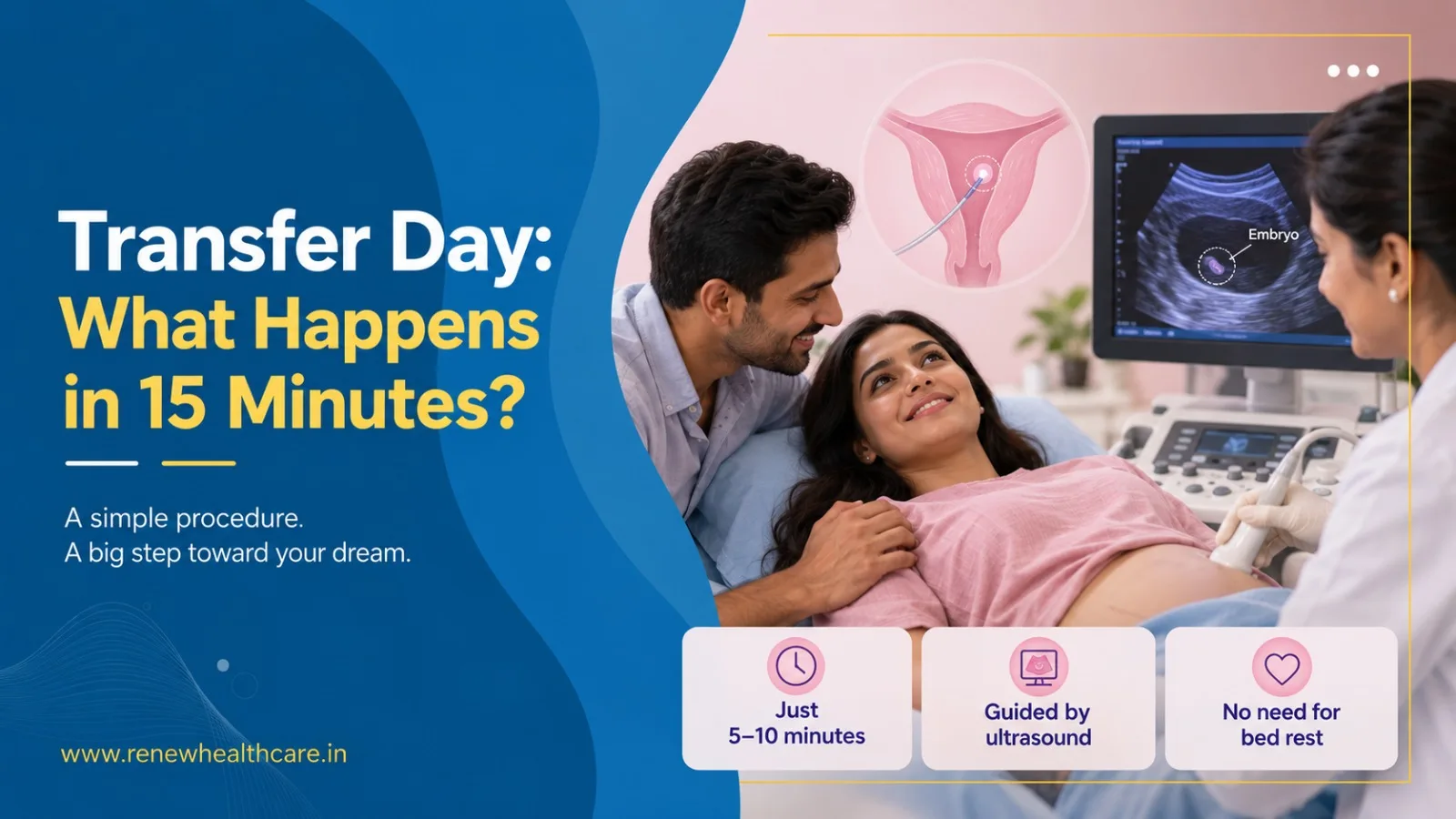
You'll arrive with a full bladder, changed already if this is a day-of instruction. Fresh or frozen, medicated or natural — the mechanics on the table are nearly identical. An abdominal ultrasound probe rests on your belly to guide the catheter in real time; this is why the bladder needs to be full — it lifts the uterus into a straighter, more visible line. A speculum is placed, the cervix is gently cleaned, and a soft catheter loaded with your embryo is passed through the cervical canal under direct ultrasound view.
Placement is aimed at the mid-portion of the uterine cavity, not the very top or bottom. The embryo is released with steady pressure, the catheter is withdrawn and checked under the microscope to confirm the embryo left the tip, and you're done. No cutting, no needles into tissue, and for the large majority of patients, no sedation at all.
The Evidence Behind Each Ritual
This is where most patient-facing content gets sloppy, so let's be precise about what's proven and what's tradition.
Full bladder. Pooled data from multiple trials shows a full bladder is associated with meaningfully higher odds of clinical and ongoing pregnancy compared with an empty one, alongside fewer difficult or instrument-assisted transfers. This is one of the better-supported “rituals” in the room.
Bed rest. This is the one most clinics still over-promise on. A meta-analysis of over 1,000 women found no significant difference in clinical pregnancy or live birth rates between bed rest and immediate mobilization. A separate meta-analysis pooling over 21,000 cycles found a similar pattern. The honest, current position: you can stand up and walk out immediately without disadvantaging your chances.
Catheter choice and technique. ESHRE's 2022 technical consensus favours soft catheters over rigid ones where feasible, ultrasound guidance over “blind” transfer, and a calm, atraumatic pass — because catheter trauma and difficult transfers are linked with poorer outcomes, not the minutes spent lying still afterward.
Fresh vs. Frozen Transfer Day: What Differs
| Element | Fresh Transfer | Frozen (FET) |
|---|---|---|
| Timing driver | Fixed to retrieval + culture day | Chosen once lining is ready |
| Hormonal state | Still recovering from stimulation | Controlled, often steadier |
| Bladder/procedure steps | Identical | Identical |
| OHSS consideration | Must be ruled out before proceeding | Not applicable |
Myth vs. Fact
| Myth | Fact |
|---|---|
| “Lying still for hours protects the embryo.” | Trial evidence shows no pregnancy-rate benefit to bed rest; you can resume normal light activity the same day. |
| “A full bladder is just clinic convenience.” | It measurably improves ultrasound visualization and is linked to better pregnancy odds in pooled data. |
| “You'll need sedation.” | Most transfers need no sedation — discomfort is typically mild and brief. |
| “Any catheter works the same.” | Soft, ultrasound-guided catheters with atraumatic technique are the current evidence-based preference. |
Before You Go: Action Checklist
- Confirm your bladder-filling instructions with the clinic 24 hours before — timing matters.
- Ask whether your clinic performs (or has performed) a mock transfer for you.
- Plan light activity, not bed rest, for the rest of the day.
- Arrange to bring someone to drive, even without sedation, for comfort and calm.
- Avoid heavy lifting or strenuous exercise for 24–48 hours as a precaution, not a strict evidence-based rule.
Frequently Asked Questions
Does the transfer hurt?
Most women describe mild cramping similar to a Pap smear — brief and tolerable without sedation.
Should I really not rest afterward?
You can rest if it feels emotionally comforting, but the evidence doesn't support it changing your outcome — don't feel obligated to stay horizontal for hours.
Can a difficult transfer lower my chances?
Yes — this is one area evidence does support. Atraumatic, ultrasound-guided technique with mid-cavity placement matters more than post-transfer behaviour.
How soon can I test?
That's a separate topic with its own evidence base — ask your team for your clinic's recommended beta hCG timing.
Transfer day is deliberately undramatic by design — the real work happened in the lab.
If you'd like to walk through what your specific protocol will look like, book a consultation with Dr. Neha Yadav at our Salt Lake, Kolkata clinic.
References
- ASRM Practice Committee. Standard Embryo Transfer Protocol Template: A Committee Opinion. 2017. [Verification flag: confirm current reaffirmation status before publishing]
- D'Angelo A, Panayotidis C, Alteri A, Mcheik S, Veleva Z. Evidence and consensus on technical aspects of embryo transfer. Hum Reprod Open. 2022;2022(4):hoac038.
- Cozzolino M, Troiano G, Esencan E. Bed rest after an embryo transfer: a systematic review and meta-analysis. Arch Gynecol Obstet. 2019;300(5):1121–1130.
- Rodriguez-Purata J, et al. Live Birth Rate Following Bed Rest Versus Early Mobilization After Embryo Transfer: A Systematic Review and Meta-Analysis. [Verification flag: confirm exact journal/year before publishing]
- Abou-Setta AM, Peters LR, D'Angelo A, Sallam HN, Hart RJ, Al-Inany HG. Post-embryo transfer interventions for assisted reproduction technology cycles. Cochrane Database Syst Rev. 2014;(8):CD006567.
- Full-bladder pregnancy-odds pooled data. [Verification flag: confirm primary source and exact OR/CI figures before publishing]
This article is for patient education and does not replace individualized medical advice. Please discuss your specific protocol with Dr. Neha Yadav or your treating physician.