
Dr. Arnab Kundu — confirm his qualifications, designation and registration details before publication.
In Brief
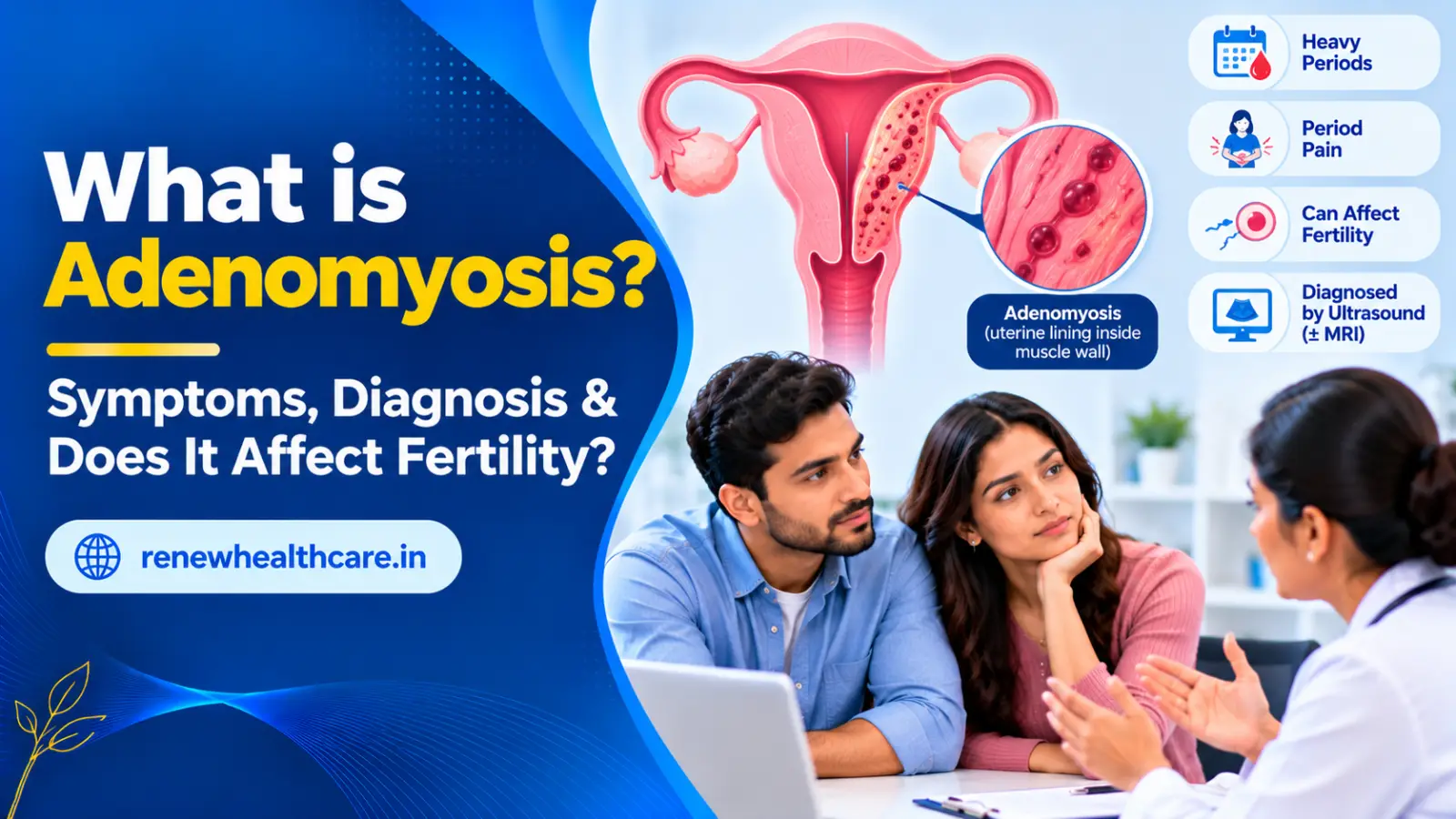
Adenomyosis is a condition in which tissue similar to the lining of the uterus grows within the muscular wall of the uterus. It may cause heavy menstrual bleeding, painful periods and pelvic discomfort, although some women have no symptoms.
Research involving women undergoing IVF has associated adenomyosis with lower pregnancy rates and a higher risk of miscarriage. However, most of this evidence comes from observational studies, so it cannot establish that adenomyosis directly causes these outcomes.
Treatment depends on symptoms, scan findings and whether pregnancy is desired now or in the future.
Your Scan Says "Adenomyosis Uterus". What Does It Mean?
Imagine having a pelvic ultrasound because of heavy periods, painful menstruation or difficulty conceiving. The report mentions "features of adenomyosis" or describes a "globular uterus".
For many women, this diagnosis can be unfamiliar and raise questions about fertility and pregnancy.
Adenomyosis is a condition in which tissue similar to the endometrium, the lining of the uterus, is found within the muscular wall of the uterus. This muscular layer is called the myometrium.
It can be associated with:
Heavy menstrual bleeding
Painful periods
Pelvic pain
Difficulty conceiving in some women
No noticeable symptoms in others
The condition can be difficult to identify because diagnostic criteria are not universally agreed upon.
A 2025 meta-analysis estimated adenomyosis in approximately 31% of women with infertility. However, this estimate was based on seven studies with considerable variation in their findings. A reliable India-specific prevalence figure was not identified in the source research.
For more information about fertility-related care, visit Renew Healthcare.
Adenomyosis vs Endometriosis vs Fibroids: What Is the Difference?
Adenomyosis, endometriosis and uterine fibroids are different conditions, although some symptoms may overlap.
| Condition | Where it occurs | Common features |
|---|---|---|
| Adenomyosis | Within the muscular wall of the uterus | Heavy or painful periods, pelvic pain or no symptoms |
| Endometriosis | Tissue similar to the uterine lining grows outside the uterus | May cause pain, inflammation and scar tissue |
| Fibroids | Non-cancerous growths in or around the uterus | Heavy periods, pressure symptoms or no symptoms |
These conditions can sometimes occur together. Being diagnosed with one does not automatically rule out the others.
Read more about endometriosis and fertility through the clinic's women's health resources, and discuss any overlapping symptoms with a qualified specialist.
How Is Adenomyosis Diagnosed?
Adenomyosis is usually assessed through imaging, particularly transvaginal ultrasound. MRI may also be considered depending on the clinical situation.
1. Transvaginal Ultrasound
Transvaginal ultrasound is generally the first imaging test used when adenomyosis is suspected.
Ultrasound specialists assess several features of the uterus. These can include:
Small cysts within the uterine muscle
Bright areas or islands within the muscle
A globular appearance of the uterus
An irregular junctional zone, which is the boundary between the uterine lining and the muscle
A European ultrasound expert consensus also recommends 3D ultrasound in certain situations to assess the junctional zone more clearly.
2. MRI Scan
MRI may be useful when ultrasound findings need further clarification, including when focal adenomyosis needs to be distinguished from a fibroid.
Neither ultrasound nor MRI is perfect.
A pooled analysis of six studies involving 595 women found that transvaginal ultrasound had a sensitivity of 75% and specificity of 81%. MRI had a sensitivity of 69% and specificity of 80%. The difference between the two tests was not statistically significant.
These results should be interpreted carefully because the studies included women who later underwent hysterectomy, and some had a risk of selection bias.
Does Everyone Need a Scan?
Not necessarily. Imaging may be considered when a woman has heavy or painful periods, pelvic pain, repeated IVF failure or miscarriage.
If adenomyosis is found incidentally in someone without symptoms or fertility concerns, treatment may not be necessary. The appropriate approach should be confirmed with the treating clinician.
Does Adenomyosis Affect Fertility and Pregnancy?
This is one of the most important concerns for women who are planning a pregnancy.
Research has found an association between adenomyosis and less favourable IVF outcomes. However, most available evidence comes from observational studies involving women undergoing assisted reproduction.
It is important not to interpret these findings as a guaranteed outcome for an individual woman.
What Do IVF Studies Show?
A meta-analysis involving nine studies and 1,865 women reported:
Clinical pregnancy in approximately 40.5% of women with adenomyosis, compared with 49.8% in women without it.
Miscarriage in approximately 31.9% of pregnancies among women with adenomyosis, compared with 14.1% among women without it.
The pooled relative risk was 0.72 for clinical pregnancy and 2.12 for miscarriage.
However, the studies showed considerable variation, and the main pregnancy result became less certain when one study was removed.
A separate 2021 meta-analysis of observational studies also found an association between adenomyosis and lower clinical pregnancy rates and higher miscarriage rates after assisted reproduction. The studies may overlap with earlier research, so the findings should not be treated as completely independent confirmation.
Does Adenomyosis Affect Natural Conception?
Pregnancy is possible with adenomyosis.
However, the available research is largely based on IVF populations. The source research did not identify a reliable controlled estimate of the chance of natural conception among women with adenomyosis.
This means IVF findings should not automatically be applied to every woman trying to conceive naturally.
Your age, symptoms, medical history, scan findings and duration of trying to conceive all matter when deciding what to do next.
Does Adenomyosis Increase Miscarriage Risk?
Some IVF studies have reported higher miscarriage rates among women with adenomyosis.
One meta-analysis found a relative risk of 2.12 compared with women without adenomyosis. These were observational findings, which means they show an association rather than proving direct causation.
Adenomyosis has also been associated in research with certain pregnancy complications, including pre-eclampsia, preterm birth and postpartum haemorrhage. Appropriate antenatal monitoring should therefore be discussed with the treating specialist.
Adenomyosis Treatment: Which Options Are Available?
Treatment depends on the main concern:
Heavy menstrual bleeding
Painful periods or pelvic discomfort
Difficulty conceiving
Whether pregnancy is desired now or in the future
There is no single treatment that is suitable for every woman.
1. Medical Management
Depending on the symptoms and individual circumstances, a doctor may consider:
Anti-inflammatory medicines for pain
Tranexamic acid for heavy menstrual bleeding
Combined hormonal contraceptive pills
Levonorgestrel intrauterine system
Dienogest and other progestins
GnRH analogues
Hormonal medicines and tranexamic acid should only be used under medical guidance.
For women who are not currently trying to conceive, medical management may help control bleeding and pain. Some evidence suggests that a levonorgestrel intrauterine system can reduce heavy bleeding and discomfort.
2. Treatment When Pregnancy Is Desired
Treatment planning becomes more complicated when a woman wants to become pregnant.
Many hormonal treatments temporarily suppress the menstrual cycle. Endometrial ablation and hysterectomy are not compatible with planning a future pregnancy.
GnRH analogues can also cause low-oestrogen effects, such as:
Hot flushes
Bone loss
Vaginal dryness
The ideal duration of pretreatment before frozen embryo transfer remains uncertain.
One Kolkata-based trial involving 156 women compared low-dose letrozole with GnRH agonist pretreatment. Live birth was reported in 17.7% and 19.5% of the respective groups. The trial was not large enough to establish small differences between the treatments.
Therefore, no treatment should be described as universally superior based on this study.
3. Is Surgery Necessary for Adenomyosis?
Surgery is not automatically required for adenomyosis.
Uterus-sparing surgery may be considered in selected women, but evidence about its ability to restore fertility is limited.
A literature appraisal reported a uterine rupture risk of up to 6.0% after fertility-sparing surgery. The underlying denominator and surgical techniques were not fully established in the source research, so this figure should be interpreted cautiously.
Hysterectomy may be considered for women who have completed childbearing and whose symptoms have not responded to other treatment.
It is not an option for women who wish to carry a future pregnancy.
Should You Treat Adenomyosis Before IVF?
This is a decision that requires individual assessment.
Some studies have investigated GnRH agonist pretreatment before frozen embryo transfer. However, a 2025 systematic review and meta-analysis did not demonstrate a clear improvement in live birth.
Across six studies reporting live-birth outcomes, the pooled odds ratio was 1.19, with a confidence interval of 0.69 to 2.06. The evidence was heterogeneous.
A separate Kolkata trial compared letrozole and GnRH agonist pretreatment, but it was not powered to identify small differences in live-birth outcomes.
There is therefore no established universal rule that every woman with adenomyosis must undergo pretreatment before IVF.
The decision may depend on:
Age
Symptoms and severity
Ultrasound or MRI findings
Previous pregnancy history
Previous IVF outcomes
Time already spent trying to conceive
The proposed fertility treatment plan
Discuss the expected benefits, limitations and additional time involved before starting treatment.
When Is No Treatment Needed?
Not every diagnosis of adenomyosis requires medication or surgery.
If there are no symptoms and no fertility concerns, treatment may not be necessary. The appropriate follow-up plan should be agreed with the treating doctor.
If medication does not help within the review period agreed with the doctor, the treatment plan may need to be reconsidered rather than continued indefinitely.
For women considering surgery to improve fertility, the possible benefits and risks require careful counselling.
A useful question to ask during your consultation is:
"Which of my symptoms or scan findings is this treatment intended to address, and when will we decide whether it has worked?"
Frequently Asked Questions About Adenomyosis
1. What is adenomyosis in simple words?
Adenomyosis is a condition in which tissue similar to the lining of the uterus grows within the muscular wall of the uterus. It may cause heavy periods, painful menstruation and pelvic pain, although some women have no symptoms.
2. Is adenomyosis the same as endometriosis?
No. Adenomyosis involves tissue within the muscular wall of the uterus, whereas endometriosis involves tissue similar to the uterine lining outside the uterus. Both conditions can occur together.
3. Can I get pregnant naturally with adenomyosis?
Pregnancy is possible. However, most available fertility research focuses on IVF patients, and a reliable controlled estimate for natural conception was not identified in the source research. Individual assessment is important.
4. Does adenomyosis cause miscarriage?
Some observational IVF studies have found a higher miscarriage rate among women with adenomyosis. However, these studies cannot prove that adenomyosis directly causes miscarriage. Individual risk depends on several factors.
5. Do I need surgery for adenomyosis?
Usually, surgery is not the first option for everyone. Medical management may be considered for symptoms. Uterus-sparing surgery is reserved for selected cases because fertility evidence is limited and there may be a risk of uterine rupture. Hysterectomy is considered only for women who have completed childbearing and whose symptoms have not responded to other treatment.
6. Should I treat adenomyosis first or go directly to IVF?
There is no universal answer. The decision depends on age, symptoms, scan findings, fertility history and time spent trying to conceive. Research has not established that one pretreatment approach improves live birth for every woman with adenomyosis.
The Bottom Line
Adenomyosis is a condition involving tissue similar to the uterine lining within the muscular wall of the uterus. It can cause heavy bleeding and painful periods, although some women experience no symptoms.
IVF research has associated adenomyosis with lower pregnancy rates and higher miscarriage rates, but much of the evidence is observational. Natural conception outcomes are less clearly established.
Treatment should be based on symptoms, scan findings and pregnancy plans. Medical management may be appropriate for some women, while surgery is considered selectively. A diagnosis does not automatically mean that pregnancy is impossible or that surgery is required.
For more information about fertility and women's healthcare services, visit Renew Healthcare. You can also read the Dr. Arnab Kundu profile.
About the Doctor
Dr. Arnab Kundu
Read the Dr. Arnab Kundu profile at Renew Healthcare.
Learn more about the clinic and its services at Renew Healthcare.
Medical Disclaimer
This article is intended for general educational purposes and does not replace individual medical advice, diagnosis or treatment. The appropriate investigation and management of adenomyosis depend on each woman's symptoms, medical history and pregnancy plans. Please consult a qualified healthcare professional for individual guidance.
AI disclosure: This article was drafted with AI assistance and must be reviewed, edited and approved by the named medical reviewer before publication. Add the doctor's verified qualifications and NMR/SMR registration details before publishing.
References
Chapron C, Vannuccini S, Santulli P, et al. Diagnosing adenomyosis: an integrated clinical and imaging approach. Human Reproduction Update. 2020;26(3):392–411. doi:10.1093/humupd/dmz049.
Harmsen MJ, Van den Bosch T, de Leeuw RA, et al. Consensus on revised definitions of Morphological Uterus Sonographic Assessment (MUSA) features of adenomyosis. Ultrasound in Obstetrics & Gynecology. 2022;60(1):118–131. doi:10.1002/uog.24786.
Alcázar JL, Vara J, Usandizaga C, et al. Transvaginal ultrasound versus magnetic resonance imaging for diagnosing adenomyosis: a systematic review and head-to-head meta-analysis. International Journal of Gynecology & Obstetrics. 2023;161(2):397–405. doi:10.1002/ijgo.14609.
Wang MH, Chen JH, Qi XY, et al. Global prevalence of adenomyosis and endometriosis: a systematic review and meta-analysis. Reproductive Biology and Endocrinology. 2025;23(1):148. doi:10.1186/s12958-025-01483-z.
Vercellini P, Consonni D, Dridi D, et al. Uterine adenomyosis and in vitro fertilization outcome: a systematic review and meta-analysis. Human Reproduction. 2014;29(5):964–977. doi:10.1093/humrep/deu041.
Nirgianakis K, Kalaitzopoulos DR, Schwartz ASK, et al. Fertility, pregnancy and neonatal outcomes of patients with adenomyosis: a systematic review and meta-analysis. Reproductive BioMedicine Online. 2021;42(1):185–206. doi:10.1016/j.rbmo.2020.09.023.
Alson S, Henic E, Hansson SR, Sladkevicius P. Correlation of adenomyosis features to live birth rates after the first IVF/ICSI treatment. Acta Obstetricia et Gynecologica Scandinavica. 2024;103(12):2540–2553. doi:10.1111/aogs.14986.
Benaglia L, Cardellicchio L, Leonardi M, et al. Asymptomatic adenomyosis and embryo implantation in IVF cycles. Reproductive BioMedicine Online. 2014;29(5):606–611. doi:10.1016/j.rbmo.2014.07.021.
Steinmann M, Anthon C, Kohl Schwartz AS, et al. GnRH agonist pretreatment prior to frozen embryo transfer in women with adenomyosis: a systematic review and meta-analysis. Reproductive BioMedicine Online. 2025;51(5):105075. doi:10.1016/j.rbmo.2025.105075.
Sharma S, RoyChoudhury S, Chakraborty P, et al. Comparative analysis of low-dose letrozole versus GnRH agonist on implantation markers and IVF outcomes in symptomatic adenomyosis: a randomized trial. Scientific Reports. 2026;16(1):3112. doi:10.1038/s41598-025-32974-z.
Dason ES, Maxim M, Sanders A, et al. Guideline No. 437: Diagnosis and management of adenomyosis. Journal of Obstetrics and Gynaecology Canada. 2023;45(6):417–429.e1. doi:10.1016/j.jogc.2023.04.008.
Pecorella G, Nigdelis MP, Sparic R, et al. Adenomyosis and fertility-sparing surgery: a literature appraisal. International Journal of Gynecology & Obstetrics. 2024;166(2):512–526. doi:10.1002/ijgo.15389.
World Health Organization. Endometriosis: Fact sheet. 15 October 2025. https://www.who.int/news-room/fact-sheets/detail/endometriosis.
NHS. Fibroids. https://www.nhs.uk/conditions/fibroids/.
Xiong Y, Gu F, Du L, et al. GnRH-a pretreatment duration and letrozole supplementation for optimizing live birth rates in women with adenomyosis undergoing frozen-thawed embryo transfer (GOLD-FET): study protocol. Trials. 2026;27(1):421. doi:10.1186/s13063-026-09731-2.
Schrager S, Yogendran L, Marquez CM, Sadowski EA. Adenomyosis: diagnosis and management. American Family Physician. 2022;105(1):33–38.
Szubert M, Koziróg E, Olszak O, et al. Adenomyosis and infertility: review of medical and surgical approaches. International Journal of Environmental Research and Public Health. 2021;18(3):1235. doi:10.3390/ijerph18031235.
Chandra S, Tjahyadi D, Rachmawati A, Syam HH. Fertility in adenomyosis: surgery or IVF? Minerva Obstetrics and Gynecology. 2026;78(5):437–453. doi:10.23736/s2724-606x.26.05874-4.