
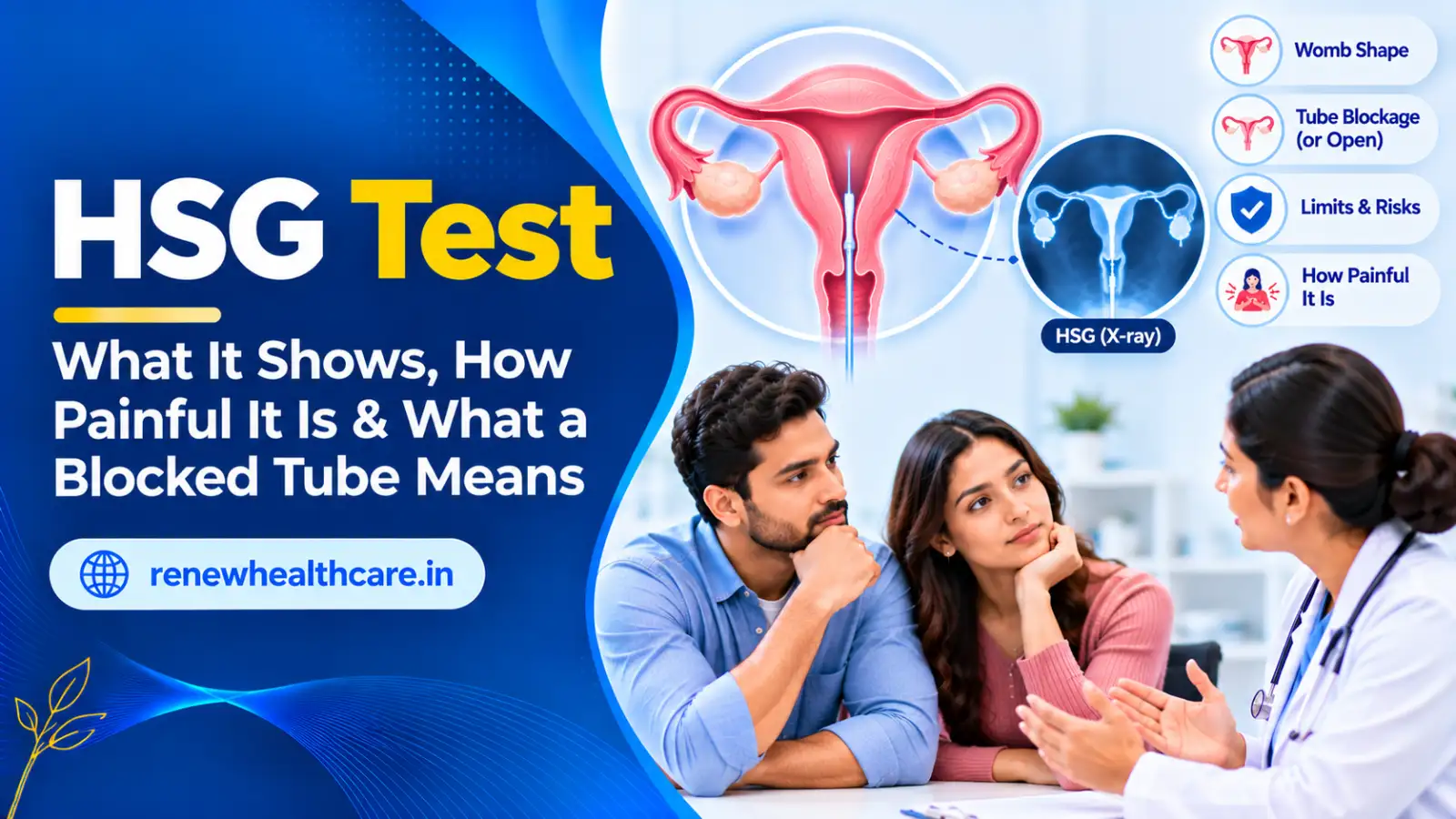
If your gynaecologist has recommended an HSG test, you may have questions about why it is needed, whether it will hurt, and what the results could mean for your fertility.
An HSG test (hysterosalpingography) is a specialised X-ray procedure used to examine the shape of the uterus and check whether the fallopian tubes are open. It is commonly recommended as part of an infertility evaluation because blocked or damaged fallopian tubes can affect the chances of natural conception.
During the procedure, a contrast liquid is gently introduced through the cervix into the uterus. X-ray images are then taken to observe how the liquid moves through the uterine cavity and fallopian tubes.
An HSG test can provide useful information, but it is not perfect. A result suggesting a blocked tube, particularly near the uterus, may sometimes need confirmation through another test.
At Renew Healthcare, fertility evaluation and treatment are considered in the context of each patient's medical history and individual requirements.
What Does an HSG Test Show?
An HSG test helps doctors examine two important areas: the uterine cavity and the fallopian tubes.
| What HSG can show | What HSG cannot show |
|---|---|
| The general shape of the uterine cavity | Whether ovulation is occurring |
| Whether contrast passes through the fallopian tubes | Egg quality or ovarian reserve |
| Possible abnormalities inside the uterine cavity | Endometriosis or most pelvic adhesions |
| A fluid-filled, blocked fallopian tube, known as hydrosalpinx | How well the lining inside the fallopian tubes functions |
The test is useful for identifying possible tubal problems, but it cannot provide a complete assessment of every factor affecting fertility.
Research comparing HSG with laparoscopy and dye testing has shown that HSG can miss some tubal abnormalities and may occasionally suggest a blockage when the tube is actually open.
For this reason, an abnormal result should always be interpreted alongside your medical history and other investigations.
Who May Need an HSG Test?
An HSG test may be recommended when a couple is experiencing difficulty conceiving and the doctor needs to assess whether the fallopian tubes are open.
It may be considered in situations such as:
Difficulty getting pregnant without an identified cause.
Suspected fallopian tube blockage.
A history of pelvic infection.
Previous ectopic pregnancy.
Suspected tubal damage.
Fertility evaluation before deciding on an appropriate treatment plan.
However, HSG is not necessarily the first test for everyone. Depending on a patient's medical history, an ultrasound-based test or laparoscopy with dye may be more appropriate.
The choice depends on the suspected cause of infertility, the information required, and the clinician's assessment.
You can explore the fertility-related care available at Renew Healthcare's Services page.
When Is an HSG Test Performed?
HSG is generally scheduled after menstruation and before ovulation so that an early pregnancy is not exposed to the X-ray procedure.
A commonly used schedule is around day 7 to day 10 of the menstrual cycle, counting the first day of the period as day 1. However, the exact timing should be confirmed by your treating team.
An HSG test should not be performed if:
You may be pregnant.
You have an active pelvic infection.
You have a known allergy to iodinated contrast that has not been assessed by the medical team.
Inform your doctor about relevant allergies, thyroid conditions, previous pelvic infections, and any possibility of pregnancy before the procedure.
How Is the HSG Test Performed?
The HSG procedure usually takes place in a radiology or imaging department.
The general steps are:
Preparation: You may be asked to lie on an examination table, similar to a gynaecological examination.
Speculum placement: A speculum is used to help the clinician access the cervix.
Catheter insertion: A thin tube is gently placed through the cervix.
Contrast injection: A contrast liquid is introduced into the uterus through the catheter.
X-ray imaging: Images are taken as the contrast moves through the uterine cavity and fallopian tubes.
Completion: The catheter is removed once the required images have been obtained.
The contrast movement helps the clinician assess the uterine cavity and determine whether the fallopian tubes appear open.
The procedure is generally performed without general anaesthesia, although individual arrangements may vary.
Is the HSG Test Painful?
One of the most common concerns about an HSG test is whether it hurts.
The experience varies from person to person. Some women describe mild discomfort, while others experience stronger cramping during the introduction of contrast.
A randomised trial involving 1,026 women reported an average pain score of 5.4 out of 10 for HSG. In the same study, the average score for a foam-based ultrasound test was 3.1 out of 10.
You may experience:
Period-like cramps.
Pressure in the lower abdomen.
Temporary discomfort during contrast injection.
Mild spotting after the procedure.
Ask your treating team whether pain relief is appropriate before the test. If you experience severe or persistent pain, fever, or heavy bleeding afterwards, contact your healthcare provider.
What Are the Risks of an HSG Test?
HSG is a commonly used diagnostic procedure, but it has some risks.
Possible risks include:
Pelvic infection: Infection can occasionally develop after the procedure.
Contrast-related reactions: Some people may have a reaction to the contrast material.
Intravasation: Contrast may enter blood vessels instead of flowing only through the uterus and tubes.
Radiation exposure: HSG uses X-rays, and the radiation dose varies according to the equipment and technique.
Temporary discomfort: Cramping and spotting may occur after the procedure.
The type of contrast used can also influence the risk profile. A national Dutch survey reported different complication and intravasation rates for oil-based and water-based contrast procedures. These figures come from Dutch clinical practice and should not automatically be treated as rates for Indian clinics.
Your doctor can explain the benefits and risks of the procedure and whether any precautions are needed in your situation.
Oil-Based vs. Water-Based Contrast: What Is the Difference?
HSG can be performed using oil-based or water-based contrast.
Research suggests that the type of contrast may influence pregnancy outcomes in some women undergoing fertility evaluation.
The H2Oil randomised trial compared oil-based and water-based contrast in 1,119 women across 27 Dutch hospitals.
| Outcome | Oil-based contrast | Water-based contrast |
|---|---|---|
| Ongoing pregnancy within six months | 39.7% | 29.1% |
| Live birth | 38.8% | 28.1% |
A Cochrane review also found that oil-based contrast may improve some pregnancy outcomes compared with no tubal flushing. However, the certainty of evidence varies, and the available trials do not establish that oil-based contrast is the right choice for every patient.
Both types contain iodine, although the amount differs. Research into possible longer-term effects is ongoing. A small 2026 observational study reported an association between HSG exposure and lower average IQ scores in a group of children, but it does not establish that HSG caused the difference. The study was small and requires further investigation.
The choice between oil-based and water-based contrast should therefore be discussed with your doctor, considering your medical history and the available evidence.
HSG vs. HyCoSy vs. Laparoscopy: What Is the Difference?
HSG is not the only way to assess whether the fallopian tubes are open.
Two other procedures that may be considered are HyCoSy and laparoscopy with dye.
| Feature | HSG | HyCoSy / HyFoSy | Laparoscopy with dye |
|---|---|---|---|
| Method | X-ray with contrast | Ultrasound with fluid or foam | Keyhole surgery |
| Radiation | Yes | No | No |
| Iodinated contrast | Yes | No | No |
| Anaesthesia | Usually not required | Usually not required | Usually required |
| Main role | Tubal imaging | Alternative tubal imaging | Can confirm and sometimes treat pelvic or tubal conditions |
The 2023 ESHRE guideline considers HSG and HyCoSy valid options for assessing tubal patency in appropriate patients. The choice may depend on clinical circumstances and the availability of experienced practitioners.
Laparoscopy is more invasive and is not routinely recommended for every person undergoing an unexplained infertility evaluation.
What Does a Blocked Fallopian Tube Mean?
If your HSG report suggests that a fallopian tube is blocked, it is important to understand exactly what the report says before drawing conclusions.
A blockage may be described as:
Proximal blockage: The suspected blockage is near the uterus.
Distal blockage: The suspected blockage is near the outer end of the tube.
Unilateral blockage: One fallopian tube appears blocked.
Bilateral blockage: Both fallopian tubes appear blocked.
A suspected blockage near the uterus does not always mean that the tube is permanently closed. Temporary spasm or other factors can affect how contrast flows during the test.
In one small study cited by the American Society for Reproductive Medicine, 24 of 40 women whose first HSG suggested a blockage near the uterus had open tubes on a repeat HSG approximately one month later.
This is why doctors may recommend confirmation before making treatment decisions based on a single image.
For more information, read our article on blocked fallopian tubes without symptoms.
What Is Hydrosalpinx?
Hydrosalpinx is a condition in which a fallopian tube becomes blocked and fills with fluid.
It may be identified during imaging investigations, including HSG and ultrasound. It can be important in fertility treatment because a fluid-filled tube may affect the chances of successful implantation and pregnancy.
In selected cases, treatment of the affected tube may be considered before IVF. The appropriate approach depends on the condition of the tube, the patient's fertility history, and the overall treatment plan.
Read more about treatment of tubal blockage.
Can You Get Pregnant After an HSG Test?
Some women conceive in the months following an HSG test.
Research suggests that tubal flushing, particularly with oil-based contrast, may improve pregnancy outcomes in certain groups. However, the effect is not guaranteed, and an HSG should primarily be understood as a diagnostic test rather than a fertility treatment.
Your chances of pregnancy depend on several factors, including:
Whether one or both fallopian tubes are open.
Age and ovarian reserve.
Ovulation.
Sperm health.
Other underlying fertility conditions.
The results should be interpreted as part of a complete fertility assessment rather than in isolation.
Frequently Asked Questions About HSG Tests
1. What is the full form of HSG?
HSG stands for hysterosalpingography. It is an X-ray procedure used to examine the shape of the uterus and whether the fallopian tubes are open.
2. Is an HSG test painful?
It can be uncomfortable. Some women experience mild cramps, while others may have stronger period-like pain during the procedure. The level of discomfort varies between individuals.
3. Can I get pregnant after an HSG test?
Yes, some women conceive after an HSG test. Studies suggest that tubal flushing, especially with oil-based contrast, may improve pregnancy chances in some circumstances. However, it is not a guaranteed fertility treatment.
4. How much does an HSG test cost?
The cost varies depending on the diagnostic centre, the type of contrast used, and the services included. Contact the relevant healthcare provider for its current itemised charges.
5. Can an HSG result be wrong?
Yes. HSG is not completely accurate. It can miss some tubal abnormalities and may sometimes suggest a blockage when the tube is actually open. Your doctor may recommend further evaluation if the result does not match your medical history or other findings.
6. Is HyCoSy better than HSG?
Neither test is universally better. HSG uses X-rays and contrast, while HyCoSy uses ultrasound and does not involve ionising radiation or iodinated contrast. The choice depends on your medical history, the clinical question, and local expertise.
The Bottom Line
An HSG test is an important investigation that can help assess the shape of the uterus and whether the fallopian tubes are open. It can provide useful information during a fertility evaluation, but it does not identify every possible cause of infertility.
A suspected blockage should not automatically be treated as a final diagnosis, particularly when it is near the uterus. Further assessment may be needed before deciding on treatment.
The most appropriate investigation depends on your medical history, symptoms, and fertility goals. Discuss the findings with a qualified fertility specialist who can explain what they mean for your individual situation.
For information about fertility care and available services, visit Renew Healthcare or explore the Services page.
Medical Review
Medically reviewed by: Dr. Arnab Kundu
Profile: Dr. Arnab Kundu – Renew Healthcare
Before publication, add the doctor's verified qualifications, NMR/SMR registration number, designation, clinic name, and city. The doctor must review and approve the final medical content.
Medical Disclaimer: This article is intended for general educational purposes only and does not replace individual medical advice, diagnosis, or treatment. Consult a qualified healthcare professional regarding your medical condition and fertility concerns.
AI Disclosure: This article was drafted with AI assistance and must be reviewed, edited, and approved by the named medical professional before publication. Confirm the final disclosure wording with the clinic's legal or compliance adviser.