
Medically reviewed by Dr. Rajeev Agarwal, MBBS, Medical Director, Infertility Specialist, IVF Expert & Gynaecologist at Renew Healthcare, Kolkata
Last updated: July 2026
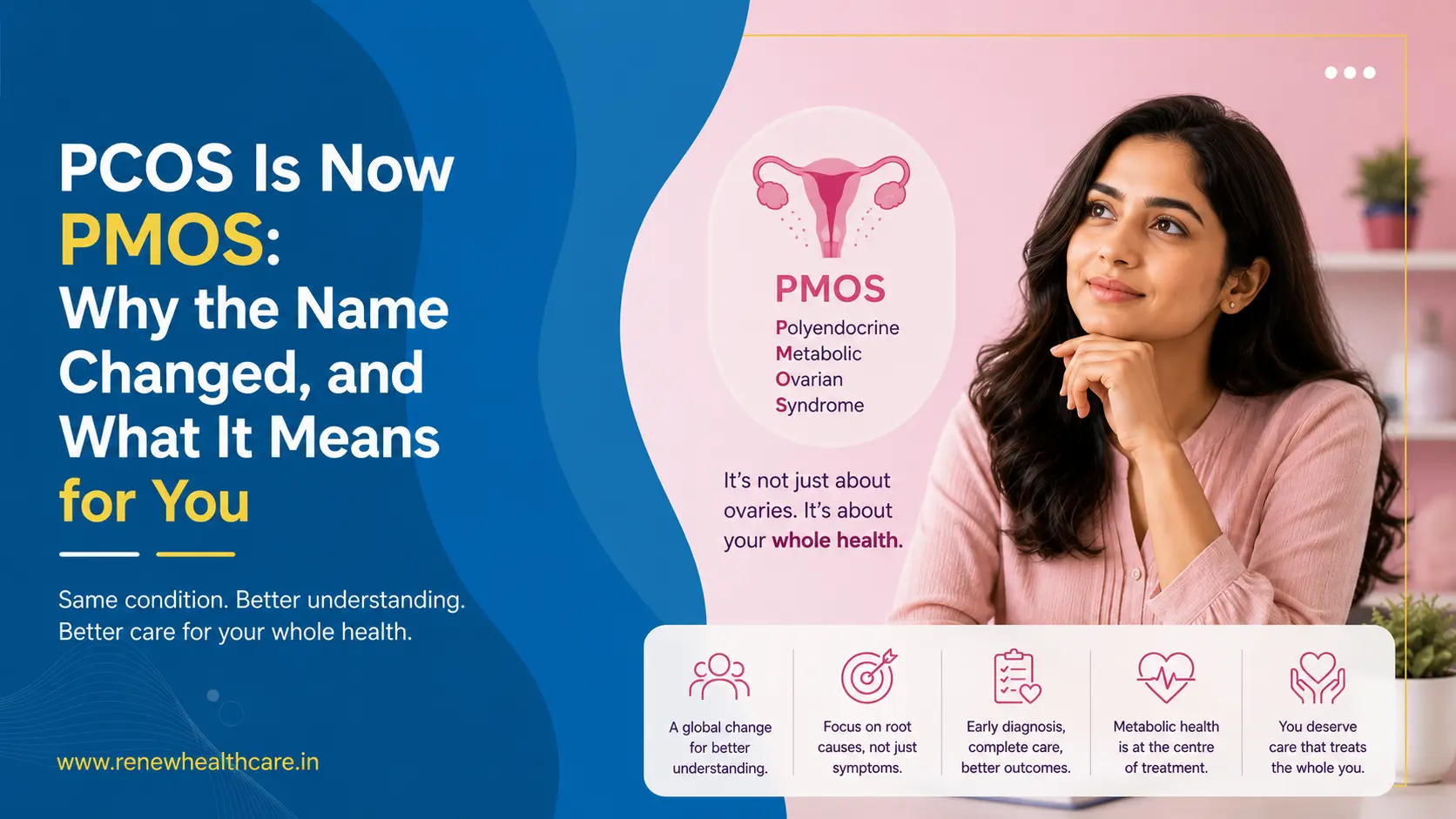
In brief: In May 2026, polycystic ovary syndrome was formally renamed polyendocrine metabolic ovarian syndrome (PMOS) following a global consensus published in The Lancet. The old name was wrong on both counts: the "cysts" are not cysts, and the ovary is not the centre of the condition. Your diagnosis, your tests and your treatment do not change.
What happened, and when
On 12 May 2026, The Lancet published the outcome of a multistep global consensus process renaming polycystic ovary syndrome to polyendocrine metabolic ovarian syndrome, PMOS.¹
This was not a small academic exercise. The process was led by a Global Name Change Consortium involving the Androgen Excess and PCOS Society, the patient organisation Verity, and Monash University, and drew together 56 academic, clinical and patient organisations across six continents over a consultation running some fourteen years.¹ ²
More than 14,000 survey responses from people living with the condition and from health professionals fed into it, alongside Delphi surveys and structured workshops.¹ ² The American Society for Reproductive Medicine endorsed the change on 27 May 2026, noting that women with the condition "were the biggest drivers of the name change."³
Support was strong on both sides: around 86% of patients and a clear majority of health professionals backed a change.² ⁴
The most important thing first
Nothing about your care changes today.
If you were diagnosed with PCOS, you have the same condition, and it is now called PMOS. Diagnostic criteria and treatment recommendations are not altered by the renaming.⁴ The transition is planned over roughly three years, with the terminology formally incorporated into the next international guideline update expected in 2028.² ⁵
So you will see both terms for a while. They mean the same thing.
Why the old name had to go
"Polycystic" was simply inaccurate
Women were told they had cysts on their ovaries. Many understandably concluded that something was growing inside them, or that surgery was needed to remove it.
What the ultrasound actually shows is a larger-than-usual number of small, immature follicles, the same follicles every ovary contains, arrested at an early stage instead of maturing and releasing an egg. They are not cysts in any meaningful sense. They are not dangerous. They do not need removing.
The consensus authors put it directly: the old term was "inaccurate, implying pathological ovarian cysts, obscuring diverse endocrine and metabolic features."²
"Ovary syndrome" pointed care in the wrong direction
This was the more serious failing. Naming the condition after the ovary frames it as a gynaecological, reproductive problem, so a great deal of care stopped at the periods and the fertility, and skipped the blood sugar, the lipids, the blood pressure and the liver.
ASRM described the consequence bluntly: the condition "has been reduced from a complex, long-term hormonal or endocrine disorder to a misunderstanding about 'cysts' and a focus on ovaries. This contributed to missed diagnoses and inadequate treatment."³
The argument was never about wording. It was that a name pointing at the ovary produced care that stopped at the ovary.
What the new name is telling you
Each word was chosen deliberately.²
| Word | What it signals |
|---|---|
| Polyendocrine | Multiple interacting hormonal disturbances (insulin signalling, androgen production, neuroendocrine pathways), not one gland misbehaving |
| Metabolic | Insulin resistance and metabolic risk are central, not incidental |
| Ovarian | The link to ovulation problems and infertility is retained, but placed last |
Read that order again. Metabolic comes before ovarian. That is the whole point of the change.
What the condition actually is
Beneath varied presentations sits a fairly consistent mechanism.
Insulin resistance is central for a large proportion of women, including many who are not overweight. The body produces more insulin to compensate. Raised insulin drives the ovaries to produce more androgens and lowers the protein that binds circulating testosterone, so more of it is active.
That single mechanism explains most of what patients experience:
- Raised androgens → acne, excess facial and body hair, scalp hair thinning
- Disrupted follicle maturation → irregular or absent periods, and the ultrasound appearance
- Absent ovulation → difficulty conceiving
- Metabolic disturbance → weight that is hard to shift, and long-term risk
Not every woman has all of these. There are lean women with the condition, women with regular-looking cycles, and women whose ovaries look entirely normal on ultrasound.
The condition is common: ASRM puts it at roughly one in eight women, more than 170 million worldwide.³
How it is diagnosed, and the myth to unlearn
Diagnosis rests on three features, of which any two are required, after excluding other causes:
- Irregular or absent ovulation
- Excess androgens, clinically visible or on blood tests
- Polycystic ovarian morphology on ultrasound
Notice what that means. Ultrasound is one of three criteria and you only need two. A woman can have this condition with entirely normal-looking ovaries. And a woman can have the ultrasound appearance without having the condition, because it is common in the general population.
The 2023 International Evidence-Based Guideline also recognised AMH as an acceptable alternative to ultrasound in adults, and advised against using ultrasound for diagnosis in girls within a few years of their first period.⁵
Two practical consequences: if you were diagnosed on ultrasound alone, that deserves review. If you were told you don't have it because your ovaries looked normal, that also deserves review.
What a proper assessment should include
Because the condition is metabolic, the workup must be too.
| Domain | What should be checked |
|---|---|
| Reproductive | Cycle history, ovulation, androgen levels, ultrasound where appropriate |
| Exclusion of mimics | Thyroid function, prolactin, other causes of androgen excess |
| Metabolic | Blood glucose or glucose tolerance testing, HbA1c |
| Cardiovascular | Lipid profile, blood pressure, weight and waist measurement |
| Liver | Assessment for fatty liver where indicated |
| Sleep | Screening for obstructive sleep apnoea where symptoms suggest it |
| Endometrial | Consideration of the lining where periods have been absent for long stretches |
| Wellbeing | Screening for depression and anxiety, which are more common in this group |
If your care has consisted of a tablet to bring on periods and nothing else, this table is your next appointment.
One point that matters especially in India
South Asian women appear to develop insulin resistance and metabolic complications at lower body weights than thresholds derived from Western populations. A woman can sit within a "normal" BMI and still have significant metabolic disturbance.
Do not let a normal BMI be the reason nobody checks your blood sugar or lipids.
The long-term risks the old name hid
Compared with women without the condition, there is increased risk of type 2 diabetes and gestational diabetes; abnormal lipids and cardiovascular risk factors; metabolic-associated fatty liver disease; obstructive sleep apnoea; endometrial hyperplasia where periods have been absent for prolonged stretches; and higher rates of anxiety and depression.⁵
None of these are inevitable. All are more manageable when someone is actually looking for them.
Delayed diagnosis has been the norm rather than the exception: the consensus authors noted diagnostic delay affecting a majority of those with the condition.² That is what the renaming is meant to fix.
The good news, which usually gets buried
If you are reading this because you are trying to conceive, this should have been said first.
This is one of the most treatable causes of infertility there is.
The problem is usually straightforward: eggs are present, often in abundance, but they are not being released. Ovarian reserve is typically good, sometimes better than average. The task is to restore ovulation, and medicine does that well.
The treatment ladder
- Lifestyle and weight management, where relevant. Even modest weight reduction can restore ovulation in women who are overweight, and improves the metabolic picture at the same time.
- Ovulation induction with tablets. Current guidance favours letrozole as first-line for ovulation induction, on the basis of evidence showing better ovulation and live birth rates than the older alternative.⁵ If you were started on clomiphene without letrozole being discussed, ask why.
- Metformin, in specific situations, particularly where metabolic features are prominent.
- Injectable gonadotropins with careful monitoring, where tablets have not worked.
- Laparoscopic ovarian surgery, in selected cases.
- IVF, where other approaches have not succeeded or other factors are present.
One safety note that matters
Women with this condition have a higher risk of ovarian hyperstimulation syndrome during IVF, because the ovaries contain so many follicles and respond vigorously.
This is well understood and largely preventable: antagonist protocols, alternative trigger medications, and freezing all embryos rather than transferring in a high-risk cycle. Ask your clinic specifically what they do to prevent it.
What should actually change now
A rename only matters if it changes behaviour. Four things should follow:
- Screening. Metabolic assessment becomes an obvious part of care, not an afterthought.
- Who manages it. Care shared across gynaecology, endocrinology and primary care.
- How it is explained. Women stop being told they have cysts.
- When care ends. It becomes a lifelong condition to manage, not a fertility problem that resolves once a baby arrives.
That last point is the one to hold onto. Many women are followed attentively while trying to conceive and discharged entirely afterwards. The metabolic risk does not end with the pregnancy.
Frequently asked questions
Has PCOS really been renamed?
Yes. In May 2026 a global consensus published in The Lancet renamed the condition polyendocrine metabolic ovarian syndrome (PMOS). ASRM and 56 organisations across six continents were involved. Both terms will be in use during a transition period.
Do I need to be re-diagnosed or re-tested?
No. The diagnosis is the same condition under a new name. Diagnostic criteria and treatment recommendations are not changed by the renaming.
Do I have cysts on my ovaries?
Almost certainly not in the way you are imagining. The ultrasound appearance is caused by a larger number of small immature follicles, normal structures in every ovary. Removing the inaccurate word "cyst" is precisely why the name changed.
Can I have this condition if my ovaries look normal on ultrasound?
Yes. Ultrasound is one of three diagnostic criteria and only two are needed.
Can I have it if I am not overweight?
Yes. Lean presentations are well recognised, and insulin resistance can be present at a normal BMI, particularly relevant for South Asian women.
Does this mean I cannot get pregnant?
No. This is among the most treatable causes of infertility. The usual problem is absent ovulation, which can generally be restored with treatment.
Will it go away after I have a baby?
Reproductive symptoms often ease over time, but the metabolic aspects persist and continue to need attention. This is a lifelong condition.
When will doctors and reports start using PMOS?
Gradually, over about three years. The terminology is expected to be formally incorporated into the international guideline update in 2028.
The bottom line
For decades the condition was named after the least important thing about it, an ultrasound appearance that is neither dangerous nor necessary for diagnosis, while the insulin resistance and metabolic disturbance driving both the symptoms and the long-term risk went unnamed.
That has now been corrected. Polyendocrine metabolic ovarian syndrome is a mouthful, but it is an accurate one, and the order of the words is the message: hormones and metabolism first, ovary last.
If you have this diagnosis, the practical takeaway is unchanged by the new label: ask for the metabolic workup, and do not accept a plan that stops at your periods. And if you are trying to conceive, take some comfort, of all the causes of infertility, this is one medicine handles well.
References
- Teede HJ, Khomami MB, Morman R, et al. Polyendocrine metabolic ovarian syndrome, the new name for polycystic ovary syndrome: a multistep global consensus process. The Lancet. Published online 12 May 2026. doi:10.1016/S0140-6736(26)00717-8
- Contemporary OB/GYN. Global consensus renames PCOS to polyendocrine metabolic ovarian syndrome (PMOS). 2026.
- American Society for Reproductive Medicine. PCOS is Now PMOS: Understanding the Name Change. ASRM News, 27 May 2026.
- American Journal of Managed Care. PCOS Renamed PMOS in Landmark Shift Reflecting Metabolic and Endocrine Features. 2026.
- Teede HJ, Tay CT, Laven J, et al. International Evidence-Based Guideline for the Assessment and Management of Polycystic Ovary Syndrome. Monash University, 2023.
- Teede HJ, Moran L, Morman R, et al. Polycystic ovary syndrome: perspectives from patients and health professionals on clinical features, current name, and renaming: a longitudinal international online survey. eClinicalMedicine. 2025. doi:10.1016/j.eclinm.2025.103219
Get complete care, not just cycle management
Dr. Rajeev Agarwal provides full assessment at Renew Healthcare, Kolkata: reproductive and metabolic evaluation together, evidence-based ovulation induction, and IVF with proper hyperstimulation prevention where needed.
Book a consultation: 062922 69060 | renewhealthcare.in | Ground Floor, 18 C, Mandeville Gardens, Ekdalia, Ballygunge, Kolkata, West Bengal 700019
This article is for general education and does not replace individual medical advice. Please consult a qualified specialist about your own situation.