
Medically reviewed by Dr. Arnab Kundu
If an ultrasound report mentions a uterine polyp, you may wonder whether it needs treatment, whether it could affect your chances of getting pregnant, or whether it could be something serious.
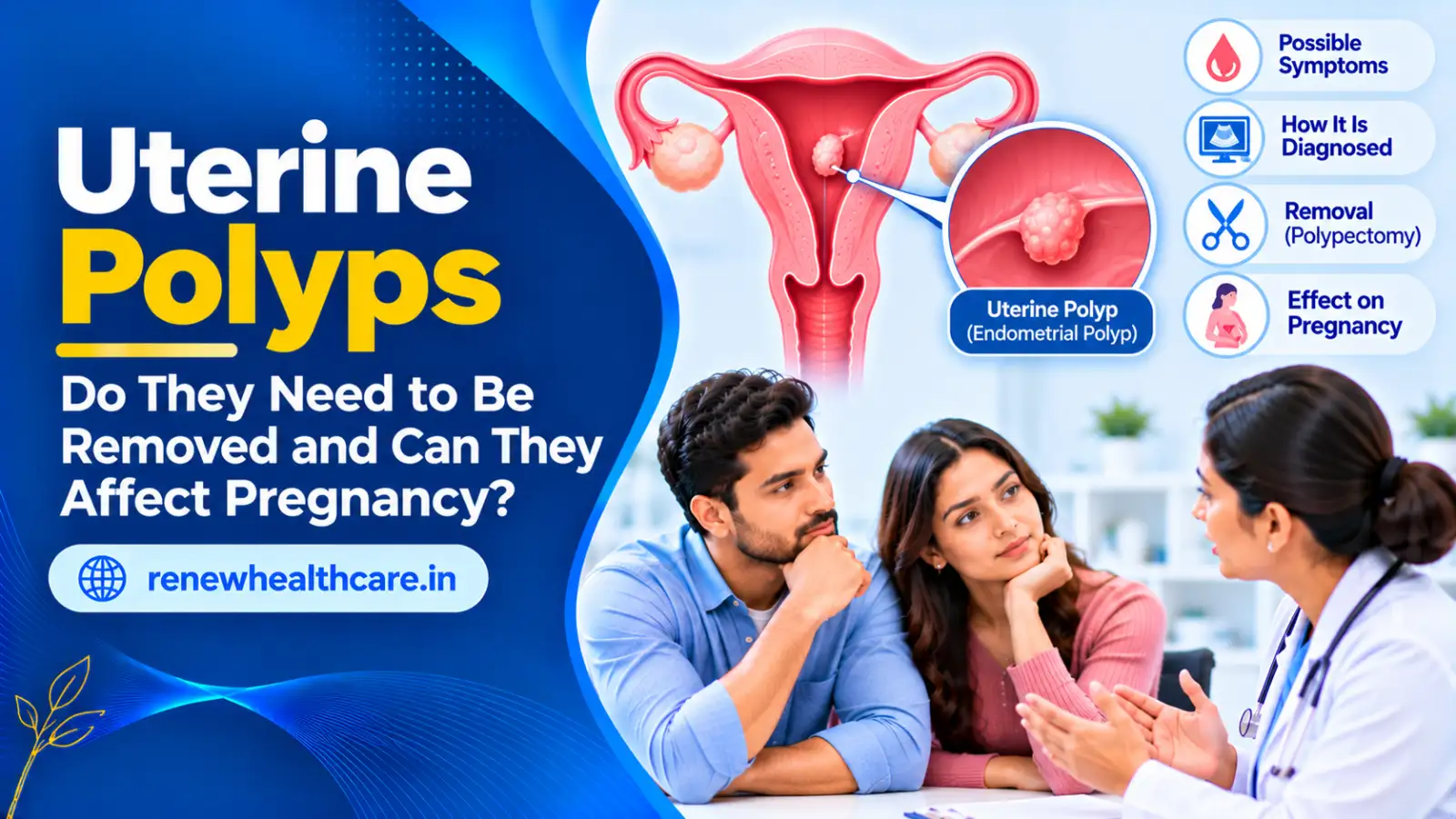
A uterine polyp is a soft overgrowth of tissue that develops either inside the womb lining or on the cervix. Some polyps cause abnormal bleeding, while others do not produce noticeable symptoms.
The decision to remove a polyp depends on where it is located, whether you have symptoms, your age, your pregnancy plans and the findings of your medical evaluation. Removal may be considered in some fertility situations, but the evidence is not equally strong for every treatment.
What Is a Uterine Polyp?
A uterine polyp is an overgrowth of tissue that develops in the reproductive tract. The term can refer to two different conditions: an endometrial polyp or a cervical polyp.
Although both are called polyps, they develop in different locations and may require different approaches.
Endometrial Polyps
An endometrial polyp develops inside the uterine cavity, growing from the lining of the womb.
Possible symptoms include:
Abnormal or irregular menstrual bleeding.
Bleeding between periods.
Bleeding after menopause.
Difficulty conceiving in some cases.
No noticeable symptoms.
Endometrial polyps are commonly investigated using ultrasound, saline sonography or hysteroscopy.
Cervical Polyps
A cervical polyp develops on the cervix or inside the cervical canal. The cervix is the lower, narrow part of the uterus that connects to the vagina.
Possible symptoms include:
Bleeding between periods.
Bleeding after sexual intercourse.
Bleeding after menopause.
Unusual vaginal discharge.
No noticeable symptoms.
A cervical polyp may be visible during a speculum examination and can sometimes be noticed during a routine cervical screening examination.
| Feature | Endometrial polyp | Cervical polyp |
|---|---|---|
| Location | Inside the uterine cavity | On the cervix or in the cervical canal |
| Common symptoms | Abnormal bleeding, sometimes fertility concerns | Bleeding between periods or after sex, discharge |
| How it is found | Ultrasound, saline sonography or hysteroscopy | Speculum examination |
| Removal | Usually hysteroscopic removal | Often a minor outpatient procedure |
How Are Uterine Polyps Diagnosed?
The appropriate investigation depends on the suspected location of the polyp and the symptoms being evaluated.
1. Transvaginal Ultrasound
Transvaginal ultrasound is commonly used as an initial investigation for suspected endometrial polyps.
It allows the doctor to examine the uterine lining and look for an abnormal growth inside the uterine cavity.
Additional imaging techniques, such as colour Doppler, three-dimensional ultrasound or contrast imaging, may improve diagnostic accuracy in selected cases.
2. Saline Sonography
Saline sonography, also called saline infusion sonography, involves introducing a small amount of sterile saline into the uterine cavity during an ultrasound examination.
The saline helps separate the walls of the uterus, making it easier to identify abnormalities such as endometrial polyps.
3. Hysteroscopy
Hysteroscopy involves passing a thin camera through the cervix to examine the inside of the uterus.
It allows the doctor to directly inspect the uterine cavity and identify the location and appearance of a suspected polyp. It can also be used to remove the polyp when appropriate.
You can read more about hysteroscopy for abnormal uterine bleeding.
Why Is Blind D&C Not Preferred for Diagnosing Polyps?
Blind dilatation and curettage (D&C) involves removing tissue from the uterus without directly viewing the uterine cavity.
Because polyps are focal growths, blind scraping may fail to identify or remove them accurately. An evidence-based hysteroscopy guideline advises against using blind D&C to diagnose endometrial polyps.
Do Uterine Polyps Affect Fertility?
Endometrial polyps have been associated with difficulty conceiving, but finding a polyp does not automatically mean it is the cause of infertility.
One proposed explanation is that a polyp may affect the uterine lining and its ability to support implantation. However, the evidence supporting this explanation is limited.
The decision to remove a polyp may be different before intrauterine insemination (IUI) and before in vitro fertilisation (IVF).
Before IUI: What Does the Evidence Show?
One randomised study involving 215 women with ultrasound-diagnosed endometrial polyps compared hysteroscopic polyp removal with diagnostic hysteroscopy and polyp biopsy.
Across up to four IUI cycles, the study reported 93 pregnancies:
64 pregnancies in the polyp-removal group.
29 pregnancies in the comparison group.
The reported relative risk was 2.1.
The findings suggest that removing a polyp before IUI may improve pregnancy chances. However, the evidence comes from a single trial and was graded as low quality by the Cochrane review. The study did not report live-birth or miscarriage outcomes.
Therefore, the possible benefit should be discussed with a fertility specialist rather than treated as a guarantee.
Before IVF or ICSI: Is Polyp Removal Necessary?
The evidence is less clear for routine polyp removal before IVF or ICSI.
A Cochrane review found no randomised trial establishing whether removing endometrial polyps before IVF or ICSI improves outcomes. A separate 2019 systematic review covering eight studies and 2,267 patients also found no clear benefit for pregnancy or live-birth outcomes.
This does not mean that a polyp should never be removed before IVF. The decision may depend on the size and location of the polyp, symptoms, age, fertility history and the planned treatment.
If a polyp is identified before IVF, discuss the potential benefits, limitations and timing of removal with your specialist.
You can also read about hysteroscopy and its role in IVF treatment.
What If My Scan Is Normal?
If routine imaging does not show an abnormality, that does not automatically mean hysteroscopy is needed.
The 2023 European Society of Human Reproduction and Embryology (ESHRE) guideline recommends against hysteroscopy solely to look for and correct abnormalities that were not identified on routine imaging in women with unexplained infertility.
A normal scan and a polyp already identified on a scan are different situations and should not be treated as the same clinical problem.
Can a Uterine Polyp Be Cancerous?
Most uterine polyps are benign, but removed tissue should be examined under a microscope to identify any abnormal or potentially cancerous changes.
The concern is particularly relevant in women who have reached menopause or who experience abnormal bleeding.
A pooled analysis of 20 studies involving 11,204 women over the age of 45 with histologically confirmed polyps found that 287 polyps, or 2.75%, were malignant.
The analysis also found higher odds of pre-malignant or malignant changes among menopausal women compared with non-menopausal women. Abnormal bleeding and greater endometrial thickness were also associated with higher risk.
These figures come from a selected group of women over 45 whose polyps had been removed and examined. They should not be applied directly to younger women.
What About Cervical Polyps?
Cervical polyps are usually benign. In one retrospective study involving 4,063 removed cervical polyps, malignancy was identified in three cases, or approximately 0.1%. All three were found to have spread from the uterine lining.
Your doctor may recommend removal and tissue examination depending on the appearance of the polyp, symptoms and clinical findings.
Why Is Bleeding After Menopause Important?
Bleeding after menopause should always be assessed by a qualified gynaecologist.
If a suspected endometrial polyp is associated with postmenopausal bleeding, diagnostic hysteroscopy and removal may be recommended. Evaluation should not be unnecessarily delayed, particularly when bleeding continues or returns.
When Should a Uterine Polyp Be Removed?
Not every polyp requires immediate removal. The decision depends on symptoms, menopausal status, cancer risk factors and pregnancy plans.
Situations Where Removal May Be Recommended
Removal may be considered in the following situations:
Abnormal uterine bleeding: A polyp associated with irregular or unexplained bleeding may need removal.
Bleeding after menopause: A suspected polyp in a woman with postmenopausal bleeding requires appropriate assessment and may need hysteroscopic removal.
Certain postmenopausal polyps without symptoms: Removal may be recommended for polyps larger than 2 cm or when additional endometrial cancer risk factors are present.
Before IUI: Removal of a polyp identified on ultrasound may be considered, although the supporting fertility evidence is limited to one low-quality trial.
When May Removal Not Be Necessary?
Observation may be considered in selected women who:
Have no symptoms.
Are not planning pregnancy.
Have no identified risk factors requiring removal.
For women who have not reached menopause and have no symptoms, removal may still be considered when cancer risk factors are present.
The decision should be individualised. A polyp should not be ignored simply because it is small, nor should every polyp automatically lead to surgery.
Can Uterine Polyps Come Back After Removal?
Yes. Endometrial polyps can recur after removal, so the procedure does not guarantee that another polyp will never develop.
A 2026 systematic review and meta-analysis of 34 studies reported the following 12-month recurrence estimates:
Approximately 6.3% after tissue-removal systems.
Approximately 13.5% after electrosurgery.
These are pooled descriptive figures, not a direct comparison proving that one method is better than the other. Evidence comparing different instruments was limited and of very low certainty.
The same review identified two non-randomised studies in which a hormone-releasing intrauterine system after removal was associated with fewer recurrences. However, this does not prove that the device caused the reduction.
Cervical polyps can also occasionally return.
If abnormal bleeding develops again after removal, inform your doctor so that further assessment can be considered.
What Should You Ask Your Doctor Before Polyp Removal?
Before deciding on treatment, it is useful to understand why the polyp needs attention and what the procedure is expected to achieve.
You can ask:
Is the polyp inside the uterus or on the cervix?
Is it likely to explain my bleeding or difficulty conceiving?
Is removal necessary, or is observation an option?
If I am planning IUI or IVF, how strong is the evidence for removing it first?
Will the removed tissue be sent for histopathology?
What follow-up will be required after the procedure?
A particularly useful question is:
“Is this polyp the likely reason for my bleeding or delay in conceiving, and what will we do with the tissue report?”
If you also experience heavy or irregular menstrual bleeding, you can read our guide on period blood clots and the possible causes of heavy periods.
Frequently Asked Questions
1. What Is a Uterine Polyp in Simple Words?
A uterine polyp is a soft overgrowth of tissue that develops from the womb lining or on the cervix. Some women experience irregular bleeding, while others have no symptoms. Most are benign, but removed tissue should be examined under a microscope.
2. Is an Endometrial Polyp the Same as a Cervical Polyp?
No. An endometrial polyp grows inside the uterine cavity, while a cervical polyp develops on the cervix or within the cervical canal. They are found using different examinations and may require different removal procedures.
3. Can a Uterine Polyp Stop Me from Getting Pregnant?
A polyp might affect fertility, but the evidence is limited. One randomised trial found more pregnancies after removal before IUI, although live-birth outcomes were not reported. The evidence before IVF is less conclusive.
4. Do I Need to Remove a Polyp Before IUI or IVF?
Before IUI, removal may be considered when a polyp has been identified on ultrasound, based on one trial with low-quality evidence. Before IVF, there is no randomised trial establishing that routine removal improves outcomes. Your specialist should consider your symptoms, age, fertility history and treatment plan.
5. Can a Uterine Polyp Be Cancerous?
Most uterine polyps are benign, but a small proportion may contain malignant changes. Risk is higher in selected groups, particularly women after menopause. This is one reason why abnormal bleeding and postmenopausal bleeding require proper assessment.
6. Will Uterine Polyps Come Back After Removal?
Yes, recurrence is possible. A 2026 pooled analysis reported 12-month recurrence estimates of 6.3% after tissue-removal systems and 13.5% after electrosurgery. These figures are descriptive and do not establish that one technique is superior.
Conclusion
Uterine polyps are soft tissue growths that may develop inside the womb or on the cervix. Some cause abnormal bleeding, while others produce no symptoms.
Removal is commonly considered when a polyp is associated with abnormal bleeding or postmenopausal bleeding. For women trying to conceive, the evidence suggests a possible benefit before IUI, while the benefit of routine removal before IVF remains uncertain.
The most appropriate decision depends on the location of the polyp, symptoms, age, fertility plans and examination findings. Discussing these factors with a qualified specialist can help determine whether removal, observation or further investigation is appropriate.
Medical Review: Dr. Arnab Kundu — View Doctor Profile
This article is for general educational purposes and does not replace individual medical advice. Please consult a qualified specialist about your own situation.