
Medically reviewed by Dr. Arnab Kundu
A follicular study is a series of ultrasound scans performed during one menstrual cycle to monitor the growth of ovarian follicles and assess whether ovulation has occurred.
It is commonly recommended when ovulation medicines are being used or when ovulation needs to be timed for fertility treatment. However, not everyone trying to conceive needs repeated follicular scans.
Understanding what happens during the study, how many scans may be required, and what the results can tell you can help you have a more informed discussion with your fertility specialist.
What Is a Follicular Study?
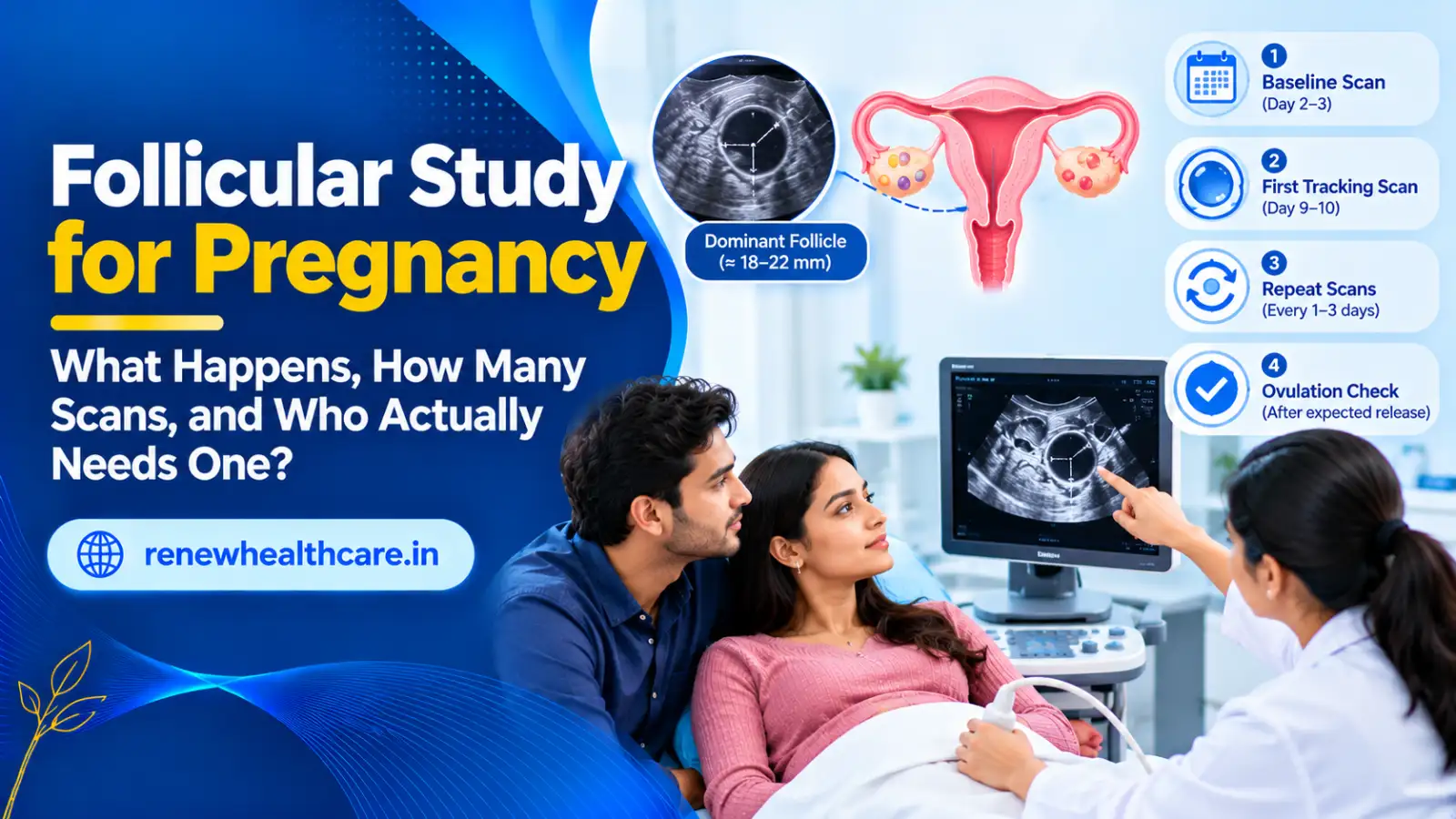
A follicular study, also known as follicular monitoring or follicle tracking, is a series of ultrasound examinations performed across one menstrual cycle.
The scans monitor the development of follicles in the ovaries. Follicles are small, fluid-filled structures that contain immature eggs. During a menstrual cycle, one follicle usually becomes dominant and continues growing before ovulation.
A follicular study helps the doctor assess:
Whether ovarian follicles are developing.
How many follicles are growing.
The size of the dominant follicle.
Whether the follicle appears to have released its egg.
The condition of the uterine lining, when relevant.
The purpose is to understand how the cycle is progressing and whether any treatment decisions are needed.
On Which Day Does a Follicular Study Start?
There is no single scan schedule that applies to every woman. The timing depends on menstrual cycle length, treatment protocol, follicular development and the reason for monitoring.
A common clinic schedule may look like this:
| Scan | Usual timing | What is assessed |
|---|---|---|
| Baseline scan | Days 2–3 | Ovaries and uterine lining before follicular development progresses |
| First tracking scan | Around days 9–10 | Number and size of developing follicles |
| Repeat scans | Every 1–3 days, depending on growth | Changes in follicle size and development |
| Ovulation check | After expected ovulation | Whether the dominant follicle appears to have changed or ruptured |
These timings represent a common clinic approach, not a universal evidence-based rule. A 2020 NHS patient leaflet for women taking letrozole describes scans usually beginning around day 10 and notes that more than one scan may be required.
Women with longer or irregular cycles may need a different schedule.
How Many Follicular Scans Are Usually Needed?
The number of scans varies according to how quickly the follicles develop and what the doctor needs to assess.
Three to six scans over approximately seven to ten days may be common in some clinic protocols. However, this is not a fixed requirement for every patient.
A slowly developing follicle may require additional monitoring, while another cycle may need fewer visits.
Before starting, it is reasonable to ask your doctor:
How many scans are expected during this cycle?
How frequently will the scans be repeated?
What findings will determine the next step?
When will the monitoring stop?
What Is the Normal Follicle Size for Ovulation?
Follicle size is one of the measurements assessed during a follicular study. However, there is no single diameter that guarantees a follicle is mature or that ovulation will occur.
In a multicentre observational study involving 107 women with normal fertility, the average largest follicle diameter before ovulation was approximately 20.5 mm. However, around 40% of the analysed cycles had a follicle smaller than 19 mm on the day before ovulation.
The study also estimated average follicular growth at approximately 1.7 mm per day, while cautioning that ovulation timing cannot be predicted reliably from follicle diameter alone.
This means that:
A 17 mm follicle is not automatically a failed cycle.
A 20 mm follicle does not guarantee ovulation.
The change in follicle size across successive scans is important.
Your doctor considers the overall cycle rather than relying on one measurement.
Follicle development can vary between women and between cycles in the same woman. Your scan results should therefore be interpreted in the context of your treatment and medical history.
Who Needs a Follicular Study?
Follicular monitoring is useful in particular situations, but its value differs depending on whether you are trying naturally or receiving fertility treatment.
1. Women with Regular Periods Trying Naturally
If you have regular menstrual cycles, are not taking ovulation medicines and have been trying to conceive for less than a year, routine monthly follicular scans are generally not necessary.
A 2023 Cochrane review found no studies assessing whether ultrasound-timed intercourse improves pregnancy outcomes. The evidence for urinary ovulation test kits was more encouraging in one trial, but that does not establish a benefit from routine follicular scans.
For many couples, intercourse every two to three days is a practical approach to covering the fertile window.
You can also read our guide comparing an ovulation kit, period app and follicle scan to understand the differences between these methods.
2. Women Taking Ovulation Medicines
Follicular monitoring may be recommended during treatment with medicines such as clomiphene or letrozole.
These medicines are used to support ovulation, but the ovarian response can vary. Ultrasound monitoring helps the doctor assess how many follicles are developing and how they are growing.
One retrospective study of 425 clomiphene cycles found that 14% had three or more follicles measuring at least 14 mm. This illustrates why monitoring may be important in selected treatment cycles.
The Federation of Obstetric and Gynaecological Societies of India (FOGSI) also notes that clomiphene cycles may require ultrasound monitoring.
For letrozole cycles, the need for ultrasound monitoring depends on the individual treatment plan. Some protocols may use blood tests, while others may include scans.
3. Women Undergoing IUI Treatment
Intrauterine insemination (IUI) involves placing prepared sperm into the uterus around the time of ovulation.
Follicular monitoring may be used to assess follicle development and help coordinate the timing of insemination. Whether scans are required, and how frequently they are performed, depends on the medicines used and the clinic's protocol.
The role of routine ultrasound monitoring in every IUI cycle remains debated. Monitoring may be particularly relevant when injectable medicines are used, because the development of multiple follicles needs consideration.
Read more about the IUI procedure and what happens during treatment.
4. Women Receiving Gonadotrophin Injections or IVF Treatment
Ultrasound monitoring is an important part of treatment involving gonadotrophin injections.
The NICE NG257 fertility guideline recommends ovarian ultrasound monitoring of follicle size and number as an integral part of gonadotrophin therapy. Monitoring helps assess ovarian response and manage the risk of multiple pregnancy and ovarian hyperstimulation.
During IVF or ICSI treatment, ultrasound scans are used to monitor the development of multiple follicles.
A Cochrane review comparing ultrasound monitoring alone with ultrasound plus blood oestradiol monitoring found no clear difference in clinical pregnancy rates. The available evidence was of low certainty, and live-birth outcomes were not reported in the included studies.
5. Women with Irregular or Absent Periods
Irregular or absent periods can make it difficult to determine whether ovulation is happening regularly.
A series of scans may help assess follicular development and whether a dominant follicle appears to release an egg. A mid-luteal progesterone blood test may also be used to assess whether ovulation has occurred.
The appropriate approach depends on your symptoms, cycle pattern and medical history.
If you experience irregular periods, you can read more about their possible causes and relationship with fertility.
What Can a Follicular Study Tell You, and What Can It Not Tell You?
A follicular study provides useful information about follicular development, but it cannot assess every aspect of fertility.
What it can help assess:
The number of developing follicles.
The growth of the dominant follicle.
Changes in follicle size between visits.
Whether the dominant follicle appears to have ruptured.
The uterine lining, when included in the examination.
What it cannot establish:
The quality of the egg inside the follicle.
Whether the fallopian tubes are open.
Whether sperm parameters are normal.
Whether fertilisation will occur.
Whether an embryo will implant successfully.
A follicle may appear to develop normally but still fail to release its egg. This is one reason why ultrasound findings sometimes need to be considered alongside blood tests and other fertility assessments.
A progesterone blood test may be recommended in some cases to help confirm whether ovulation has occurred.
When Should Follicular Monitoring Stop?
A follicular study should have a clear purpose and stopping point. Repeated scans should be guided by what the results may change about the treatment plan.
Some situations that may lead to a change in monitoring include:
When Ovulation Has Been Documented
In a monitored treatment cycle, scans may usually stop once ovulation has been documented or the cycle has been stopped, depending on the clinic's protocol.
When Several Large Follicles Develop
If several follicles develop, the doctor may reconsider the treatment plan because of the possibility of multiple pregnancy.
The decision depends on the number and size of follicles, the medicines used and the clinic's protocol. Ask your doctor which follicle-number criteria are used to continue, modify or cancel a cycle.
When the Treatment Plan Needs Review
If several monitored cycles have not produced the expected result, it may be appropriate to review the overall fertility plan rather than simply continuing the same schedule.
There is no single number of monitored cycles that applies to everyone. The decision should consider age, diagnosis, treatment response and other fertility factors.
A useful question to ask during your consultation is:
“What will each scan change about my treatment, and how many scans do you expect me to need?”
Frequently Asked Questions
1. What Is a Follicular Study in Simple Words?
A follicular study is a series of ultrasound scans performed during one menstrual cycle to monitor the growth of follicles in the ovaries. It helps assess how many follicles are developing, how large they are and whether the dominant follicle appears to have released its egg.
2. On Which Day Should a Follicular Study Start?
There is no fixed starting day for every woman. Some clinic protocols include a baseline scan on days 2–3 and a first tracking scan around days 9–10. The timing may change depending on cycle length, follicular growth and fertility treatment.
3. How Many Scans Are Needed for a Follicular Study?
The number depends on how quickly the follicles develop and what needs to be monitored. Three to six scans over approximately a week to ten days may be common in some clinic protocols, but this is not a universal requirement.
4. What Is the Ideal Follicle Size for Ovulation?
There is no single follicle size that guarantees ovulation. One multicentre study found an average largest pre-ovulatory follicle diameter of approximately 20.5 mm, but some women ovulated with smaller follicles. Doctors assess the growth trend and the overall clinical picture.
5. Is a Follicular Study Necessary If My Periods Are Regular?
Usually not if you have regular cycles, are not taking ovulation medicines and have been trying to conceive for less than a year. Your doctor may recommend monitoring if there are other fertility concerns or if treatment is planned.
6. Is a Follicular Study Needed Before IUI?
It depends on the treatment protocol and medicines being used. Ultrasound monitoring may be recommended to assess follicular development and coordinate treatment timing. Discuss with your fertility specialist what each scan is intended to assess.
Conclusion
A follicular study helps monitor the development of ovarian follicles throughout a menstrual cycle and assess whether ovulation appears to have occurred.
It can be particularly useful during ovulation-induction treatment, selected IUI cycles and treatment involving gonadotrophin injections. However, routine monthly scans are not automatically necessary for women with regular cycles who are trying to conceive naturally.
Follicle size is only one part of the assessment. The growth pattern, treatment response and individual medical history all matter when interpreting the results.
Before beginning a follicular study, discuss the expected scan schedule, the purpose of each visit and the findings that will determine the next step in your treatment.
Medical Review: Dr. Arnab Kundu — View Doctor Profile
This article is for general educational purposes and does not replace individual medical advice. Please consult a qualified fertility specialist about your own situation.