
Medically reviewed by Dr. Neha Yadav — Infertility Specialist & IVF Consultant at Renew Healthcare, Salt Lake, Kolkata. Reviewed against ASRM and ESHRE guidance.
Last updated: September 2026
In brief: A standard IUI cycle runs roughly two to four weeks — eight to twelve days of monitoring, one procedure day, then a two-week wait for a blood test. Trigger timing is the single most decision-critical step, bed rest afterwards is not supported by randomised evidence, and most successful cycles happen within the first three attempts.
Most people are told to come back on day 3 and left to fill in the rest themselves. IUI is one of the most commonly prescribed fertility treatments in India, yet the actual day-by-day experience — what happens, when, and why — rarely gets explained clearly before it starts. Here is the cycle mapped out honestly, with the evidence behind each step.
Key takeaways
- A standard IUI cycle runs roughly two to four weeks: eight to twelve days of monitoring, one procedure day, then a two-week wait for the blood test.
- Reported per-cycle pregnancy rates vary widely, roughly 7–20% depending on age, diagnosis and protocol — there is no single universal number.
- A randomised trial (Human Reproduction, 2017) found no benefit to bed rest after IUI — a routine still recommended by many clinics.
- ASRM guidance supports reassessing the plan after three to four IUI cycles, since most successful cycles occur within the first three attempts.
The day-by-day walkthrough
Day 2–3 of your period
A baseline ultrasound and bloodwork confirm your ovaries are quiet and ready to start. This is also when the male partner's semen analysis is usually reviewed, if it has not been done already.
Day 3–7
Ovulation-stimulating medication begins — oral letrozole or clomiphene for about five days, or injectable gonadotropins for a longer, more closely monitored eight to twelve day course. The choice depends on your diagnosis, not on what worked for someone else's cycle.
Day 8–12
Follicle-tracking ultrasounds every one to three days watch the lead follicle grow towards 18–20 mm, alongside endometrial thickness checks.
Trigger day
Once follicles are ready, an hCG trigger injection is timed precisely to release the egg. The IUI is scheduled 24–36 hours later — this timing is the single most decision-critical step in the entire cycle.
Procedure day
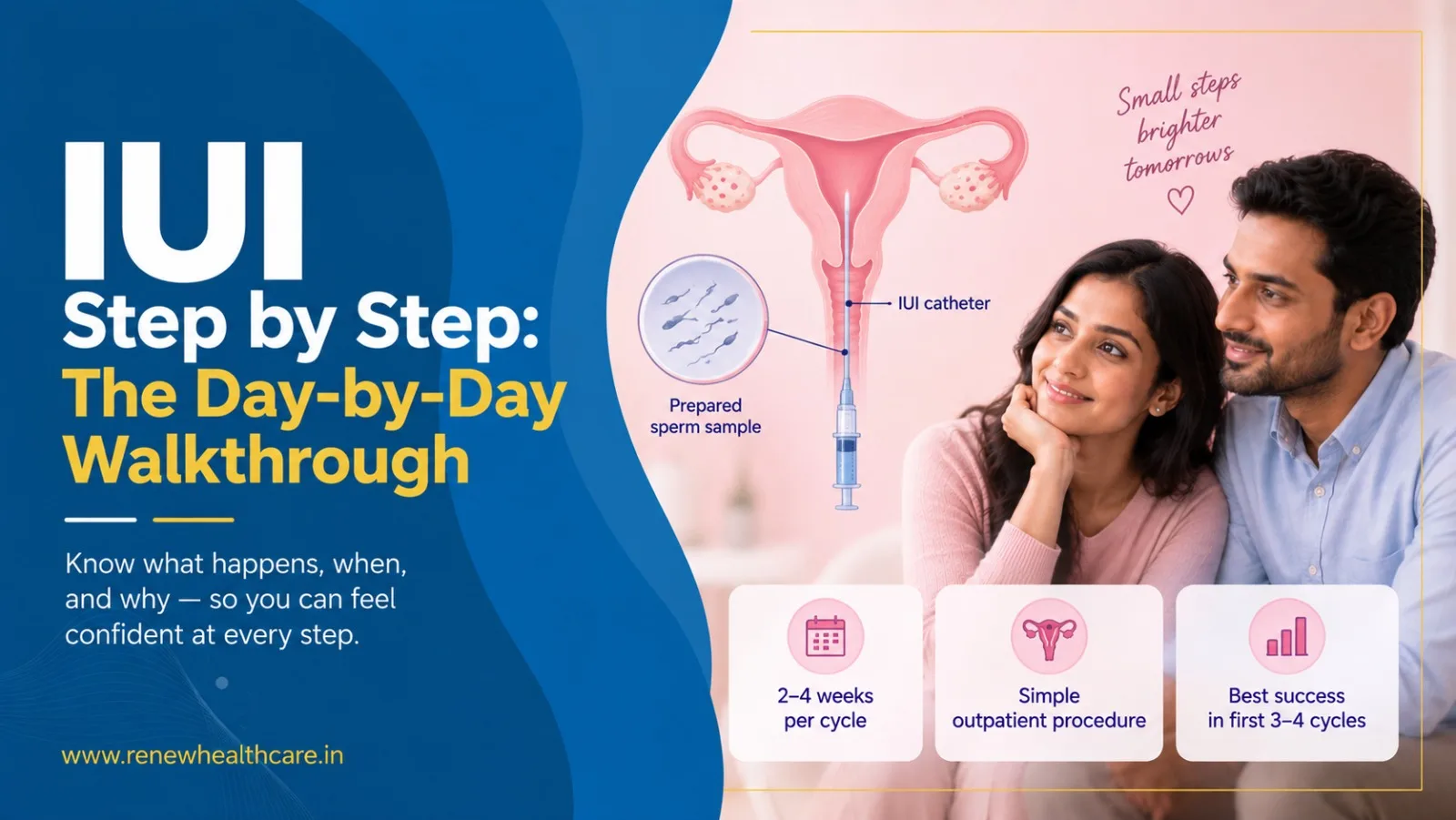
Your partner provides a fresh sample, which is washed in the lab over roughly 30 to 60 minutes to concentrate healthy, motile sperm. The insemination itself takes two to five minutes, using a thin catheter through the cervix — no anaesthesia, and discomfort similar to a Pap smear.
The two-week wait
You return to normal activity immediately. A serum beta-hCG blood test, not a symptom checklist, is the only reliable way to confirm pregnancy — typically scheduled 14 days after the procedure.
Natural-cycle versus medicated IUI
| Natural-cycle IUI | Medicated IUI |
|---|---|
| Relies on your own ovulation, timed via the LH surge or ovulation predictor kits | Uses letrozole, clomiphene or gonadotropins to grow follicles |
| Fewer clinic visits, lower cost, no multiple-pregnancy risk from stimulation | More monitoring visits; a small increase in twin risk, roughly 8–10% with oral agents |
| Best for regular, predictable cycles | Often preferred for irregular ovulation, PCOS or unexplained infertility |
Myth vs. fact
| Myth | Fact |
|---|---|
| Lying down for 15 to 30 minutes after IUI improves success. | A randomised trial of 1,934 cycles (Human Reproduction, 2017) found no statistically significant benefit to bed rest after IUI. |
| More follicles always means a better chance. | Beyond two mature follicles, the added pregnancy benefit is minimal while multiple-pregnancy risk rises sharply — which is why monitoring exists. |
| If it has not worked in six or more cycles, one more will. | Cumulative benefit flattens after three to four cycles for most diagnoses; ASRM-aligned practice is to review the plan, not repeat indefinitely. |
Action checklist before your first cycle
- Confirm both partners have completed baseline testing — AMH, semen analysis, and tubal patency where relevant.
- Ask your clinic which protocol, natural or medicated, is planned for you, and why.
- Clarify the exact trigger-shot timing and procedure-day logistics in advance.
- Plan to resume normal activity right after the procedure — no special bed rest is required.
- Schedule the day-14 beta-hCG blood test rather than relying on symptoms.
- Ask in advance what the plan is if this cycle does not succeed.
Frequently asked questions
How many IUI cycles should we try before moving to IVF?
Most clinics and ASRM-aligned guidance suggest reviewing your plan after three to four cycles, since roughly 88–90% of IUI successes occur within the first three attempts in published cohorts — though this figure comes from single-centre data and individual clinic experience will vary.
Is IUI painful?
Most patients describe it as similar to a Pap smear — mild cramping is common, but anaesthesia is not required.
Do I need bed rest after the procedure?
Current randomised evidence does not support it. You can resume normal activity immediately.
Thinking about starting IUI?
Every cycle is different, and your protocol should be built around your age, ovarian reserve and diagnosis rather than a generic template. Dr. Neha Yadav offers personalised IUI consultations at the Renew Healthcare clinic in Salt Lake, Kolkata to help you understand whether IUI is the right next step for you.
References
- Bensdorp AJ et al. Immobilisation or mobilisation after IUI: a randomised controlled trial. Human Reproduction, 2017.
- Van Eekelen R et al. Predicting success of intrauterine insemination using a clinically based scoring system. Reproductive BioMedicine Online, 2022.
- American Society for Reproductive Medicine (ASRM). Committee opinion on the management of unexplained infertility, 2020.
- Fifteen and 30 minutes of immobilisation after IUI: a randomised controlled trial. PubMed, 2023 (PMID 36942496).
- Clinic-published timelines used only for general day-range cross-checking, and flagged as secondary sources rather than primary evidence.