
Medically reviewed by Dr. Arnab Kundu, MBBS, DGO, DNB (Obs & Gynae) — Infertility Specialist, IVF Expert & Gynaecologist at Renew Healthcare, Ballygunge–Gariahat, Kolkata
Last updated: September 2026
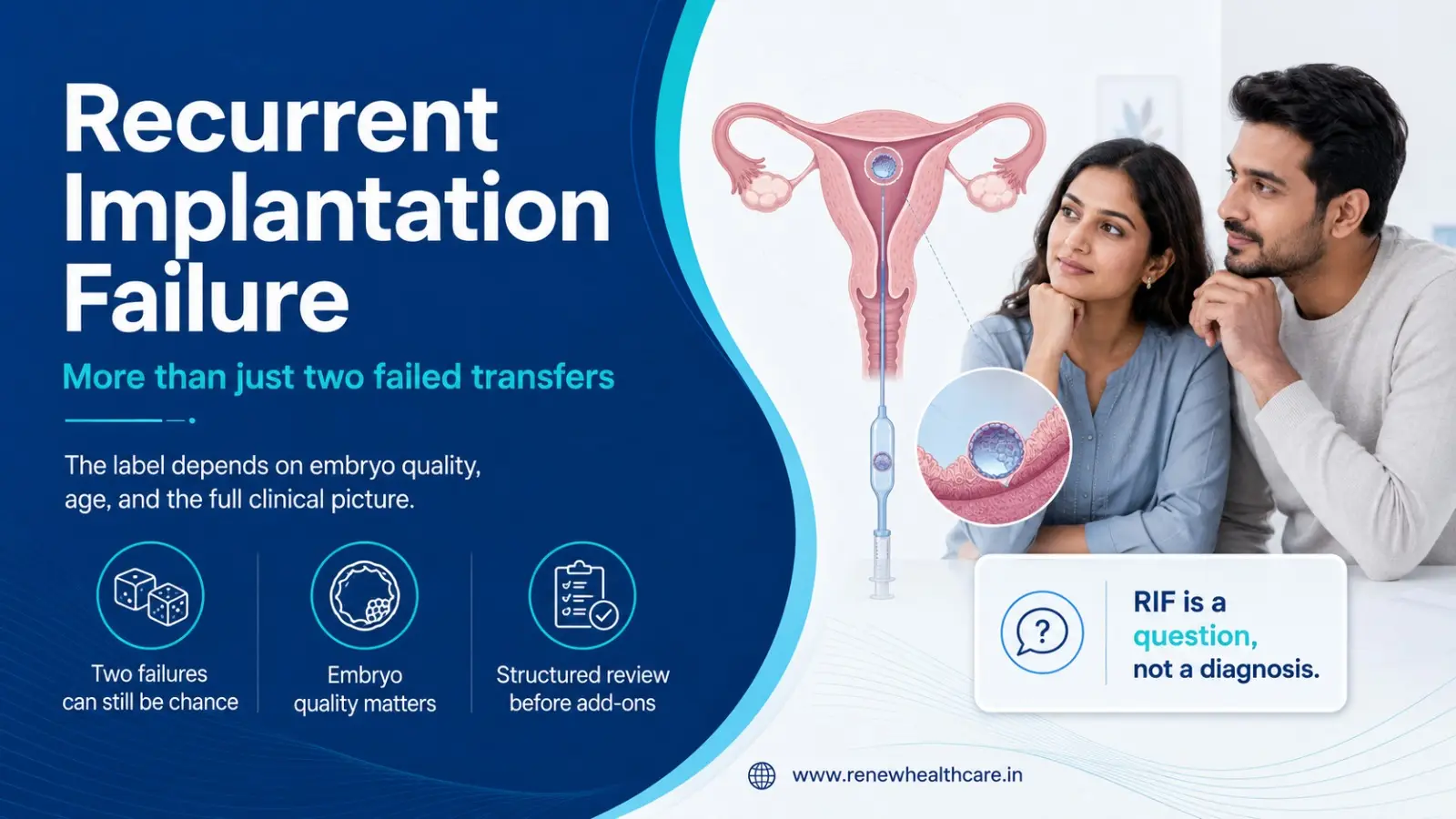
In brief: "Recurrent implantation failure" (RIF) sounds like a diagnosis. It is actually a debated label with no universally agreed definition — and that vagueness is commercially convenient, because the label unlocks a menu of expensive tests and add-ons. Before accepting it, insist on the arithmetic: implantation is probabilistic, and two or three failed transfers are often just probability doing what probability does — especially when embryo quality and age are factored in. What helps after failed transfers is a structured review, not a shopping list.
The label that arrives with a price list
The pattern repeats in clinics everywhere. Two transfers have failed. At the review appointment, the couple hears the phrase "recurrent implantation failure" — and immediately after it, a list: immune panels, NK-cell testing, endometrial receptivity testing, intralipid infusions, steroids.
Notice the sleight of hand. A descriptive label ("your transfers haven't worked yet") has been converted into a disease ("you have RIF"), and the disease now justifies products. The 2026 ASRM committee opinion on this topic exists precisely because the field recognises how loosely the label is applied.
So let us do what the sales conversation skips: define the thing properly.
The arithmetic nobody shows you
Even a genuinely good blastocyst transferred into a well-prepared uterus implants some of the time, not all of the time. Success per transfer varies with age and embryo quality, but it is never close to certain.
Run the honest numbers. If a given transfer has, illustratively, a 40 to 50% chance of working, then two consecutive failures happen to roughly a quarter to a third of couples with nothing whatsoever wrong — the way two coin flips land tails-tails a quarter of the time. Three failures still happen to a meaningful fraction of entirely normal couples.
This is the central point: repeated failure is expected behaviour of a probabilistic process, and it takes more failures than intuition suggests before "something must be wrong" becomes the better explanation than "chance". Any clinic that reaches for the RIF label after two transfers — without discussing embryo quality, age, or how many good embryos have actually been transferred — is skipping the arithmetic.
What a meaningful definition looks at
Definitions in the literature vary, but the thoughtful ones share ingredients. The question is never just "how many transfers failed?" It is:
- How many embryos, of what quality? Three failed transfers of poor-quality day-3 embryos in a 41-year-old is a completely different story from three failed transfers of good blastocysts in a 32-year-old. The first is largely an embryo-quality story; the second genuinely warrants a deeper look.
- Were the transfers technically sound? Difficult transfers, fluid in the cavity, poorly prepared linings — cycle-level explanations come before patient-level labels.
- Has anything obvious been left unexamined? An unassessed uterine cavity, an untreated hydrosalpinx, an unnoticed thyroid problem, sperm factors — the boring checklist outperforms the exotic one.
A working shorthand many specialists use: concern sharpens after failure of several good-quality embryos, with the exact threshold depending on age and context. What it is not is an automatic stamp after transfer number two.
After failed transfers: the review that actually earns its fee
Here is what a structured, evidence-minded review looks like — and none of it starts with an immune panel.
- Re-examine the embryology. Fertilisation rates, blastocyst formation, grades across cycles. A pattern of poor embryo development points towards egg or sperm factors and protocol changes — not the uterus at all.
- Look at the cavity properly — hysteroscopy or saline sonography for polyps, adhesions and septa; check for hydrosalpinx, whose fluid demonstrably reduces implantation and whose treatment demonstrably helps.
- Revisit the basics: thyroid, prolactin, vitamin D status, BMI, smoking; semen factors including DNA fragmentation in selected cases.
- Consider chromosomes where the picture fits — parental karyotypes, and a discussion of PGT-A with honest framing (the UK regulator rates it red; it has specific uses, not universal ones).
- Change something rational — protocol, transfer timing, lining preparation — rather than repeating the identical cycle a fourth time or leaping to the exotic.
And what about the famous add-ons — NK-cell tests, intralipids, IVIG, steroids, receptivity arrays? The headline: the UK regulator rates intralipids and receptivity testing among its lowest categories, IVIG and steroids red with safety concerns, and none holds a green rating. After multiple failures the desire to try something — anything — is completely human. That is precisely when the evidence question matters most: does this improve live birth, and what does it cost?
The emotional truth of repeated failure
A failed transfer is a bereavement rehearsal each time, and by the third one most couples are exhausted, poorer, and vulnerable to anyone offering an explanation — any explanation. Two things are worth saying plainly.
Unexplained is not untreatable. Many couples with several failed transfers succeed on subsequent ordinary attempts, because probability keeps operating in both directions. Cumulative success across repeated transfers keeps rising.
And a pause is a legitimate medical option. A cycle off, counselling, and a properly structured review often serve the next attempt better than an immediate, add-on-laden retry.
Frequently Asked Questions
How many failed transfers officially means RIF?
There is no official number — definitions vary, and the 2026 ASRM opinion reflects that debate. Thoughtful practice weighs the number and quality of embryos transferred against age, rather than counting transfers alone.
Is two failed transfers a reason to panic?
No. With realistic per-transfer success rates, two failures are common among couples with nothing wrong. It is a reason for a structured review, not a label.
Should I get NK-cell testing after failed transfers?
Understand first that its clinical usefulness is disputed and the associated treatments (intralipids, IVIG, steroids) rate poorly on evidence — IVIG and steroids carry safety concerns. Ask what decision the result would change before buying the test.
Could the problem be the embryos rather than my uterus?
Very often, yes — embryo aneuploidy rises steeply with age and is the single commonest reason transfers fail. This is why reviewing the embryology comes before testing the uterus for exotic conditions.
Does changing clinics help?
Sometimes — laboratories genuinely differ. But move for a reason (better embryology results, a more rigorous review), not just for motion. Take all your records; the pattern across cycles is diagnostic gold.
Will I ever be told a clear reason?
Possibly not — and that is hard. But cumulative success statistics are on the side of persistence-with-review far more than the word failure makes it feel.
The bottom line
"Recurrent implantation failure" is a question, not a diagnosis — and often the honest answer to the question is probability, plus embryo quality, plus time. After failed transfers, buy a structured review: embryology first, cavity second, basics third, rational changes fourth. Be slowest to buy the things sold fastest.
A review, not a menu
Dr. Arnab Kundu at Renew Healthcare, Ballygunge–Gariahat, Kolkata — structured post-failure reviews that start with your embryology and end with a plan, not a price list.
Book a consultation: +91 6292 269 060 | renewhealthcare.in | Renew Healthcare, 18C Mandeville Gardens, Ballygunge, Gariahat, Kolkata 700019
This article is for general education and does not replace individual medical advice. Please consult a qualified specialist about your own situation.