
Medically reviewed by Dr. Arnab Kundu, MBBS, DGO, DNB (Obs & Gynae) — Infertility Specialist, IVF Expert & Gynaecologist at Renew Healthcare, Ballygunge–Gariahat, Kolkata
Last updated: September 2026
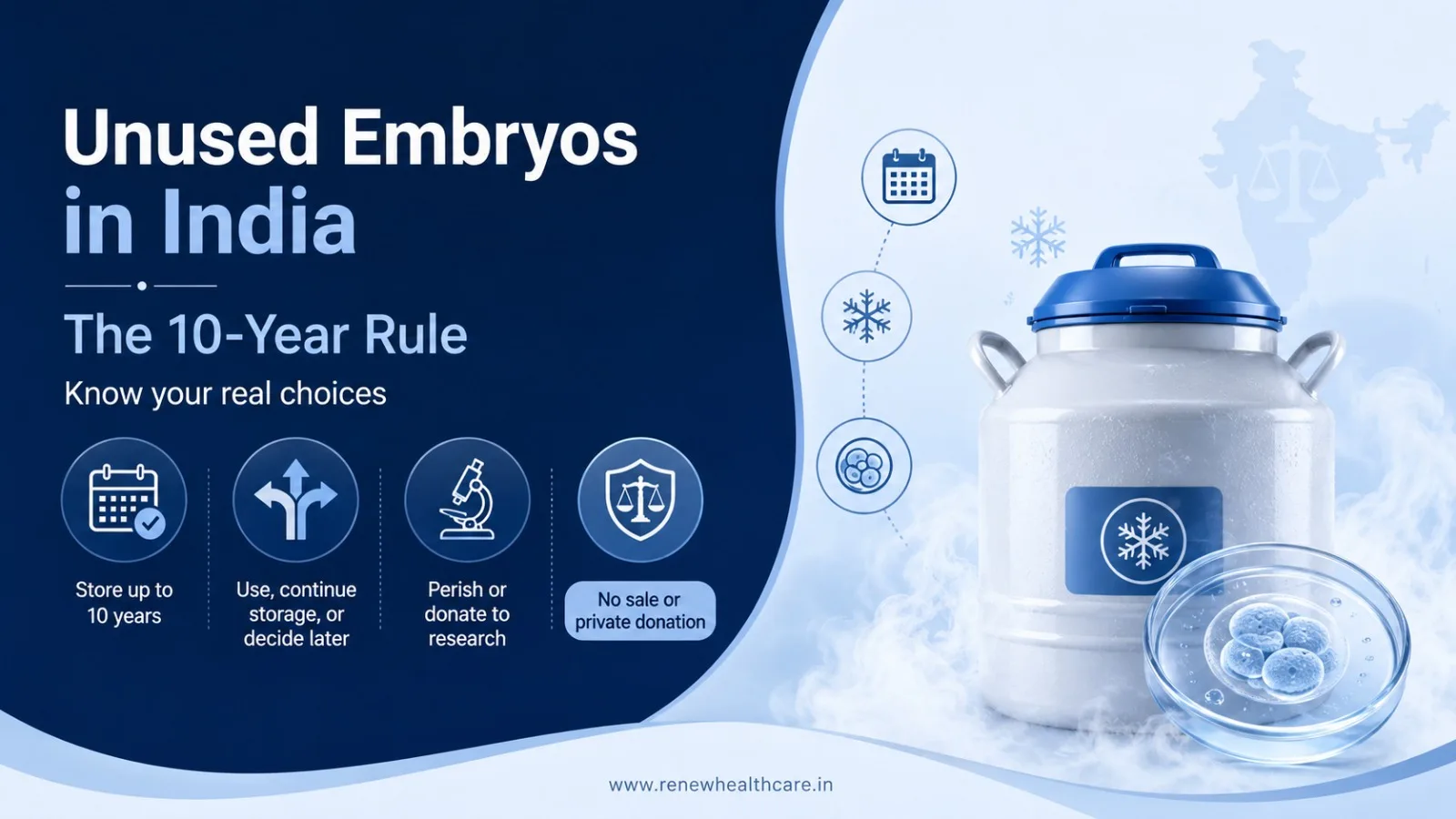
In brief: Under India's ART (Regulation) Act, 2021, frozen embryos and gametes may be stored for a maximum of ten years; after that, with your written consent, they must either be allowed to perish or be donated to a registered research organisation. Selling embryos is prohibited; moving your own embryos for personal use needs National Board permission; and cancer patients can store beyond ten years with permission. Most couples are told none of this at freezing time — and the annual storage invoice is the only reminder they ever get.
The decision you made on your busiest day
Embryo freezing usually happens at the most overloaded moment of a cycle — fresh from retrieval, mid-hope, signing a stack of consent forms. Somewhere in that stack you answered questions about storage duration, payment, and what happens to the embryos if you die or divorce.
Years later, most couples remember none of it. The embryos sit in nitrogen; an invoice arrives annually; and the family quietly avoids the topic. This article is the missing briefing — the law, the choices, and the conversations worth having before the tenth year forces them.
What the law actually says
India's ART (Regulation) Act, 2021 and its Rules govern every registered clinic. The provisions that matter to a couple with frozen embryos:
| Question | The legal position |
|---|---|
| How long can embryos stay frozen? | Not more than ten years |
| What happens after ten years? | With the couple's consent: allowed to perish, or donated to a registered research organisation |
| Can we sell or give our embryos to another couple privately? | Sale or transfer is prohibited — India's donor-gamete framework runs through registered banks, not private arrangements |
| Can we move embryos to another clinic or city for our own use? | Own-use transfer requires permission of the National Board — plan ahead; it is paperwork, not a courier booking |
| Can they be taken abroad? | Export restrictions apply; for research it is prohibited outright — anyone planning treatment overseas should raise this early |
| What if one partner dies or the couple separates? | Clinics must obtain specific written instructions in advance covering death or incapacity — this is those forms you half-remember |
| Cancer patients? | Storage beyond ten years is allowed for oncofertility patients, with National Board permission — a genuinely important, little-known protection |
Two practical notes ride on this. First, the ten-year clock and your storage payments are separate things — stopping payment does not legally resolve anything; it just creates an abandoned-embryo problem your clinic must chase. Second, clinics are required to keep records and report to the National Registry, so "the clinic will have lost track" is not a plan either.
The real decision: your four options, honestly
1. Use them
The obvious option, and worth stating properly: frozen embryos from your younger self are biologically your best embryos — vitrified embryos keep well, and a frozen transfer years later carries the implantation potential of the age at which they were made. Couples planning a second child often sit on their most valuable fertility asset without thinking of it that way.
2. Continue storing — deliberately
Storing "for now" is legitimate, with two honesty checks: the fee is real money annually (ask your clinic for its current annual storage charge in writing), and the ten-year ceiling means "for now" has a statutory endpoint. A deliberate decision reviewed every year or two beats a decade of default.
3. Allow them to perish
The option couples find hardest to say aloud — and a legitimate, legal, and for many families the right choice once their family is complete. Clinics handle this with a consent process. Couples differ enormously in how they experience this decision — for some it is administrative, for others a genuine grief — and both responses are normal. What helps most is deciding together, in an unhurried conversation at home, not in a corridor when the invoice arrives.
4. Donate to research
Where a registered research organisation is available to receive them, donation after the storage period is the Act's alternative to perishing — some couples find meaning in it. Availability is practical, not guaranteed: ask your clinic what actually exists, rather than assuming.
What is not on the menu in India: donating your embryos directly to another named couple, or selling them. The law routes third-party reproduction through registered banks and its own donor framework.
Conversations worth having this year, not in year ten
- Between yourselves: are we done having children? If the honest answer is "probably", what does that mean for the annual fee and the eventual consent?
- With your clinic: what did our original consent say about death, divorce and default? May we have a copy? What is your process at the ten-year mark?
- If you are moving cities or abroad: what does transferring our embryos actually involve, and how long does Board permission take?
- If either of you faces cancer treatment: ask about the extended-storage provision before starting therapy — it exists for exactly this.
- If you are divorcing: embryos become one of the most delicate items in any settlement; both partners' consent governs their use, and the advance directives you signed now matter enormously. Get legal advice specific to your forms.
Frequently Asked Questions
Do frozen embryos weaken over time?
Vitrified embryos are remarkably stable in storage — years in nitrogen do not meaningfully degrade them. The quality that matters was fixed on the day of freezing, at the age you were then.
We stopped paying storage fees years ago. What has happened to our embryos?
Legally, nothing can be done with them without your consent — but you have created an unresolved situation, not an exit. Contact the clinic, settle the account, and make an actual decision; silence decides nothing.
Can we donate our embryos to my sister, or to a childless couple we know?
Not under Indian law — direct embryo donation between couples is not part of the framework, which routes donor treatment through registered banks under their own rules.
What actually happens when embryos "perish"?
They are removed from storage and allowed to thaw without intervention, following your written consent — a quiet, clinical process. Some couples ask to be informed of the date; some prefer not to know. Both are accommodated.
Is ten years extendable for anyone besides cancer patients?
The oncofertility route is the Act's explicit extension. For anyone else, treat ten years as the planning horizon — which for most couples is not the binding constraint; the decision usually ripens far earlier.
We disagree with each other about what to do. Who wins?
Neither, unilaterally — use requires both partners' consent, which is precisely why the advance directives exist and why the unhurried conversation matters. Persistent disagreement is worth taking to counselling before it takes itself to lawyers.
The bottom line
Frozen embryos are the only part of fertility treatment that outlives the treatment — a standing decision renewed by every invoice. Know the four options, know the ten-year rule, dig out the consent you actually signed, and give the question one honest conversation a year. Families finish; the paperwork should not be what announces it.
Review your storage decisions properly
Dr. Arnab Kundu at Renew Healthcare, Ballygunge–Gariahat, Kolkata — storage reviews, consent walk-throughs, and unhurried counselling for the decision itself.
Book a consultation: +91 6292 269 060 | renewhealthcare.in | Renew Healthcare, 18C Mandeville Gardens, Ballygunge, Gariahat, Kolkata 700019
This article is for general education and does not replace individual medical or legal advice. Please consult a qualified specialist about your own situation.