
Medically reviewed by Dr. Arnab Kundu, MBBS, DGO, DNB (Obs & Gynae) — Infertility Specialist, IVF Expert & Gynaecologist at Renew Healthcare, Ballygunge–Gariahat, Kolkata
Last updated: September 2026
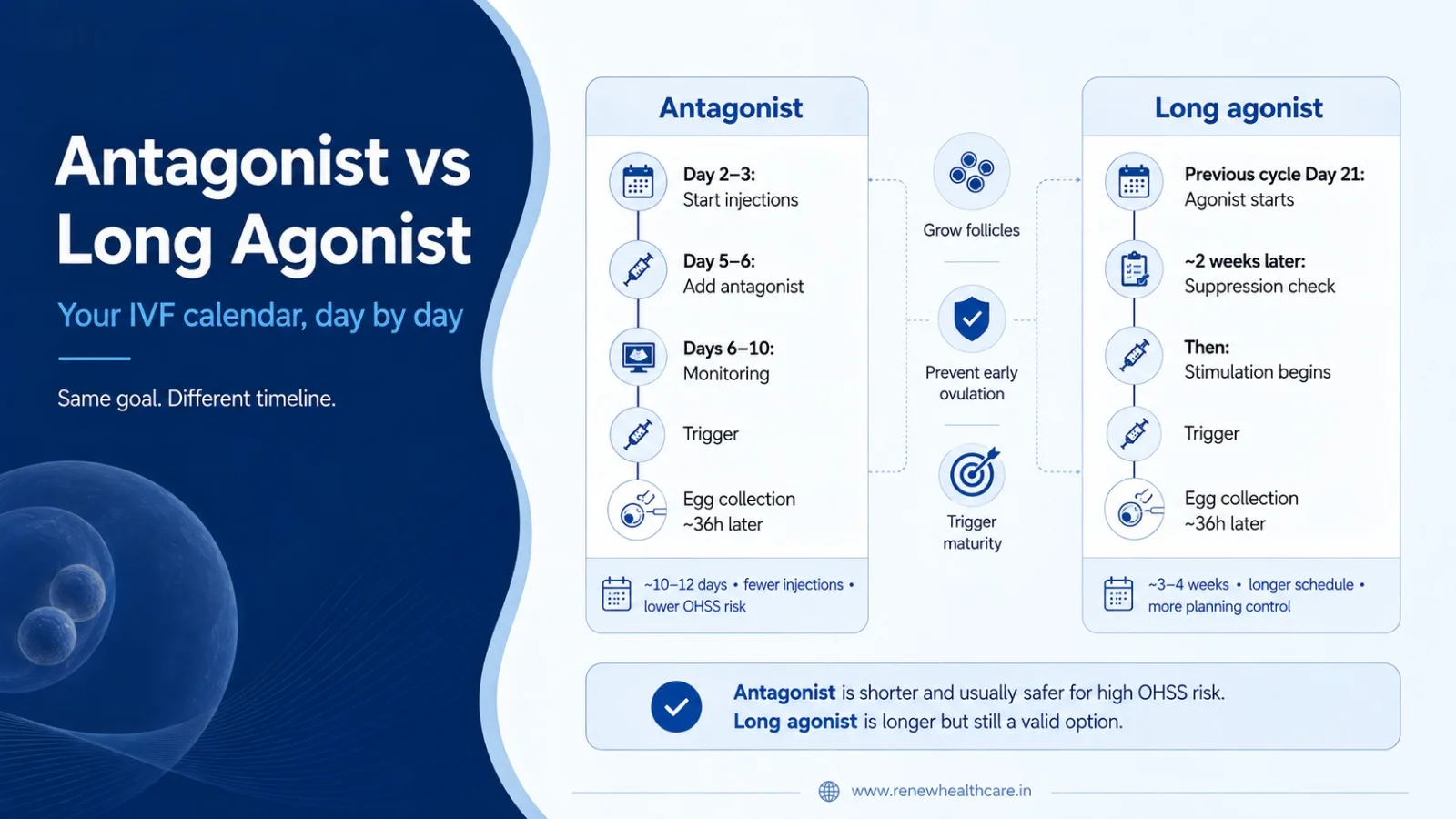
In brief: The two main IVF protocols differ mostly in how your body's own hormone surge is switched off — the antagonist protocol blocks it mid-cycle (shorter, fewer injections, and a roughly 40% lower risk of OHSS with equivalent live birth rates), while the long agonist protocol suppresses it in advance (longer, sometimes preferred in specific situations). Neither is better universally. What patients actually need — and almost never get — is a calendar. Here is one for each.
The conversation that produces no calendar
You are told: "We'll use the antagonist protocol." You nod. What you wanted to know was: how many days of injections? How many clinic visits? Which days can't I travel? When exactly is the egg collection?
Protocols are logistics as much as pharmacology — they determine your leave applications, your travel windows, and your daily routine for a month. So this article does what the consultation rarely does: lays out the day-by-day shape of each, then explains honestly how the choice is made.
First, what every protocol is trying to do
Three jobs, always the same:
- Grow multiple follicles with daily hormone injections (gonadotropins), instead of the single egg a natural cycle makes.
- Prevent premature ovulation — your brain, seeing rising oestrogen, will try to fire the eggs off early; every protocol must block that surge, and how it blocks it is the entire difference between protocols.
- Trigger final egg maturation at the chosen moment, with collection about 36 hours later.
The antagonist protocol: the modern default
Total span: roughly 10 to 12 days from first injection to egg collection.
| Days | What happens | Visits |
|---|---|---|
| Day 2–3 of period | Baseline scan and bloods; injections start | 1 |
| Days 1–5 of stimulation | Daily gonadotropin injections (self-given, small needle, at home) | — |
| Day 5–6 | Scan; antagonist injection added — this second daily injection is the block that prevents early ovulation | 1 |
| Days 6–10 | Both injections daily; scans every 2–3 days tracking follicle growth | 2–3 |
| When follicles are ready | Trigger injection at an exact evening hour | 1 |
| About 36 hours later | Egg collection, under sedation — take this day off entirely | 1 |
Why it has become the default worldwide: it is shorter, involves fewer total injections, and — the decisive point — Cochrane's review found it cuts the risk of ovarian hyperstimulation syndrome (OHSS) by around 40% with no loss of live birth rate. It also allows a safer trigger option (an agonist trigger) for women at high OHSS risk — particularly relevant in PCOS/PMOS.
The long agonist protocol: the older workhorse
Total span: roughly three to four weeks, starting in the cycle before your treatment cycle.
| Phase | What happens |
|---|---|
| About day 21 of the previous cycle | Daily agonist injections (or nasal spray) begin — these first overstimulate, then exhaust and silence your surge mechanism ("downregulation") |
| About 2 weeks later | A scan or blood test confirms suppression; a period usually arrives in this window |
| Then | Stimulation injections begin — agonist continues alongside; scans as above |
| End | Trigger, and collection about 36 hours later |
Its character: longer, more injections, deeper suppression — with slightly higher OHSS risk and a longer, more schedulable runway. Some clinics still prefer it for specific groups, and cycle scheduling is genuinely easier when dates must be fixed far ahead.
How the choice is actually made
Honest answer: for most patients it matters less than the internet suggests — live birth rates are comparable — and the decision usually turns on:
- OHSS risk: high AMH, high antral follicle count, PCOS/PMOS point strongly to the antagonist protocol, for its safety profile and trigger flexibility.
- Convenience and cost: antagonist is shorter with fewer injections.
- Scheduling: the long protocol offers more control of dates.
- Your history: how you responded last time outranks theory — a previous cycle is the most informative document you own.
- Clinic familiarity: teams run best what they run often, which is legitimate.
Variants exist — short or flare protocols, mild stimulation, DuoStim in low reserve — each with narrower niches. If a clinic proposes something other than the two mainstays, the fair question is simply: why this one, for me?
The practical calendar advice nobody writes down
- The trigger time is immovable. It is calculated backwards from your collection slot; being hours late genuinely matters. Set two alarms and have a backup person.
- Plan leave around collection day, not the whole cycle — most monitoring visits are early-morning and work-compatible; collection day is a full day off, with sedation and a required escort.
- Outstation patients: the final week is the visit-dense stretch — from around stimulation day 5 to collection, plan to be near the clinic. Earlier scans can sometimes be shared with a local gynaecologist; ask.
- Injections are learnable in one sitting. Tiny needles, pen devices, subcutaneous — most patients self-inject from day one, and the fear outweighs the reality by a wide margin.
- Expect the schedule to flex. "Scan on day 8" becoming "come back day 9" is follicles growing at their own pace, not a problem.
Frequently Asked Questions
Which protocol has better success rates?
For most patients, live birth rates are comparable — the Cochrane evidence supports the antagonist protocol's equivalence with less OHSS. Individual factors, not protocol ideology, drive the choice.
How many injections in total?
Antagonist: typically 20 to 30 over about 10 to 12 days (two daily injections once the antagonist starts). Long protocol: more, over three to four weeks. Exact counts depend on dose and response.
Are the injections painful?
They are small subcutaneous needles into the belly or thigh — most patients rate them far below their fears. Soreness and bruising at the sites is common and minor.
Can I work through an IVF cycle?
Most people do. Monitoring visits are brief and early; the non-negotiable absences are collection day (sedation — a full day, with an escort) and, by choice, transfer day.
What if I respond too strongly, or too weakly?
Doses are adjusted at each scan; that is what monitoring is for. Strong responders on antagonist protocols also have the agonist-trigger plus freeze-all safety route, which is a genuine advantage of that protocol.
My clinic chose the long protocol. Should I worry?
No — it remains a legitimate, widely used protocol, and clinic experience with it counts. The reasonable question is the same as ever: why this protocol for my situation? A good team answers specifically.
The bottom line
Antagonist: shorter, fewer injections, around 40% less OHSS, same live birth rate — the sensible modern default, and near-mandatory logic in PCOS/PMOS and high responders. Long agonist: older, longer, schedulable, still legitimate. Ask for your protocol's reason and your cycle's calendar — you are entitled to both on day one.
Get your calendar on day one
Dr. Arnab Kundu at Renew Healthcare, Ballygunge–Gariahat, Kolkata — protocol choice explained against your own reserve and history, with a written day-by-day plan before you start.
Book a consultation: +91 6292 269 060 | renewhealthcare.in | Renew Healthcare, 18C Mandeville Gardens, Ballygunge, Gariahat, Kolkata 700019
This article is for general education and does not replace individual medical advice. Please consult a qualified specialist about your own situation.