
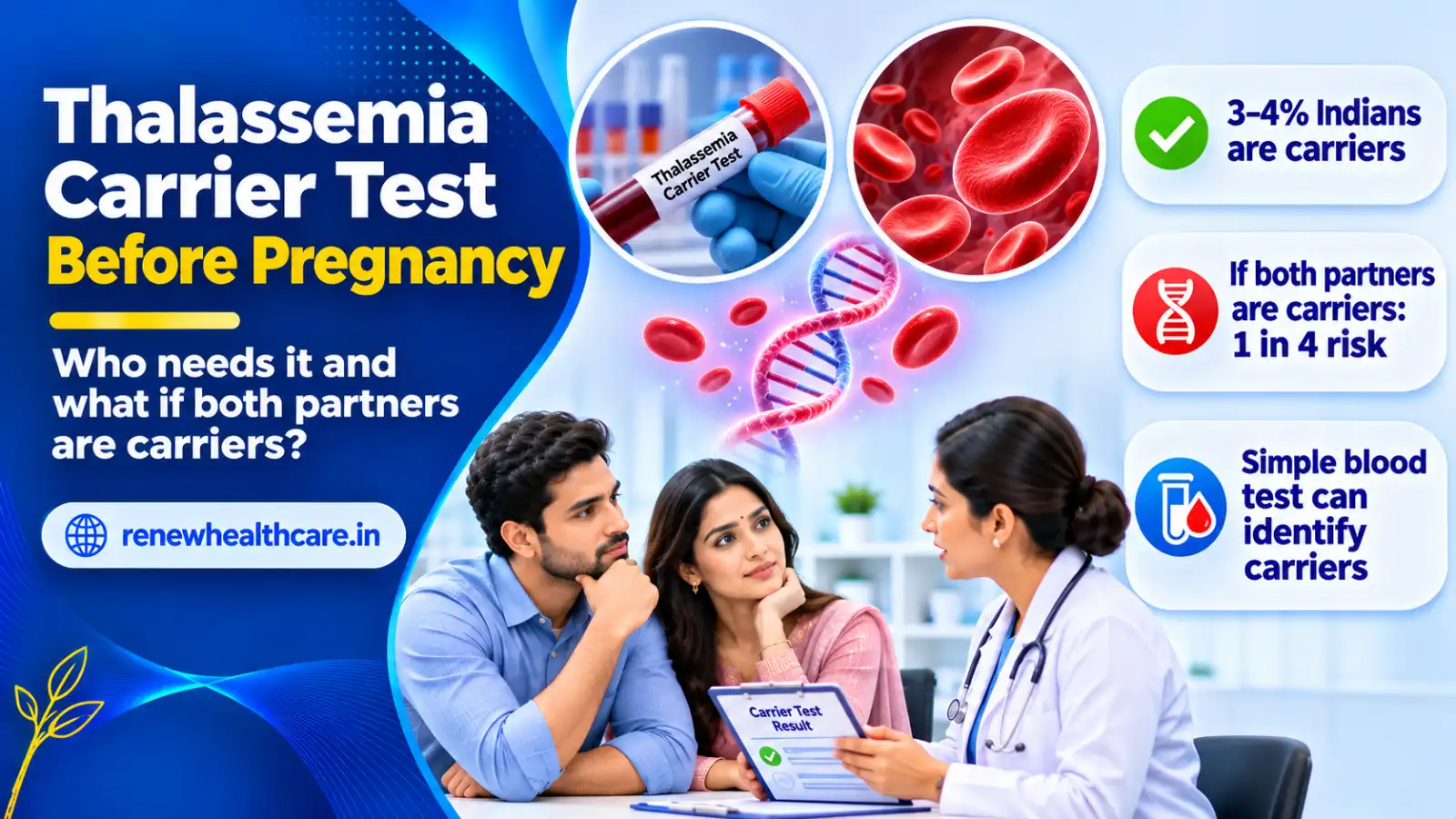
Every couple in India planning a pregnancy should consider thalassemia carrier screening. Approximately 3 to 4 in every 100 Indians carry beta-thalassemia, usually without experiencing noticeable symptoms.
If both partners are beta-thalassemia carriers, each pregnancy has a 25% chance of resulting in a child with thalassemia major. A simple blood test can help identify carriers and enable couples to make informed reproductive decisions before pregnancy.
Why Is Thalassemia Carrier Testing Important Before Pregnancy?
Most thalassemia carriers feel completely healthy and may remain unaware of their carrier status for years.
Some individuals are repeatedly diagnosed with mild anaemia and prescribed iron supplements without significant improvement. This may happen because their anaemia is associated with thalassemia carrier status rather than iron deficiency.
In some families, the first indication that both parents are carriers is the birth of a child with thalassemia major.
Identifying carrier status before pregnancy gives couples an opportunity to understand their genetic risks, receive appropriate counselling and explore available reproductive options.
Learn more about thalassemia genetic counselling and screening at Renew Healthcare.
How Common Is Thalassemia Carrier Status in India?
A systematic review and meta-analysis of Indian studies published in 2023 found that the pooled prevalence of beta-thalassemia carriers in the general population was approximately 3.74%.
However, carrier rates vary across different geographical regions and communities, with considerably higher prevalence in certain populations.
In eastern India, haemoglobin E, commonly known as HbE, is also prevalent. When haemoglobin E is inherited alongside a beta-thalassemia genetic variant, it can result in a potentially serious blood disorder.
Evidence grade: Moderate. The prevalence estimate is based on a systematic review and meta-analysis of Indian studies.
These findings highlight the importance of considering carrier screening before pregnancy, even when neither partner has symptoms or a known family history of thalassemia.
Which Tests Are Required to Identify Thalassemia Carriers?
Thalassemia carrier screening involves blood tests that assess red blood cells and different types of haemoglobin. Additional genetic testing may be recommended depending on the results.
| Test | Purpose |
|---|---|
| Complete Blood Count (CBC) | Identifies small red blood cells and reduced MCV or MCH values that may suggest thalassemia carrier status. |
| HPLC or Haemoglobin Electrophoresis | Measures haemoglobin variants, including HbA2 and HbE, and helps establish carrier status. |
| Iron Studies | Identifies iron deficiency, which can mimic or mask certain thalassemia screening findings. |
| DNA Testing | Helps identify specific genetic variants when both partners are carriers and assists in planning reproductive options. |
Complete Blood Count (CBC)
A complete blood count is often the initial investigation. Low mean corpuscular volume (MCV) and mean corpuscular haemoglobin (MCH) may raise suspicion of thalassemia carrier status.
However, a routine blood count alone cannot confirm whether an individual is a thalassemia carrier.
HPLC or Haemoglobin Electrophoresis
High-performance liquid chromatography (HPLC) and haemoglobin electrophoresis are used to analyse different types of haemoglobin present in the blood.
These investigations help identify abnormal haemoglobin patterns and establish beta-thalassemia or haemoglobin E carrier status. Additional genetic testing may be necessary in uncertain cases.
Iron Studies
Iron deficiency can produce blood test findings similar to those seen in thalassemia carriers. It may also influence certain haemoglobin measurements.
Iron studies help distinguish between iron deficiency and thalassemia-related changes in red blood cells.
Individuals should not take iron supplements solely because they have mild anaemia unless iron deficiency has been confirmed.
DNA Testing
If both partners are identified as carriers, DNA testing may be required to determine the specific genetic variants involved.
This information helps specialists assess the risk to future children and discuss appropriate reproductive options.
Should Both Partners Be Tested Before Pregnancy?
The Federation of Obstetric and Gynaecological Societies of India (FOGSI) recommends universal antenatal thalassemia screening.
Where possible, both partners should undergo screening at the same time.
If only one partner is initially tested and found to be a carrier, the other partner should be tested promptly.
Although screening during pregnancy is important, completing carrier testing before conception gives couples more time to understand their results, receive genetic counselling and consider available reproductive options.
What Happens If Both Partners Are Thalassemia Carriers?
When both partners carry a beta-thalassemia genetic variant, their child may inherit the variant from either or both parents.
For each pregnancy, the following inheritance probabilities generally apply:
| Possible Outcome | Probability |
|---|---|
| Child without thalassemia and not a carrier | 25% or 1 in 4 |
| Child who is a healthy thalassemia carrier | 50% or 2 in 4 |
| Child who inherits both variants and may develop thalassemia major | 25% or 1 in 4 |
These probabilities apply independently to every pregnancy.
Having one unaffected child does not eliminate the possibility of having an affected child in a subsequent pregnancy. Similarly, having an affected child does not mean that every future pregnancy will be affected.
Genetic counselling can help couples understand these inheritance patterns and assess their specific reproductive risks.
What Reproductive Options Are Available If Both Partners Are Carriers?
Being a thalassemia carrier does not mean that a couple cannot have children without thalassemia major.
Several reproductive options may be considered following appropriate medical evaluation and genetic counselling.
1. Natural Conception With Prenatal Diagnosis
Couples may choose to conceive naturally and undergo appropriate prenatal diagnostic testing during pregnancy.
Prenatal diagnosis can help determine whether the developing baby has inherited the genetic variants associated with thalassemia.
The timing and suitability of prenatal testing should be discussed with a qualified healthcare professional.
2. IVF With Preimplantation Genetic Testing (PGT-M)
Preimplantation Genetic Testing for Monogenic Disorders, commonly known as PGT-M, is a specialised genetic testing technique performed alongside IVF.
For couples carrying known thalassemia-related genetic variants, PGT-M may help identify embryos that are unaffected by the targeted genetic disorder before embryo transfer.
However, genetic testing does not guarantee implantation, pregnancy or the birth of a healthy baby.
Read more about preimplantation genetic testing for families at risk of thalassemia.
Further information is available on Preimplantation Genetic Diagnosis at Renew Healthcare.
3. Donor Eggs or Donor Sperm
Depending on individual circumstances, couples may also consider using appropriately screened donor eggs or donor sperm.
This may be an option for reducing the risk of passing on certain inherited genetic disorders.
The medical, genetic and personal implications of using donor gametes should be discussed with a fertility specialist and genetic counsellor.
The Importance of Genetic Counselling Before Pregnancy
Genetic counselling helps couples understand how thalassemia is inherited, interpret carrier screening results and evaluate the reproductive options available to them.
It also provides an opportunity to discuss the limitations of genetic testing, possible outcomes and individual medical circumstances before making decisions.
For families who already have a child affected by a serious inherited blood disorder, additional specialised genetic and reproductive counselling may be relevant.
The choice of reproductive approach should be based on informed decision-making, individual preferences and appropriate medical guidance.
Explore thalassemia genetic counselling at Renew Healthcare.
Ethical and Legal Considerations for Embryo Genetic Testing
Genetic testing of embryos may be used for medically appropriate indications, including the assessment of serious inherited genetic disorders such as thalassemia.
Sex determination or sex selection for non-medical purposes is prohibited under Indian law. Fertility clinics cannot offer embryo sex selection as a reproductive preference.
All genetic testing and assisted reproductive procedures must comply with applicable Indian medical, ethical and legal requirements.
Is Thalassemia Carrier Testing Required During Every Pregnancy?
Thalassemia carrier status is inherited and does not change over time.
Once a reliable and conclusive HPLC result establishing carrier status is available, the test generally does not need to be repeated during every pregnancy.
However, additional investigations may be recommended if previous results were inconclusive, relevant medical circumstances have changed or specific genetic variants need to be identified.
Your healthcare professional can review previous reports and determine whether further testing is necessary.
Frequently Asked Questions (FAQs)
1. I Am a Thalassemia Carrier. Will I Get Sick?
Most thalassemia carriers remain healthy and do not develop thalassemia major.
Some carriers may have mild anaemia or smaller-than-normal red blood cells, but they generally do not require treatment specifically for carrier status.
Iron supplements should only be taken when iron deficiency has been confirmed through appropriate investigations.
2. Can Two Thalassemia Carriers Have Healthy Children?
Yes. When both partners are beta-thalassemia carriers, each pregnancy generally has a 75% chance of resulting in a child without thalassemia major.
This includes a 25% chance of having a child who is not a carrier and a 50% chance of having a child who is a carrier.
Prenatal diagnosis and appropriate genetic testing can help identify affected pregnancies or assess embryos for the targeted genetic disorder.
3. Is a Thalassemia Carrier Test the Same as a Normal Blood Count?
No. A routine complete blood count may identify findings that suggest possible thalassemia carrier status, but it cannot establish the diagnosis on its own.
HPLC or haemoglobin electrophoresis is generally required to identify relevant haemoglobin abnormalities. Additional DNA testing may be necessary in certain circumstances.
4. Should Couples Undergo Thalassemia Carrier Testing Before Marriage?
Many medical experts recommend considering thalassemia carrier screening before marriage or pregnancy, particularly among individuals with a family history of thalassemia or those belonging to communities with a higher prevalence of carrier status.
Knowing the carrier status of both partners early provides more time for genetic counselling and informed reproductive planning.
The Bottom Line
Thalassemia carrier status is relatively common in India, frequently causes no noticeable symptoms and can be identified through appropriate blood testing.
Knowing your carrier status before pregnancy can help you understand potential genetic risks and make informed reproductive decisions.
If both partners are carriers, genetic counselling, prenatal diagnosis and appropriate assisted reproductive techniques may provide different options depending on individual circumstances.
Thalassemia carrier screening before pregnancy is an important consideration for couples planning to start a family.
References
Dharmarajan S, Kar A. Prevalence of beta thalassemia carriers in India: A systematic review and meta-analysis. Journal of Community Genetics. 2023;14(6):527–541.
Yadav SS, Panchal P, Menon KC. Prevalence and Management of β-Thalassemia in India. Hemoglobin. 2022;46(1):27–32.
Federation of Obstetric and Gynaecological Societies of India (FOGSI). Good Clinical Practice Recommendations for Universal Antenatal Thalassemia Screening, Prevention, and Diagnosis in India. 2025.
Read the FOGSI clinical recommendations.
Discussing Thalassemia Carrier Screening With a Specialist
Dr. Neha Yadav is an Obstetrician, Gynaecologist, Infertility Specialist and Associate Consultant at Renew Healthcare, Kolkata.
With over 11 years of experience, her clinical interests include infertility care, patient counselling and high-risk pregnancies.
Couples planning a pregnancy who have questions regarding thalassemia carrier screening, inherited genetic disorders or reproductive options can discuss their individual circumstances with her and receive appropriate referrals for specialised genetic counselling when required.
Doctor: Dr. Neha Yadav
Designation: Associate Consultant and Infertility Specialist
Medical Registration Number: WBMC 85882
Clinic: Renew Healthcare
Consultation Days: Monday to Saturday, Salt Lake
Clinic Address: CB 69, CB Block, Sector 1, Bidhannagar, Kolkata – 700064.
Consultation Enquiries: +91 62923 12076
Consultation Fee: Contact the clinic for details.
Website: renewhealthcare.in
Medical Disclaimer
This article is intended for general educational purposes and does not replace individual medical advice, diagnosis or treatment. Please consult a qualified healthcare professional regarding your genetic screening results, reproductive health and individual medical circumstances.