
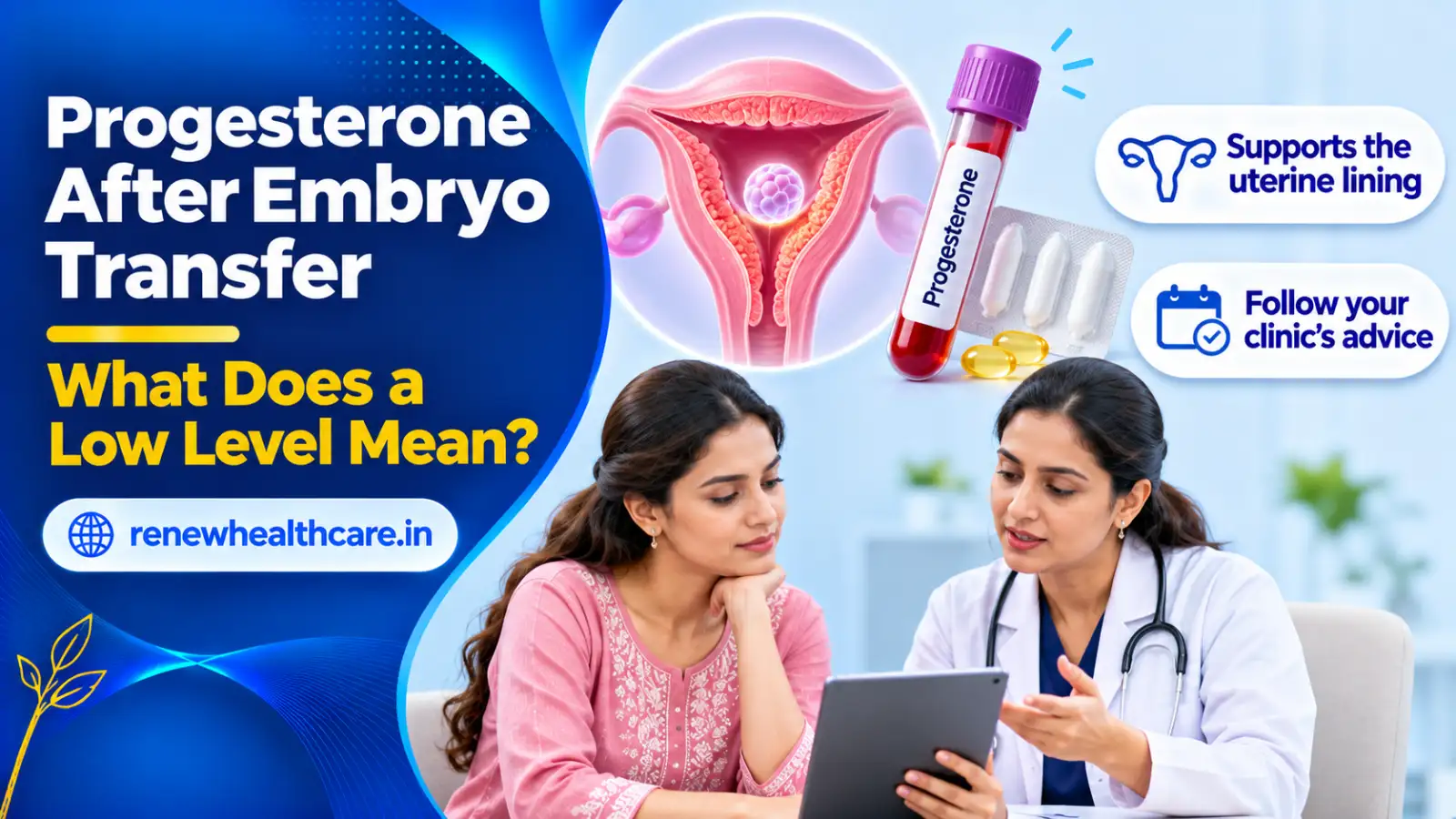
Progesterone prepares and maintains the uterine lining to support embryo implantation and early pregnancy. After IVF, additional progesterone, known as luteal phase support, helps improve pregnancy outcomes.
In hormone-programmed frozen embryo transfer cycles, low progesterone levels around the day of embryo transfer have been associated with lower ongoing pregnancy rates. Some fertility clinics recommend additional progesterone supplementation, known as rescue treatment, although further clinical trials are needed.
Why Is Progesterone Important After Embryo Transfer?
Progesterone is an essential reproductive hormone that prepares the uterine lining for embryo implantation and supports the early stages of pregnancy.
During a natural menstrual cycle, progesterone is produced by the corpus luteum, a temporary structure that forms in the ovary after ovulation.
However, ovarian stimulation during IVF can disrupt the normal function of the corpus luteum. In hormone-programmed frozen embryo transfer cycles, ovulation does not occur, meaning there is no corpus luteum to produce progesterone naturally.
For this reason, additional progesterone supplementation is commonly prescribed after IVF.
A Cochrane review of clinical trials, conducted primarily in fresh IVF cycles, found that progesterone supplementation was associated with more live births or ongoing pregnancies compared with placebo or no luteal phase support. The benefits of using human chorionic gonadotropin (hCG) alone were less clear.
Evidence grade: Low. The available trials were relatively small, although progesterone supplementation remains a standard part of IVF treatment.
Read more about the differences between fresh and frozen embryo transfer cycles.
Does the Type of Progesterone Matter After IVF?
Progesterone supplementation is available in several forms. Patients may receive different formulations depending on their treatment protocol and individual medical circumstances.
Common forms include:
Vaginal progesterone pessaries
Vaginal progesterone gels
Progesterone injections
Oral progesterone or prescribed progestogens
For most fresh embryo transfer cycles, appropriately selected progesterone formulations provide broadly similar outcomes. However, the choice of formulation may depend on the treatment protocol, patient comfort, cost and potential side effects.
Different progesterone formulations are not necessarily interchangeable, particularly in programmed frozen embryo transfer cycles.
Patients should discuss with their fertility specialist which form of progesterone has been prescribed and why it is appropriate for their treatment plan.
What Does Low Progesterone Mean After Embryo Transfer?
Low progesterone levels around the day of embryo transfer may be associated with poorer pregnancy outcomes in certain IVF treatment protocols.
However, the significance of a low progesterone result depends on the type of embryo transfer cycle, the method of supplementation and the laboratory used for testing.
| Treatment Situation | What Research Suggests |
|---|---|
| Programmed frozen embryo transfer using vaginal progesterone | Low serum progesterone around transfer day has been associated with lower ongoing pregnancy rates. |
| Additional progesterone rescue treatment | Observational studies suggest that additional injections may help improve outcomes in patients with low progesterone levels, although randomised trials remain limited. |
| Natural-cycle frozen embryo transfer | The corpus luteum produces progesterone naturally, making routine progesterone level monitoring less clearly useful. |
Studies involving programmed frozen embryo transfer cycles have used serum progesterone thresholds of approximately 9 to 11 ng/mL around the day of embryo transfer.
However, this range should not be interpreted as a universal threshold for every patient or treatment protocol.
Progesterone test results can vary between laboratories, and a single measurement should be interpreted in the context of the patient's individual treatment plan.
Evidence grade for routine progesterone testing and rescue treatment: Weak to moderate.
What Is Progesterone Rescue Treatment?
Progesterone rescue treatment refers to additional progesterone supplementation prescribed when a patient's progesterone level is considered insufficient during a fertility treatment cycle.
In some programmed frozen embryo transfer cycles, fertility specialists may recommend adding injectable progesterone when blood progesterone levels are low despite vaginal supplementation.
Observational studies have reported pregnancy outcomes comparable to, or in some cases better than, those observed in patients with normal progesterone levels following such additional supplementation.
However, randomised clinical trials remain limited, and the most appropriate rescue protocol has not been established for every patient.
Progesterone rescue treatment should only be prescribed by the treating fertility specialist. Patients should not increase their medication dose, change the formulation or introduce additional progesterone independently.
Is Progesterone Monitoring Necessary During Natural-Cycle Embryo Transfer?
During a natural-cycle frozen embryo transfer, ovulation occurs and the corpus luteum produces progesterone naturally.
This differs from a hormone-programmed frozen embryo transfer, where progesterone support is provided through medication.
Routine progesterone blood testing may therefore be less useful in some natural-cycle transfers.
Whether testing or additional supplementation is required depends on the individual's treatment protocol and the fertility specialist's assessment.
When Can Progesterone Be Stopped After Embryo Transfer?
Many fertility clinics continue progesterone supplementation until approximately 8 to 12 weeks of pregnancy, when the placenta progressively takes over progesterone production.
However, scientific evidence supporting the need to continue supplementation for this entire period is limited, and clinical practices vary.
At Renew Healthcare, the timing of progesterone discontinuation is determined on a case-by-case basis, depending on the patient's treatment protocol and individual medical circumstances.
This is particularly important in hormone-programmed frozen embryo transfer cycles, where there is no corpus luteum to provide natural progesterone support.
Patients should never stop progesterone early without consulting their treating fertility specialist.
If you are experiencing uncertainty during the period between embryo transfer and pregnancy testing, read our guide on managing the two-week wait after IVF.
What Happens to Progesterone Treatment if the Pregnancy Test Is Negative?
If the pregnancy test following embryo transfer is confirmed to be negative, progesterone supplementation is generally discontinued according to the fertility clinic's instructions, often immediately after confirmation.
Progesterone can delay the onset of menstruation. A period will generally begin within a few days after stopping the medication, although the timing may vary between individuals.
Patients should complete their scheduled pregnancy blood test and follow their clinic's instructions rather than stopping medication based on symptoms or an early home pregnancy test.
Read more about beta hCG after embryo transfer and what your pregnancy test result means.
If you experience spotting or bleeding during progesterone supplementation, you can also read our day-by-day guide to bleeding after embryo transfer.
Do not discontinue progesterone because of spotting or bleeding without medical advice.
Ethical and Legal Considerations
Sex determination and sex selection of embryos for non-medical purposes are prohibited under Indian law. Fertility clinics cannot offer embryo sex selection as a reproductive preference.
All assisted reproductive procedures must comply with applicable medical, ethical and legal requirements.
Frequently Asked Questions (FAQs)
1. I See Some Leakage After Using a Progesterone Pessary. Am I Losing the Dose?
Some vaginal discharge or medication residue after using a progesterone pessary is normal.
The presence of discharge does not necessarily mean that the medication has failed to absorb or that the entire dose has been lost.
If you are concerned about leakage or the correct administration of your medication, discuss it with your fertility specialist.
Do not take an additional dose without medical advice.
2. Will Progesterone Prevent a Miscarriage?
Progesterone supplementation after IVF helps support embryo implantation and early pregnancy.
However, progesterone cannot prevent every miscarriage, particularly those caused by chromosomal abnormalities in the embryo.
Its effectiveness depends on the underlying cause of pregnancy loss and the patient's individual medical circumstances.
3. Should Every Woman Have a Progesterone Blood Test After Embryo Transfer?
Not necessarily.
Progesterone monitoring may be particularly useful in hormone-programmed frozen embryo transfer cycles where vaginal progesterone is used for luteal phase support.
Routine testing may not provide the same benefit in every treatment protocol.
Ask your fertility specialist whether progesterone monitoring is appropriate for your cycle and how the results would influence your treatment plan.
4. Can Progesterone Delay My Period if the Pregnancy Test Is Negative?
Yes. Progesterone supplementation can delay menstruation even when pregnancy has not occurred.
After progesterone is discontinued according to the fertility clinic's instructions, menstruation generally begins within a few days.
The exact timing may vary between individuals. If your period does not begin within the expected timeframe, discuss this with your treating healthcare professional.
The Bottom Line
Progesterone supplementation after IVF is an evidence-based component of fertility treatment that helps prepare and maintain the uterine lining for embryo implantation and early pregnancy.
In hormone-programmed frozen embryo transfer cycles, monitoring progesterone levels and providing additional supplementation when levels are low may be reasonable clinical approaches, although further research is required.
The appropriate progesterone formulation, dosage, monitoring schedule and duration of treatment should be determined according to the patient's individual circumstances.
Always follow your fertility clinic's instructions and avoid changing or stopping progesterone medication without medical advice.
References
van der Linden M, Buckingham K, Farquhar C, Kremer JAM, Metwally M. Luteal phase support for assisted reproduction cycles. Cochrane Database of Systematic Reviews. 2015;(7):CD009154.
Labarta E, Mariani G, Paolelli S, et al. Impact of low serum progesterone levels on the day of embryo transfer on pregnancy outcome: a prospective cohort study in artificial cycles with vaginal progesterone. Human Reproduction. 2021;36(3):683–692.
Yazbeck C, Olivennes F, Kazdar N, Pietin-Vialle C, Gricourt S. Effect of a luteal phase rescue protocol on live birth rates in frozen embryo transfer cycles. Frontiers in Reproductive Health. 2025;7:1547939.
Di Guardo F, Midassi H, Racca A, Tournaye H, De Vos M, Blockeel C. Luteal phase support in IVF: comparison between evidence-based medicine and real-life practices. Frontiers in Endocrinology. 2020;11:500.
Discussing Progesterone Support With a Fertility Specialist
Dr. Neha Yadav is an Obstetrician, Gynaecologist, Infertility Specialist and Associate Consultant at Renew Healthcare, Kolkata.
Patients undergoing IVF or frozen embryo transfer who have questions regarding progesterone supplementation, low progesterone levels, luteal phase support or medication discontinuation can discuss their individual treatment plans with her.
Doctor: Dr. Neha Yadav
Designation: Associate Consultant and Infertility Specialist
Medical Registration Number: WBMC 85882
Clinic: Renew Healthcare
Location: Salt Lake, Kolkata
Website: renewhealthcare.in
Consultation Fee: Contact the clinic for details.
Medical Disclaimer
This article is intended for general educational purposes and does not replace individual medical advice, diagnosis or treatment. Please consult a qualified healthcare professional regarding progesterone supplementation, fertility treatment and your individual medical circumstances.