
Medically Reviewed By: Dr. Arnab Kundu, MBBS, DGO, DNB (OBY-GYN), Infertility Specialist and IVF Expert at Renew Healthcare.
In Brief: Do Uterine Polyps Always Need to Be Removed Before Pregnancy?
No, not always. Uterine polyps are commonly found in women being investigated for infertility, but randomised evidence that removing a polyp improves live birth is missing or uncertain.
Removal is usually advised for abnormal bleeding, bleeding after menopause, or a large or symptomatic polyp. These reasons apply regardless of fertility plans.
If a polyp is found before IVF or a frozen embryo transfer, ask your doctor why removal is recommended in your particular case and what evidence supports that decision.
Why Does This Question Matter?
Seeing the word “polyp” on a scan report can make you feel that you must act immediately. Some clinics recommend removing a suspected polyp before fertility treatment, while others may advise waiting.
A 2017 review noted that many clinicians recommend hysteroscopy and polyp removal before IVF or frozen embryo transfer. However, the evidence behind this practice is conflicting.
Understanding the difference between common clinical practice and proven treatment benefit can help you discuss your options with your doctor.
What Is a Uterine Polyp?
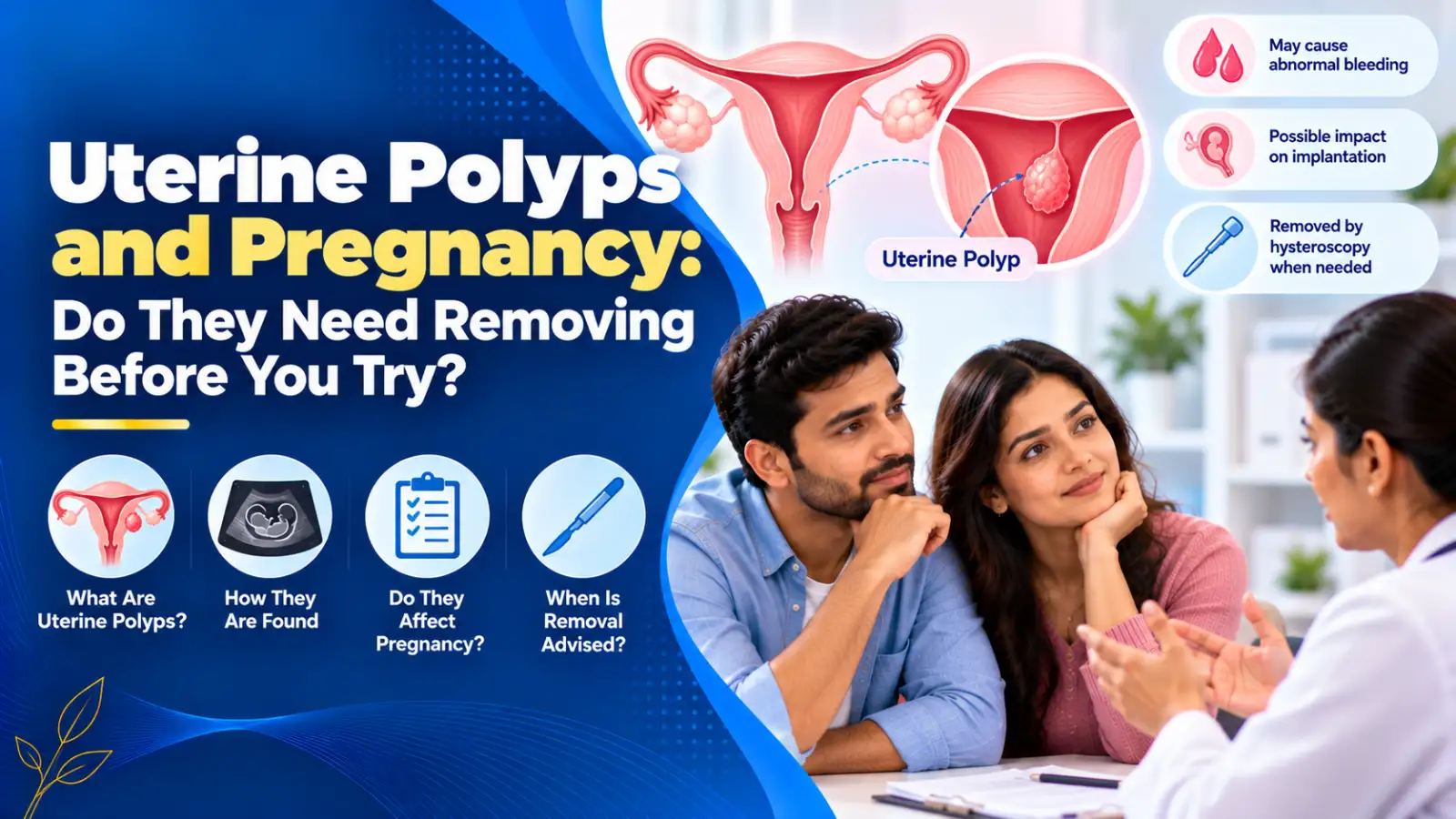
An endometrial polyp is an overgrowth of the lining of the uterus. It may be small or large and can sit on a stalk or lie flat against the uterine wall.
Most are benign, according to the source article.
A polyp may be discovered during an investigation for infertility, even if you have not noticed any symptoms.
How Common Are Uterine Polyps, and How Are They Found?
Polyps are frequently seen in women being investigated for subfertility.
A Cochrane review reported that polyps, fibroids inside the uterine cavity, a uterine septum and adhesions together are found in approximately 10–15% of women seeking treatment for subfertility. This figure refers to these uterine-cavity abnormalities collectively, not to polyps alone.
Uterine polyps can be identified using:
Transvaginal ultrasound: An ultrasound examination that can detect a suspected polyp.
Saline infusion sonography: May help clarify findings when an ultrasound scan is unclear.
Hysteroscopy: A thin camera is passed into the uterus to examine the uterine cavity. A polyp can also be removed during the same procedure.
Your doctor will determine which examination is appropriate for your situation.
Do Uterine Polyps Affect Pregnancy?
Some evidence suggests that uterine polyps may affect fertility, but the exact mechanism remains uncertain.
Possible explanations include interference with sperm movement, embryo implantation, inflammation in the uterus, or changes in how receptive the uterine lining is.
Observational studies have reported higher pregnancy rates after polyp removal. However, these are not randomised comparisons, so they do not establish that removing a polyp causes the improvement.
The relationship between polyps and fertility therefore remains an area where the evidence has important limitations.
What Does the Evidence Say About Removing Uterine Polyps?
The evidence does not establish that removing a polyp improves live birth in general.
| Question | What the evidence shows | Certainty |
|---|---|---|
| Does removing a polyp improve live birth? | The Cochrane review assessed in the source found no randomised trials of polyp removal for the specific comparison it examined. | Very uncertain |
| Does screening hysteroscopy before IVF improve live birth? | A pooled analysis found a higher live-birth rate across six trials, but the sensitivity analysis restricted to two trials with a low risk of bias found no difference. This evidence was not specific to polyps. | Low-quality evidence |
| Which option is best when a polyp is found during IVF stimulation? | There is insufficient evidence to prefer one option. A properly designed randomised trial is needed. | Insufficient evidence |
The distinction matters: studies examining routine hysteroscopy before IVF do not necessarily establish the benefit of removing a polyp specifically.
Removing a polyp has not been shown to improve live birth in general. Any benefit before IVF has not been confirmed by trials that test polyp removal on its own.
When Is Uterine Polyp Removal Usually Advised?
Polyp removal is usually advised for certain symptoms and clinical circumstances, regardless of whether you are trying to conceive.
These include:
Heavy bleeding.
Bleeding between periods.
Bleeding after sex.
Any bleeding after menopause.
A polyp that is large or causing symptoms.
Polyps can rarely contain abnormal cells, which is one reason removed tissue is usually sent for examination.
Your doctor should explain what removal is expected to address in your case and why the procedure is being recommended.
Should a Uterine Polyp Be Removed Before IVF or Frozen Embryo Transfer?
If a polyp is discovered before IVF or a frozen embryo transfer, many clinicians recommend removing it.
However, the evidence does not establish that polyp removal by itself improves live birth. The decision therefore involves weighing the procedure, recovery time and cost against a benefit that remains uncertain.
Before agreeing to removal, ask your doctor:
What is the specific reason for recommending removal?
Is the polyp causing symptoms?
What evidence supports removal in my situation?
What could happen if we wait?
How would the decision affect my planned fertility treatment?
There is insufficient evidence to recommend one universal approach for every patient. The decision should be discussed in the context of your symptoms and planned treatment.
For further reading, see our related article on adenomyosis and uterine causes of infertility. (Link to the existing article once its URL is confirmed.)
What Does Uterine Polyp Removal Involve?
Polyp removal is usually performed through a procedure called hysteroscopy.
A thin camera passes through the cervix into the uterus. Small instruments are then used to remove the polyp.
Depending on the clinic and the polyp, the procedure may be performed as a day procedure under local anaesthesia or sedation.
What Is Recovery Like After Polyp Removal?
Recovery is usually short. Light cramping or spotting may occur for a few days.
Rarely, scar tissue can form inside the uterus after the procedure, and infection is a small risk.
Contact your doctor if you experience fever, heavy bleeding or severe pain after the procedure.
The appropriate recovery advice will depend on your procedure and your clinic's instructions.
For more information about the procedure itself, see hysteroscopy and what it involves. (Link to an existing hysteroscopy article if available; the URL was not provided in the source document.)
What About the Cost and Follow-Up?
The source document does not provide a confirmed procedure price. Ask the clinic for an itemised price list before making a decision.
A follow-up scan is sometimes arranged after removal. Ask whether one is necessary in your case rather than repeating an examination or procedure without a specific reason.
Questions to Ask Your Doctor
If a uterine polyp has been identified on your scan, consider asking:
“Is this polyp causing any symptoms? What evidence supports removing it in my case, and what happens if we wait?”
You can also discuss the polyp's size and location, the symptoms you have, and whether you are planning natural conception, IVF or a frozen embryo transfer.
These questions can help you understand the reasoning behind your doctor's recommendation.
Frequently Asked Questions
1. Do all uterine polyps need to be removed before pregnancy?
No. Many small polyps cause no symptoms, and the source document reports no trial showing that removing a polyp improves live birth in general.
The decision depends on symptoms, size, location and the treatment planned. Ask your doctor to explain the reason for removal and what you can expect if you wait.
2. Can a uterine polyp cause miscarriage?
Some evidence links uterine polyps with pregnancy loss, but the relationship has not been established. The studies are mixed and largely observational, and the possible mechanisms remain uncertain.
Discuss your own medical and pregnancy history with your doctor rather than assuming that a polyp is the cause.
For related information, see our article on recurrent miscarriage tests, including the uterine check. (Link to the existing article once its URL is confirmed.)
3. How are uterine polyps found?
Transvaginal ultrasound often detects suspected polyps. Saline infusion sonography can help when the scan is unclear.
Hysteroscopy provides a direct view of the uterine cavity and allows a polyp to be removed during the same procedure. Removed tissue is usually examined under a microscope.
4. Is uterine polyp removal a major operation?
It is usually performed through the cervix using a thin camera, often as a day procedure. The type of anaesthesia depends on the clinic and the polyp.
Light bleeding or cramping for a few days is common, and most people return to normal activity quickly, according to the source document.
5. When should a polyp be removed if I am not trying to conceive?
Removal is usually recommended when there is abnormal bleeding, bleeding after menopause, or a polyp that is large or causing symptoms.
The tissue is examined afterwards. Your doctor can explain what removal is expected to address in your particular case.
6. Does removing a uterine polyp guarantee pregnancy?
No. Polyp removal does not guarantee pregnancy or live birth.
The evidence does not establish that removal changes the chance of live birth in general. Your outcome also depends on other factors, including age and the reason for infertility.
Ask your doctor what result is realistic in your situation, without relying on a promise of pregnancy.
The Bottom Line
Uterine polyps are commonly found in women being investigated for infertility, and most are benign. However, evidence that removing a polyp improves live birth is weak or missing, so removal is not automatic before pregnancy or IVF.
Removal is usually advised for abnormal bleeding, bleeding after menopause, or a large or symptomatic polyp, regardless of fertility plans.
If you are unsure whether removal is necessary, ask your doctor to explain the specific reason, the evidence supporting the recommendation and what may happen if you wait.
Talk to a Specialist at Renew Healthcare
If a polyp has been found on your scan, bring your report and symptom history to a consultation with Dr. Arnab Kundu, an infertility specialist and IVF expert at Renew Healthcare.
Your doctor can discuss whether removal is advised for your situation and explain what the available evidence does—and does not—show.
Visit Renew Healthcare to learn more about the clinic.
This article is for general education and does not replace individual medical advice. Please consult a qualified specialist about your own situation.
References
Al Chami A, Saridogan E. Endometrial polyps and subfertility. Journal of Obstetrics and Gynaecology of India. 2017;67(1):9–14. doi:10.1007/s13224-016-0929-4.
Bosteels J, van Wessel S, Weyers S, et al. Hysteroscopy for treating subfertility associated with suspected major uterine cavity abnormalities. Cochrane Database of Systematic Reviews. 2018;12. doi:10.1002/14651858.CD009461.pub4.
Kamath MS, Bosteels J, D'Hooghe TM, et al. Screening hysteroscopy in subfertile women and women undergoing assisted reproduction. Cochrane Database of Systematic Reviews. 2019;4. doi:10.1002/14651858.CD012856.pub2.
Publication note: The source document flags several clinical statements for doctor sign-off and notes that the Cochrane reviews may have newer versions. Obtain the required clinical review and update reference checks before publication. Do not add unverified prices, cancer-risk percentages or claims that polyp removal improves live birth.