
Key Takeaways
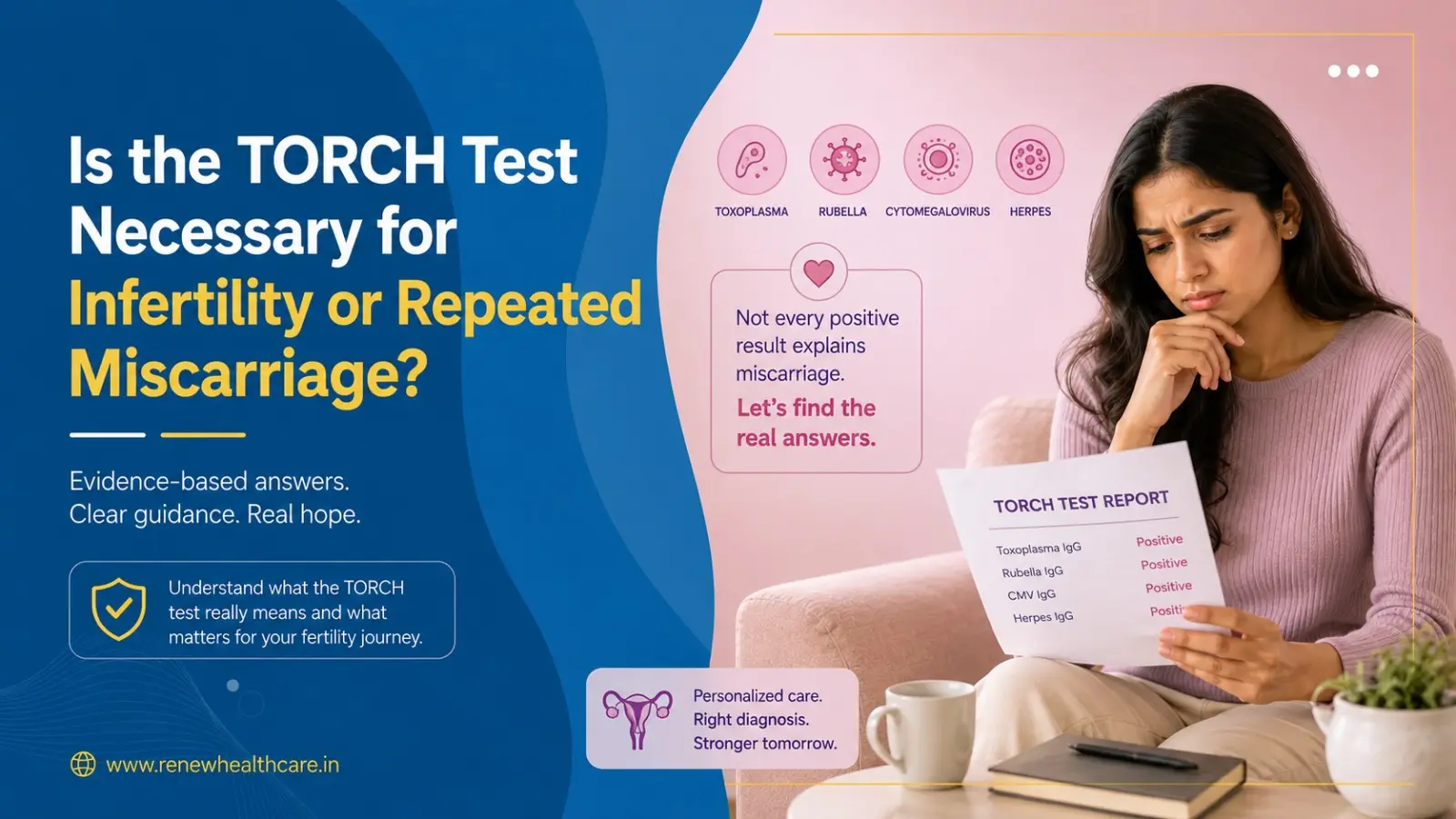
- The TORCH panel (Toxoplasma, Rubella, Cytomegalovirus, Herpes) does not cause infertility or repeated miscarriage in a healthy adult woman, and major guidelines (ASRM, ESHRE, RCOG) do not recommend it for either work-up.
- A positive IgG result almost always means past exposure and lifelong immunity — it is a sign of protection, not disease, and needs no treatment.
- The one genuinely useful piece of the panel is a rubella IgG immunity check, done once before conception — not the full four-infection panel, and not repeated testing.
- A real recurrent miscarriage work-up looks elsewhere: genetic testing of the miscarriage tissue, parental karyotyping, antiphospholipid antibody testing when indicated, uterine cavity evaluation, and thyroid/metabolic screening.
- If you've already paid for a TORCH panel, this article will help you read it correctly — and know what to ask your doctor for next.
Why This Question Matters More Than It Seems
If you're reading this, chances are you're holding a lab report, a prescription slip, or a WhatsApp message from a diagnostic centre with the words "TORCH panel" on it — and somewhere between the second miscarriage and the third round of tests, you've started to wonder: is this actually necessary, or is it just another expense on an already exhausting journey?
That is a fair question, and it deserves a direct answer rather than a reassuring shrug. Fertility and pregnancy loss are already emotionally heavy; adding tests that cannot change the plan adds cost and anxiety without adding answers. Multiple experienced Indian IVF specialists have said as much publicly, and international guideline bodies agree. This article walks through exactly why, using the same evidence a specialist would use to make this call in clinic.
What Is the TORCH Test, Exactly?
TORCH is an acronym for a group of infections historically associated with birth defects when a first-time infection occurs during pregnancy:
- Toxoplasmosis
- Other infections (sometimes including syphilis, varicella, parvovirus B19)
- Rubella
- Cytomegalovirus
- Herpes simplex virus
The test measures two types of antibodies for each infection:
- IgM — suggests a recent or active infection.
- IgG — suggests a past infection or vaccination, and generally means lifelong immunity.
The panel was designed decades ago to investigate babies born with signs of congenital infection (low birth weight, organ abnormalities, hearing or vision problems) — not to investigate why an adult woman isn't conceiving, or why she has had repeated early miscarriages. Somewhere along the way, in general practice, it got repurposed for exactly that — without the evidence to support it.
The Short Answer: What the Evidence Actually Says
For an otherwise healthy woman with infertility or recurrent miscarriage and no symptoms of acute infection, routine TORCH panel testing is not recommended by ASRM, ESHRE, or RCOG guidelines — because it does not identify a treatable cause in this population.
Can TORCH Infections Cause Infertility?
No — and the reasoning is straightforward once explained. Fertility depends on ovulation, healthy eggs and sperm, open fallopian tubes, and a normal uterine cavity. TORCH infections don't damage any of those systems in a chronic way in an adult. Having been exposed to toxoplasma as a child, or carrying lifelong CMV or HSV antibodies (as the vast majority of adults do), does not block ovulation, does not damage sperm production, and does not scar the fallopian tubes.
Can TORCH Infections Cause Repeated Miscarriage?
A single miscarriage can, in rare instances, be linked to an acute, first-episode TORCH-type infection contracted during that specific pregnancy — this is why obstetric guidelines do ask about symptoms like fever with rash during pregnancy, and why acute infection is investigated when there are clinical clues. But recurrent pregnancy loss — defined by ASRM as two or more pregnancy losses — is a different clinical question entirely, and the evidence does not support TORCH infections as a cause of it.
The One Exception: When TORCH Testing Is Useful
There are narrow, genuinely appropriate situations for this kind of testing:
- Unexplained stillbirth or intrauterine fetal death, particularly with ultrasound findings suggestive of fetal infection (growth restriction, calcifications, abnormal fluid), where no other cause has been found.
- Suspected acute maternal infection during a current pregnancy — for example, a fever-and-rash illness, or a known exposure — investigated with appropriate timing and IgM/IgG/avidity testing, ideally guided by a specialist rather than a routine panel.
- Newborns with signs suggestive of congenital infection at birth.
Outside these situations, a routine panel in an asymptomatic woman rarely changes management.
Why Positive Results Are So Common in India
Background exposure to toxoplasma and cytomegalovirus is common across much of India. That means a positive IgG is closer to the expected result than a red flag — it reflects the population you live in, not something that went wrong in your pregnancy.
The Real Work-Up for Recurrent Pregnancy Loss
If TORCH isn't the answer, what is? This is where the conversation should actually go after two or more losses. Current ASRM/ESHRE/RCOG-aligned guidance points toward:
- Genetic testing of miscarriage tissue, where the tissue is available.
- Parental karyotyping in selected couples.
- Uterine cavity evaluation — 3D ultrasound, saline sonohysterography, or hysteroscopy.
- Antiphospholipid antibody panel (APLA) when clinically indicated.
- Thyroid function and metabolic screening, including blood sugar and prolactin where relevant.
- A thorough history — timing of losses, family history, prior pregnancies, lifestyle factors — which often guides which of the above are actually needed, rather than ordering everything at once.
Notice what's absent from this list: TORCH. That absence is not an oversight in the guidelines — it's the evidence base speaking clearly.
Myth vs Fact
- Myth: "A positive TORCH IgG means I have an active infection." Fact: IgG usually means past exposure and immunity — not active disease.
- Myth: "TORCH infections are a common cause of infertility." Fact: There is no established mechanism by which past TORCH exposure impairs fertility in a healthy adult.
- Myth: "Every miscarriage needs a TORCH test to find the cause." Fact: Recurrent miscarriage guidelines direct testing toward genetics, uterine anatomy, and antiphospholipid antibodies — not TORCH.
- Myth: "If TORCH IgG is positive, I need treatment before trying again." Fact: Positive IgG, on its own, does not require treatment in a healthy, asymptomatic woman.
- Myth: "Since I already paid for it, it must have been necessary." Fact: A test's cost or popularity doesn't establish its clinical value — guideline evidence does.
- Myth: "Rubella testing and TORCH testing are the same thing." Fact: Rubella IgG immunity checking is a distinct, genuinely useful, one-time preconception test — separate from the four-infection panel.
Practical Action Checklist
- If a TORCH panel has already been ordered or done, don't panic at an IgG-positive result — bring it to a specialist for correct interpretation before assuming it's the cause.
- If TORCH hasn't been done yet and is being suggested as a first step for infertility or recurrent miscarriage, ask specifically what clinical finding is prompting it.
- If you're planning pregnancy and unsure of your rubella immunity or vaccination history, request a rubella IgG test alone — not the full panel.
- After two or more losses, ask about genetic testing of miscarriage tissue, uterine cavity evaluation, and antiphospholipid antibody testing specifically.
- Keep a simple written timeline of your pregnancy losses (dates, gestational age, any symptoms) — this history often matters more than any single test.
- Bring your existing reports to your consultation rather than repeating tests already done elsewhere.
Frequently Asked Questions
Is a TORCH test necessary before pregnancy?
Not as a full panel for a healthy woman with no symptoms. A rubella IgG immunity check alone is the part worth doing before conception.
I had a miscarriage and my TORCH IgG is positive — did TORCH cause it?
Almost certainly not. A positive IgG reflects past exposure and immunity, not an active infection capable of causing that loss.
Does a positive TORCH report mean I can't have IVF or conceive?
No. A positive IgG result does not affect eligibility for IVF or natural conception, and does not require treatment before proceeding.
My doctor prescribed medication because of my TORCH IgM result — is that normal?
IgM results need careful, specialist interpretation, as false positives are common in low-risk, asymptomatic patients. It's reasonable to ask what specific finding supports the treatment, or to seek a second opinion.
What tests should I actually get after two miscarriages?
Genetic evaluation of the pregnancy tissue (when possible), parental karyotyping, uterine cavity imaging, antiphospholipid antibody testing, and thyroid/metabolic screening — guided by your specific history.
Is TORCH testing ever indicated in fertility care?
Yes, in narrow situations — such as unexplained stillbirth with findings suggestive of congenital infection, or suspected acute infection during a current pregnancy — but not as routine screening for infertility or recurrent early miscarriage.
Why do so many clinics and labs in India still offer TORCH as a standard fertility test?
Largely due to legacy practice patterns and bundled diagnostic packages, rather than current guideline evidence. This is gradually changing as more specialists move toward evidence-based, targeted testing.
A Final Word From Dr. Neha Yadav
Every patient who walks into a fertility consultation deserves a work-up that's built around evidence, not habit — and around their actual history, not a standard package. If you've been carrying worry over a TORCH report, or wondering whether you're missing a step in your evaluation, that's exactly the kind of conversation worth having in person, where your full history and reports can be reviewed properly.
This article is for educational purposes and does not replace individualised medical advice. Please discuss your specific reports and history with your treating specialist.
References
American Society for Reproductive Medicine (ASRM). Recurrent Pregnancy Loss: A Committee Opinion. 2026 update.
ASRM. ASRM Releases First Updated Guidance on Recurrent Pregnancy Loss in Over a Decade. Press release, 2026.
National Center for Biotechnology Information (NCBI)/StatPearls. Recurrent Pregnancy Loss. Reviewed 2023.
European Society of Human Reproduction and Embryology (ESHRE). Guideline on the Management of Recurrent Pregnancy Loss.
Royal College of Obstetricians and Gynaecologists (RCOG). Green-top Guideline: Recurrent Miscarriage.
Centers for Disease Control and Prevention (CDC). Serology Testing for Rubella. Updated 2025.
Centers for Disease Control and Prevention (CDC). Rubella Vaccine Recommendations. Updated 2025.
Dr. Neha Yadav — Infertility Specialist & IVF Expert, Salt Lake, Kolkata.