
By Dr. Neha Yadav — Infertility Specialist & IVF Consultant, Salt Lake, Kolkata
Key Takeaways
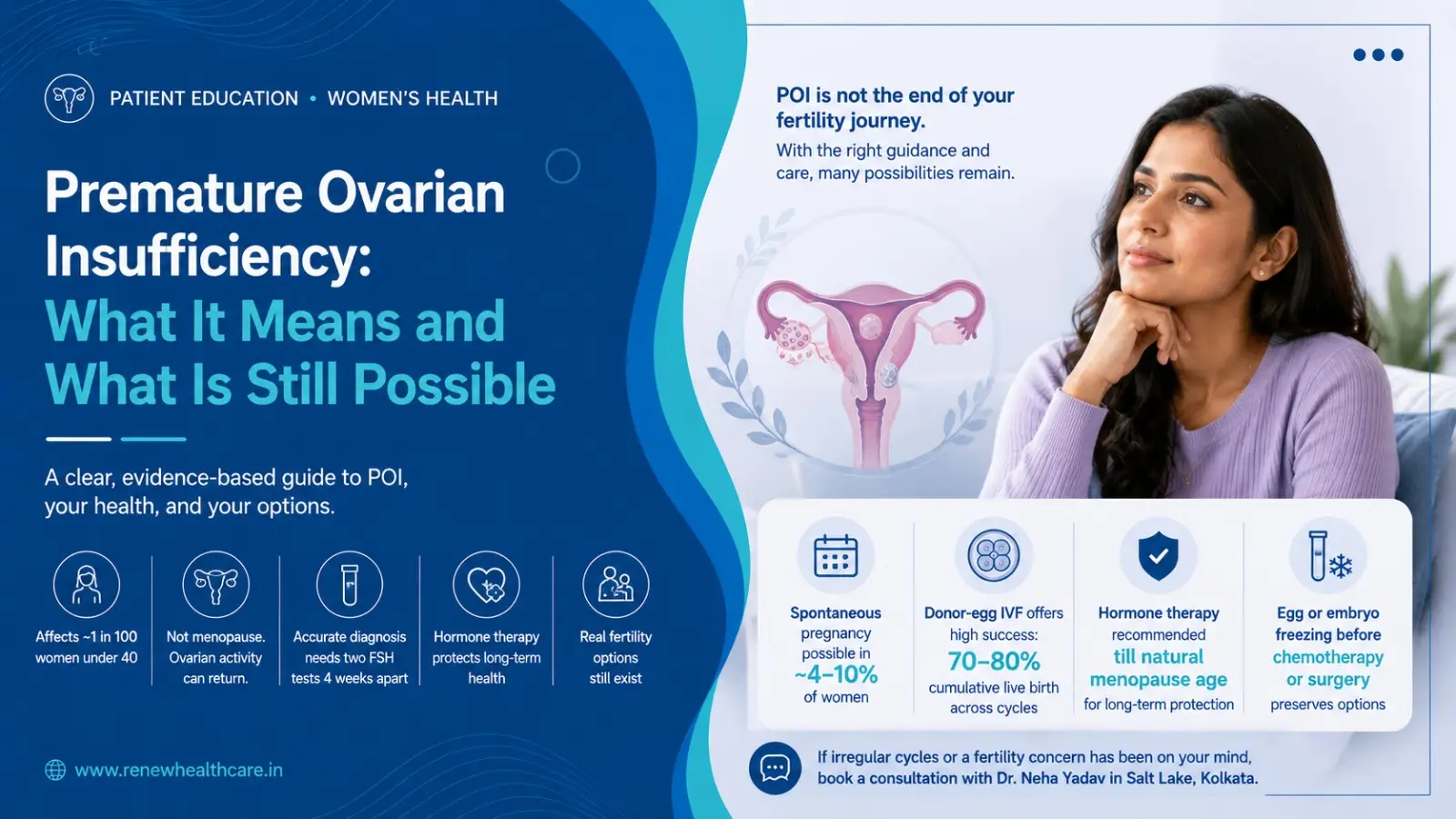
- POI affects about 1 in 100 women under 40 worldwide, per the 2024 ESHRE–ASRM–IMS joint guideline.
- POI is not menopause. Ovarian function can flicker unpredictably, and spontaneous pregnancy occurs in roughly 4 to 10% of women after diagnosis.
- Diagnosis needs two elevated FSH readings four weeks apart, plus four or more months of irregular or absent periods — not a single blood test.
- Hormone therapy protects long-term bone, heart and cognitive health, and is recommended regardless of fertility plans.
"Am I going through menopause at 29?" a patient asked me last month, her FSH report shaking slightly in her hand. It is one of the hardest sentences I hear in clinic, and one of the most misunderstood. Premature ovarian insufficiency, or POI, is real, and it does change the fertility conversation. But it rarely means the conversation is over.
What POI Actually Means
Premature ovarian insufficiency is diagnosed when periods become irregular or stop before age 40, together with a consistently raised FSH level — generally above 25 IU/L — confirmed on two tests four weeks apart. It means the ovaries are running low on responsive follicles earlier than expected. But low is not none. The 2024 ESHRE, ASRM, CREWHiRL and IMS guideline, built on 145 evidence-based recommendations, is explicit that POI behaves as a spectrum: ovarian activity can return intermittently in a meaningful minority of women, sometimes years after diagnosis.
POI vs. Menopause: Why the Difference Matters
The two are often used interchangeably, and they should not be. POI typically presents before 40, while natural menopause arrives around 45 to 55. In POI, ovarian activity is intermittent and unpredictable rather than permanently absent, which is why spontaneous pregnancy remains possible in roughly 4 to 10% of cases but is not expected after true menopause. Hormone therapy also differs in purpose: in POI it is generally recommended until the natural age of menopause, whereas menopausal hormone therapy is individualised and usually shorter-term.
What Is Still Possible: Real Fertility Options
This is the part patients most need to hear clearly, without euphemism or false comfort. If cycles still show occasional activity, monitored natural attempts can be reasonable for a defined window, and roughly 5 to 10% of women with POI do conceive naturally. When time matters more, donor-egg IVF is the option with the highest and most predictable success — cumulative live-birth rates of 70 to 80% across several cycles are well documented, and it deserves to be presented as a genuine first-line path rather than a last resort. For women diagnosed before chemotherapy or major pelvic surgery, egg or embryo freezing beforehand remains the most reliable way to preserve options. Whichever path is chosen, hormone therapy is not optional: untreated estrogen deficiency in your twenties or thirties carries real cardiovascular, bone and cognitive consequences over decades.
Myth vs. Fact
- Myth: POI means pregnancy is impossible. Natural conception still occurs in about 4 to 10% of women, and donor-egg IVF offers high success rates.
- Myth: One high FSH test confirms POI. Diagnosis requires two elevated readings four weeks apart plus four or more months of symptoms. A single result is a data point, not a verdict.
- Myth: POI and menopause are the same thing. Menopause is permanent, whereas POI can involve intermittent ovarian activity.
Frequently Asked Questions
Can stress or diet cause POI?
In most cases no identifiable cause is found — about 90% are labelled idiopathic. Genetic factors such as a Fragile X premutation, autoimmune conditions, and prior chemotherapy or ovarian surgery account for the rest.
Should I still get tested if my periods are just irregular?
Yes. Three or more irregular or missed cycles before 40 is reason enough to test, ideally with FSH, AMH and antral follicle count together.
Is HRT safe long-term?
For most women with POI, hormone therapy is recommended until the natural age of menopause, around 50 to 51, to protect bone and cardiovascular health. It is a distinct decision from menopausal HRT choices made later in life.
Will donor-egg IVF feel like giving up on my own eggs?
Many patients describe that worry, and it deserves an unhurried conversation rather than a rushed decision. We usually discuss both paths side by side, with realistic timelines for each.
When to See a Specialist
Bring your cycle history and any prior hormone reports. We will confirm the diagnosis properly, investigate the underlying cause, and build a plan around what is still possible for you, medically and reproductively.
If irregular cycles or a fertility concern has been on your mind, an evaluation at our Salt Lake, Kolkata clinic is a clear, unhurried next step. Book a consultation with Dr. Neha Yadav to discuss your options.
References
ESHRE, ASRM, CREWHiRL, IMS Guideline Group on POI. Evidence-based guideline: premature ovarian insufficiency. Human Reproduction Open / Fertility and Sterility / Climacteric, 2024–2025.
Family building after diagnosis of premature ovarian insufficiency: a cross-sectional survey in 324 women. European Journal of Endocrinology, 2023.
Restoration of fertility in patients with spontaneous POI: new techniques under the microscope. 2021.