
By Dr. Neha Yadav | Associate Consultant | Renew Healthcare
You have recently undergone egg retrieval as part of your IVF treatment. Your abdomen feels bloated, you are experiencing some discomfort, and you are wondering whether this is a normal part of recovery or something that needs medical attention.
Alternatively, perhaps you have been diagnosed with PCOS (also referred to as PMOS in the 2026 terminology used in recent research), have a high AMH level, or have been told that you may be at risk of ovarian hyperstimulation syndrome.
These concerns deserve a clear and reassuring explanation.
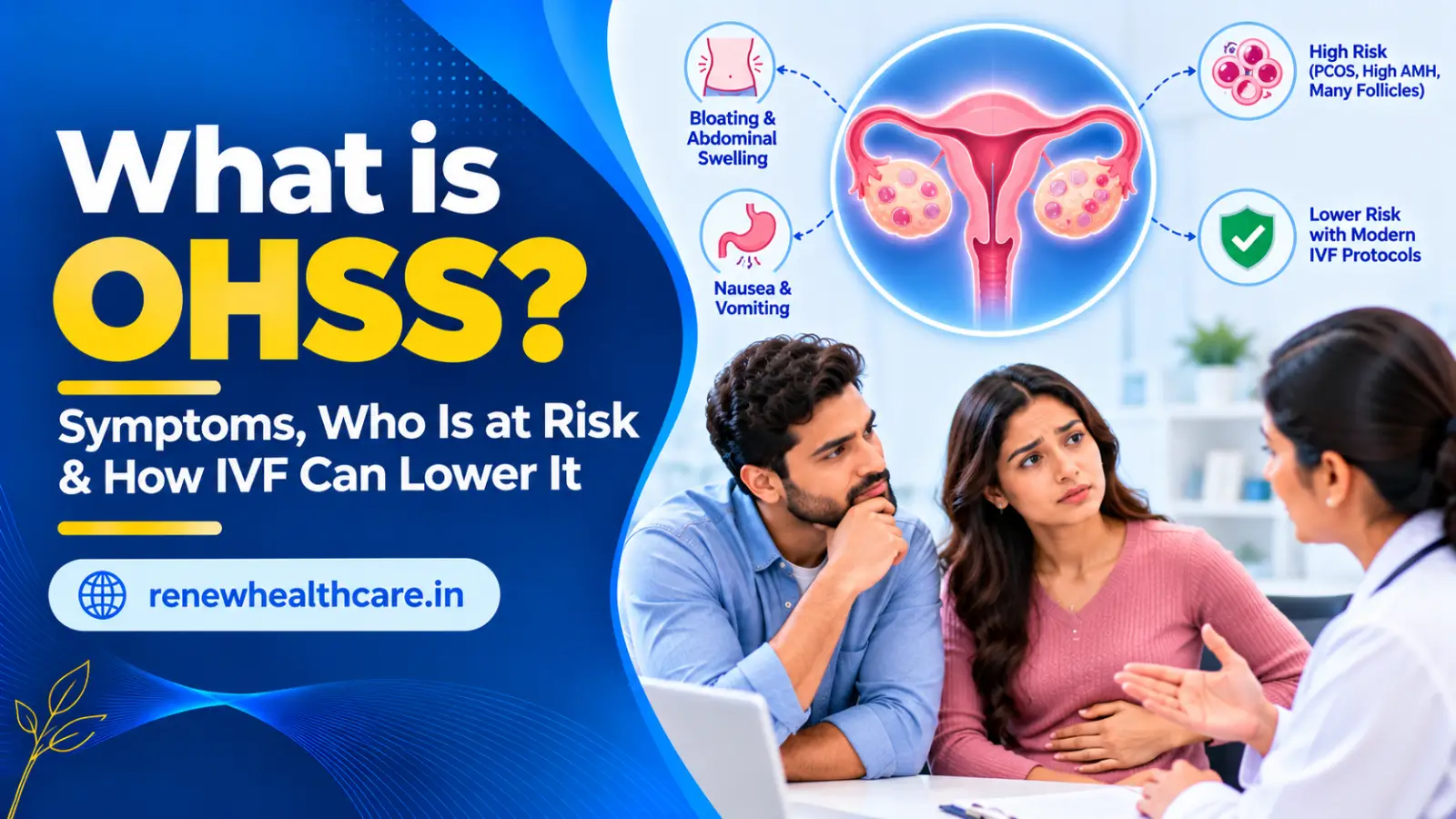
Ovarian Hyperstimulation Syndrome, commonly known as OHSS, is a potential complication of fertility treatment involving ovarian stimulation. It can range from mild abdominal bloating to more serious symptoms involving fluid accumulation, kidney function and blood clotting.
The good news is that modern IVF protocols have introduced several approaches to identify women at higher risk and reduce the likelihood of developing moderate-to-severe OHSS.
In this article, I will explain what OHSS is, how its symptoms differ by severity, who may be at higher risk, and how fertility specialists approach prevention and management.
What Is OHSS (Ovarian Hyperstimulation Syndrome)?
OHSS stands for Ovarian Hyperstimulation Syndrome. It is a reaction that can occur during fertility treatment when the ovaries respond strongly to stimulation medications.
During IVF, hormonal injections are used to encourage the ovaries to develop multiple follicles rather than the single dominant follicle usually produced during a natural menstrual cycle.
These follicles contain developing eggs.
Before egg retrieval, a trigger injection is administered to help the eggs complete their final maturation. This trigger commonly involves human chorionic gonadotrophin (hCG) or a GnRH agonist, depending on the treatment protocol.
In susceptible women, hCG can stimulate follicular cells to release a substance called vascular endothelial growth factor (VEGF).
VEGF increases the permeability of small blood vessels, allowing fluid to move from the bloodstream into surrounding tissues and the abdominal cavity.
This process can lead to:
Abdominal bloating and discomfort.
Fluid accumulation in the abdomen.
Increased concentration of blood.
Reduced urine output.
Increased risk of blood clots in more serious cases.
In severe situations, fluid may also accumulate around the lungs and affect breathing.
OHSS is therefore more than simply having enlarged ovaries after IVF stimulation. It involves changes in blood vessel permeability and fluid distribution throughout the body.
How Common Is OHSS During IVF?
The likelihood of OHSS depends on its severity and the treatment protocol being used.
According to the Royal College of Obstetricians and Gynaecologists (RCOG), mild OHSS may occur in as many as one in three IVF cycles.
Moderate-to-severe OHSS has historically been reported in approximately 1–5% of IVF cycles, according to the 2024 American Society for Reproductive Medicine (ASRM) guideline.
However, the ASRM guideline also highlights that reported rates vary because different studies use different definitions and grading systems.
Modern approaches to ovarian stimulation, trigger selection and embryo transfer have helped reduce the risk.
An expert review published in 2025 describes OHSS as a complication that has become extremely rare when modern preventive measures are used. This is an expert assessment rather than a measured universal incidence rate.
There is no verified Indian national incidence figure in the research reviewed for this article.
OHSS Symptoms: Mild, Moderate, Severe and Critical
OHSS is classified according to symptoms, ultrasound findings and blood-test results.
The exact grading boundaries may differ slightly between clinical guidelines, including those from ASRM, RCOG and the Canadian Fertility and Andrology Society.
Understanding these categories can help women recognise when symptoms need medical assessment.
1. Mild OHSS
Mild OHSS is the most common form.
Possible symptoms include:
Abdominal bloating.
Mild abdominal discomfort.
Some nausea.
Enlarged ovaries.
Blood-test results generally remain close to normal.
Mild symptoms are usually self-limiting and settle without major medical intervention.
2. Moderate OHSS
Moderate OHSS involves more noticeable symptoms.
Women may experience:
Increased abdominal swelling.
Abdominal pain.
Nausea or vomiting.
Greater discomfort than in mild OHSS.
An ultrasound may reveal free fluid accumulating inside the abdominal cavity. Blood tests may also show signs of blood concentration.
Medical monitoring becomes important at this stage.
3. Severe OHSS
Severe OHSS requires more careful medical assessment and management.
Symptoms may include:
A tense or significantly swollen abdomen.
Breathlessness.
Very little urine or dark-coloured urine.
Rapid weight gain.
Significant abdominal discomfort.
Clinical investigations may reveal ascites (fluid accumulation in the abdomen), fluid around the chest, and abnormalities in kidney or liver function.
4. Critical OHSS
Critical OHSS is rare but represents a medical emergency.
Potential complications include:
Significant fluid accumulation around the lungs.
Kidney failure.
Blood clots.
Severe breathing difficulties or respiratory failure.
Immediate medical management is necessary.
Comparison of OHSS Grades
| Grade | Symptoms | Clinical findings |
|---|---|---|
| Mild | Bloating, mild discomfort, some nausea | Enlarged ovaries; blood tests near normal |
| Moderate | Increased swelling, abdominal pain, nausea or vomiting | Abdominal fluid on ultrasound; blood concentration |
| Severe | Tense abdomen, breathlessness, reduced urine, rapid weight gain | Ascites, possible chest fluid, abnormal kidney or liver tests |
| Critical | Medical emergency | Massive chest fluid, kidney failure, blood clot or breathing failure |
Warning Signs: When Should You Contact Your Fertility Clinic?
One of the most important things women undergoing IVF should understand is the difference between expected post-treatment discomfort and symptoms that require medical attention.
Some bloating and abdominal tenderness after ovarian stimulation and egg retrieval are expected.
However, certain symptoms should never be ignored.
Contact your fertility clinic on the same day if you experience any of the following:
Weight gain of more than 1 kg within 24 hours.
Significantly reduced urine output or dark-coloured urine.
Breathlessness or chest pain.
Severe or worsening abdominal pain.
Vomiting that prevents you from drinking fluids.
A swollen or painful calf.
Dizziness or fainting.
These warning signs are particularly important because OHSS can affect fluid balance, kidney function and blood circulation.
Not everyone experiencing one of these symptoms will have severe OHSS. However, medical assessment is important to determine the cause and appropriate next steps.
Who Is at Higher Risk of Developing OHSS?
Not every woman undergoing IVF stimulation develops OHSS.
Certain characteristics before treatment and certain responses during stimulation can increase the likelihood of developing the condition.
Risk Factors Before Starting IVF
A fertility specialist may consider the following factors during the initial assessment:
1. PCOS or PMOS
Women with polycystic ovary syndrome may have a greater number of recruitable follicles and may respond strongly to ovarian stimulation.
The 2026 terminology used in the source research refers to PMOS (polyendocrine metabolic ovarian syndrome).
2. High AMH Levels
Anti-Müllerian hormone (AMH) is an important marker used when assessing ovarian reserve.
A high AMH level may indicate a greater number of recruitable follicles and a potentially stronger response to stimulation.
3. High Antral Follicle Count
A higher antral follicle count may indicate that the ovaries are likely to respond strongly to stimulation medication.
4. Previous OHSS
Women who have experienced OHSS during an earlier IVF cycle may have an increased risk of developing it again.
5. Younger Age
Younger women may have a stronger ovarian response to stimulation in some circumstances.
6. Low Body Weight
Low body weight has also been identified as a possible risk factor, although the supporting evidence is mixed.
The ESHRE guideline recommends assessing the likelihood of a high ovarian response before stimulation begins.
Risk Factors During IVF Stimulation
Risk assessment does not end after the first injection.
During treatment, doctors monitor the ovarian response through ultrasound and, when appropriate, hormone testing.
Factors that may indicate a stronger response include:
A large number of developing follicles.
High oestradiol levels on the day of the trigger.
A high number of eggs collected during retrieval.
The exact thresholds used may differ between studies and laboratories.
The overall response and individual clinical assessment are more important than relying on a single number.
How Do Modern IVF Protocols Help Prevent OHSS?
One of the major developments in IVF treatment is the ability to identify women at higher risk and modify the stimulation and transfer strategy accordingly.
The objective is not simply to collect eggs. It is to achieve an appropriate ovarian response while reducing the risk of complications.
ASRM 2024 and ESHRE's 2025 ovarian stimulation update support several approaches to OHSS prevention.
Let's understand the major strategies.
1. GnRH Antagonist Protocol
A GnRH antagonist protocol is an important option for women predicted to have a high ovarian response.
Compared with the traditional long GnRH agonist protocol, antagonist protocols have been associated with fewer OHSS cases.
A Cochrane review involving 36 trials reported an odds ratio of 0.61 for OHSS with antagonist protocols.
The review did not identify a clear difference in live-birth outcomes between the two approaches.
This makes the antagonist protocol an important consideration when planning IVF for women with an increased risk of OHSS.
Read more about the antagonist vs long agonist IVF protocol.
2. GnRH Agonist Trigger Instead of hCG
The trigger injection plays an important role in the development of OHSS.
An hCG trigger can stimulate VEGF release from follicular cells, contributing to increased blood vessel permeability.
In selected women undergoing antagonist cycles, a GnRH agonist trigger can significantly reduce OHSS risk compared with an hCG trigger.
A Cochrane review found substantially fewer OHSS cases with an agonist trigger in fresh antagonist cycles.
However, there is an important consideration.
When an agonist trigger is followed by a fresh embryo transfer, the review reported a lower live-birth rate compared with hCG triggering.
This is why an agonist trigger in women at higher risk is commonly paired with a freeze-all strategy.
3. Freeze-All Strategy
Freeze-all means that suitable embryos are frozen instead of transferring an embryo during the same stimulated cycle.
Embryo transfer is planned for a later cycle.
Why does this matter for OHSS?
A pregnancy following fresh embryo transfer produces its own hCG. This can worsen or prolong OHSS in women who have already developed an early response to stimulation.
By postponing embryo transfer, the pregnancy-related hCG rise is avoided during the immediate post-stimulation period.
A 2021 Cochrane review found that freeze-all reduced OHSS, with an odds ratio of 0.26.
The review also found that cumulative live-birth outcomes were broadly similar between fresh and frozen transfer strategies.
However, pregnancy may take longer to achieve because the transfer happens in a later cycle. Some possible differences in pregnancy-related outcomes were also reported, with varying levels of evidence.
Freeze-all is therefore a risk-reduction strategy, not an indication that the IVF cycle has failed.
4. Lower Starting Stimulation Dose
Women predicted to have a high ovarian response may benefit from an individually adjusted starting medication dose.
The purpose is to avoid excessive ovarian stimulation while still allowing appropriate follicular development.
ESHRE supports a reduced starting dose for predicted high responders, although the certainty of evidence is very low.
The appropriate dose depends on the woman's ovarian reserve, previous treatment response and clinical assessment.
5. Dopamine Agonists Such as Cabergoline
In selected women at higher risk, a dopamine agonist such as cabergoline may be used around the trigger period.
A 2021 Cochrane review found that dopamine agonists reduced moderate-to-severe OHSS, with an odds ratio of 0.32.
However, the evidence does not establish a corresponding improvement in live-birth outcomes.
This approach is particularly relevant when hCG is used in women who have an increased risk of OHSS.
6. What About Metformin?
Metformin has been studied in women with PCOS or PMOS undergoing fertility treatment.
Some research suggests it may reduce OHSS in certain settings.
However, ASRM and ESHRE advise against routinely using metformin for OHSS prevention in antagonist IVF cycles.
The evidence has not established a clear live-birth benefit, and some studies have reported additional side effects.
It should therefore not be treated as a universal OHSS-prevention medication.
Comparing OHSS Prevention Strategies
| Strategy | Effect on OHSS | Evidence consideration |
|---|---|---|
| GnRH antagonist protocol | Fewer cases of OHSS | Moderate-certainty Cochrane evidence |
| GnRH agonist trigger | Substantially fewer cases in fresh antagonist cycles | Paired with freeze-all in women at risk |
| Freeze-all | Reduces OHSS, including late-onset risk | Cumulative live birth broadly similar |
| Lower starting dose | Probably reduces OHSS in high responders | Low-certainty evidence |
| Dopamine agonist | Reduces moderate-to-severe OHSS | Live-birth effect uncertain |
| Metformin | May reduce OHSS in selected situations | Not routinely recommended in antagonist cycles |
| Coasting | May reduce OHSS in limited studies | Not recommended as a primary strategy |
The central preventive approach described in the current guidelines is an antagonist protocol, an agonist trigger when appropriate, freeze-all for women at risk, and a dopamine agonist when hCG must be used in selected high-risk situations.
Early vs Late OHSS: Why Does Timing Matter?
OHSS does not always develop at the same time.
Doctors generally distinguish between early-onset and late-onset OHSS.
Early-Onset OHSS
Early OHSS generally begins around four to seven days after the trigger injection.
It is primarily associated with the stimulation and trigger used during IVF.
In many cases, symptoms gradually improve with the onset of menstruation if pregnancy does not occur.
Late-Onset OHSS
Late OHSS generally begins nine days or more after the trigger injection.
It is associated with the body's own hCG production following pregnancy.
Because pregnancy produces additional hCG, late OHSS can become more severe and may last longer.
This explains why some women experience worsening abdominal bloating during the second week after egg retrieval, particularly after a fresh embryo transfer.
An agonist trigger helps reduce much of the early risk, while freeze-all helps reduce the pregnancy-related late risk.
The timing definitions may differ slightly between clinical guidelines, particularly when calculated from egg retrieval rather than the trigger injection.
What Happens If OHSS Develops? Treatment and Management
If OHSS develops, treatment depends on its severity and the woman's overall condition.
Mild OHSS is usually self-limiting and may be managed at home with medical guidance and an appropriate monitoring plan.
Moderate and severe OHSS require closer clinical supervision and may need outpatient or hospital-based supportive care.
Managing Mild OHSS
For mild symptoms, the management plan may include:
Drinking according to thirst rather than forcing large quantities of water.
Monitoring urine output.
Using paracetamol for pain when advised by the doctor.
Avoiding ibuprofen and other anti-inflammatory medicines because they may place additional strain on the kidneys.
Gentle movement to help reduce the risk of blood clots.
Avoiding sexual intercourse and high-impact exercise while the ovaries remain enlarged.
When Hospital Management Is Required
Hospital admission may be considered when:
Pain cannot be adequately controlled.
Vomiting prevents adequate fluid intake.
Symptoms are worsening.
Kidney function or other clinical findings require closer monitoring.
In selected cases, fluid may be drained from the abdominal cavity.
Heparin injections may also be used to reduce blood-clot risk in severe OHSS or in women admitted to hospital.
The management plan must be individualised according to symptoms, investigations and clinical assessment.
Can You Still Do IVF If You Have PCOS or High AMH?
Yes.
Having PCOS or a high AMH level does not automatically mean that IVF is unsuitable.
These factors indicate that your ovaries may respond more strongly to stimulation, so your fertility specialist needs to consider an appropriate protocol.
Depending on your individual risk assessment, the treatment plan may include:
A GnRH antagonist protocol.
An appropriately adjusted starting stimulation dose.
Careful ultrasound and hormone monitoring.
A GnRH agonist trigger when appropriate.
Freeze-all embryo transfer when the risk is high.
A strong ovarian response can also mean that a good number of eggs are available for the IVF cycle.
The important consideration is managing the response rather than avoiding treatment altogether.
You can also read our guide on trying to conceive naturally with PCOS and learn more about high AMH and fertility.
Questions to Ask Your Fertility Specialist Before IVF
Before starting an IVF cycle, it is reasonable to understand your individual OHSS risk and the preventive measures being considered.
Here is one important question to ask:
"What is my OHSS risk on this protocol, and what is the plan if my oestradiol runs high?"
You may also discuss:
Do my AMH level and antral follicle count suggest that I may respond strongly to stimulation?
Should I follow an antagonist protocol?
What type of trigger injection is appropriate for my situation?
If my response is very high, should we consider freezing all suitable embryos?
What symptoms should make me contact the clinic immediately?
Who should I contact if symptoms worsen outside normal clinic hours?
Understanding these details before treatment can help you recognise the warning signs and know what to expect.
Frequently Asked Questions About OHSS
1. How long does OHSS last after egg retrieval?
Most mild OHSS symptoms generally improve within seven to ten days and, when pregnancy does not occur, often settle by the time the next menstrual period arrives.
Late-onset OHSS, which is associated with pregnancy-related hCG, may begin nine days or more after the trigger and can last several weeks.
2. Is bloating after egg retrieval always OHSS?
No. Some abdominal bloating and tenderness are expected after ovarian stimulation and egg retrieval.
OHSS involves more than ordinary post-procedure discomfort. It is associated with fluid leakage into the abdomen and changes in blood-test findings.
Steady improvement is reassuring, but rapid weight gain, reduced urine output, breathlessness or severe abdominal pain should prompt same-day medical assessment.
3. Can I still undergo IVF if I have PCOS or high AMH?
Yes. PCOS and high AMH may increase the likelihood of a strong ovarian response, but they do not automatically rule out IVF.
An antagonist protocol, an adjusted starting dose, an appropriate trigger and freeze-all may be considered depending on the individual's risk.
4. Does an agonist trigger reduce my chance of having a baby?
The answer depends partly on the embryo transfer strategy.
An agonist trigger followed by fresh embryo transfer was associated with lower live-birth outcomes in the Cochrane review.
However, when suitable embryos are frozen and transferred in a later cycle, the OHSS risk is reduced substantially, and cumulative live-birth outcomes were broadly similar in another Cochrane review.
5. Does OHSS harm the eggs or embryos?
OHSS is primarily a reaction involving the mother's blood vessels, driven by follicular cells and hCG.
The RCOG patient information leaflet states that there are no known risks to a baby's development from OHSS itself. However, pregnancy-related complications such as pre-eclampsia and early birth may be more likely in some circumstances.
Individual pregnancy monitoring remains important.
6. Is OHSS a reason to avoid IVF?
No. OHSS risk is something that should be assessed and managed as part of IVF planning.
Modern stimulation protocols and embryo transfer strategies have made it possible to reduce the risk, particularly for women identified as high responders before treatment.
Final Thoughts: Understanding OHSS and Making Informed IVF Decisions
OHSS is an important complication to understand before undergoing IVF, particularly if you have PCOS, high AMH, a high antral follicle count or a history of a strong ovarian response.
However, being at higher risk does not automatically mean that you cannot undergo fertility treatment.
The most important step is identifying the risk early and selecting an appropriate stimulation, trigger and embryo transfer strategy.
Mild symptoms are often temporary, but certain warning signs require prompt medical assessment.
If you are preparing for IVF, discuss your individual OHSS risk with your fertility specialist before the first stimulation injection. Understanding the treatment plan, knowing the warning signs and having a clear monitoring pathway can make the process more informed.
About the Author
Dr. Neha Yadav
Associate Consultant
Renew Healthcare
Dr. Neha Yadav is part of the fertility and women's healthcare team at Renew Healthcare. Her clinical work includes obstetrics, gynaecology and infertility care.
View Dr. Neha Yadav's profile.
Medical Disclaimer
This article is intended for general educational purposes and does not replace individual medical advice, diagnosis or treatment. Symptoms following IVF stimulation or egg retrieval should be assessed by a qualified healthcare professional when concerning. Always follow the instructions of your treating fertility specialist.
Sex determination or selection is a criminal offence in India under the PCPNDT Act, 1994 and ART Act, 2021, Section 26, and is not offered.
AI disclosure: This article was drafted with AI assistance and must be reviewed, edited and approved for publication by the named doctor, with verified qualifications and registration details, in accordance with applicable NMC guidelines.
References
Teede HJ, Khomami MB, Morman R, et al. Polyendocrine metabolic ovarian syndrome, the new name for polycystic ovary syndrome: A multistep global consensus process. The Lancet. 2026;407(10545):2329–2339. https://doi.org/10.1016/S0140-6736(26)00717-8
Practice Committee of the American Society for Reproductive Medicine. Prevention of moderate and severe ovarian hyperstimulation syndrome: A guideline. Fertility and Sterility. 2024;121(2):230–245. https://doi.org/10.1016/j.fertnstert.2023.11.013
Ata B, Humaidan P. Ovarian hyperstimulation syndrome — a complication of the past. Reproductive BioMedicine Online. 2025;50(4):104792. https://doi.org/10.1016/j.rbmo.2024.104792
ESHRE Guideline Group on Ovarian Stimulation; Ata B, Bosch E, Broer S, et al. ESHRE guideline: Ovarian stimulation for IVF/ICSI: An update in 2025. Human Reproduction. 2026;41(4):498–514. https://doi.org/10.1093/humrep/deag018
Royal College of Obstetricians and Gynaecologists. Ovarian hyperstimulation syndrome: Patient information leaflet. July 2016. https://www.rcog.org.uk/for-the-public/browse-all-patient-information-leaflets/ovarian-hyperstimulation-syndrome-patient-information-leaflet/
Al-Inany HG, Youssef MA, Ayeleke RO, et al. Gonadotrophin-releasing hormone antagonists for assisted reproductive technology. Cochrane Database of Systematic Reviews. 2016;(4). https://doi.org/10.1002/14651858.CD001750.pub4
Youssef MA, Van der Veen F, Al-Inany HG, et al. Gonadotropin-releasing hormone agonist versus HCG for oocyte triggering in antagonist-assisted reproductive technology. Cochrane Database of Systematic Reviews. 2014;(10). https://doi.org/10.1002/14651858.CD008046.pub4
Zaat T, Zagers M, Mol F, et al. Fresh versus frozen embryo transfers in assisted reproduction. Cochrane Database of Systematic Reviews. 2021;(2). https://doi.org/10.1002/14651858.CD011184.pub3
Tang H, Mourad SM, Wang A, et al. Dopamine agonists for preventing ovarian hyperstimulation syndrome. Cochrane Database of Systematic Reviews. 2021;(4). https://doi.org/10.1002/14651858.CD008605.pub4
Tso LO, Costello MF, Albuquerque LET, et al. Metformin treatment before and during IVF or ICSI in women with polycystic ovary syndrome. Cochrane Database of Systematic Reviews. 2020;(12). https://doi.org/10.1002/14651858.CD006105.pub4
D'Angelo A, Amso NN, Hassan R. Coasting (withholding gonadotrophins) for preventing ovarian hyperstimulation syndrome. Cochrane Database of Systematic Reviews. 2017;(5). https://doi.org/10.1002/14651858.CD002811.pub4
Buckett W, Sylvestre C, Liu K, et al. Management of moderate and severe ovarian hyperstimulation syndrome: A Canadian Fertility and Andrology Society clinical practice guideline. Reproductive BioMedicine Online. 2026;52(6):105541. https://doi.org/10.1016/j.rbmo.2026.105541