
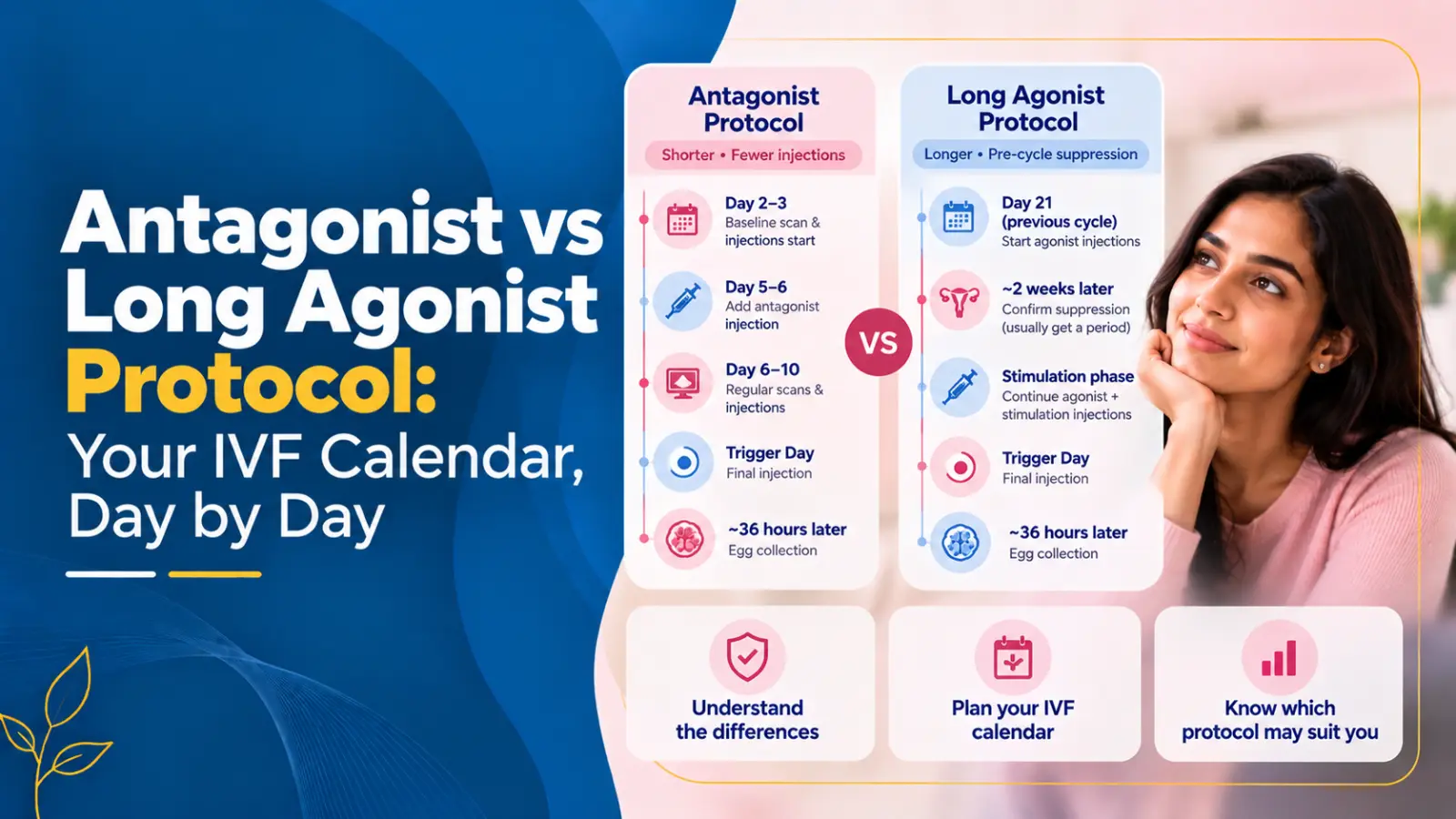
When you start IVF, one of the first things you may hear is: “We’ll use the antagonist protocol” or “We’ll use the long agonist protocol.”
But what does that actually mean?
How many days will you need injections? How often will you visit the clinic? When will egg collection happen? Can you travel or work during the cycle?
The two protocols mainly differ in when and how they prevent premature ovulation. The antagonist protocol generally starts within the treatment cycle, while the long agonist protocol begins earlier and suppresses the body's hormone signalling before stimulation starts. 25 - Antagonist vs Long Protoco…
Neither protocol is universally appropriate for everyone. Your ovarian reserve, previous IVF response, OHSS risk, scheduling needs and your clinic's experience all matter.
First: What Is Every IVF Protocol Trying to Do?
Regardless of the protocol, IVF stimulation has three main goals:
- Grow multiple follicles using daily gonadotropin injections.
- Prevent premature ovulation while the follicles are developing.
- Trigger final egg maturation at a carefully calculated time, followed by egg collection approximately 36 hours later. 25 - Antagonist vs Long Protoco…
The main difference between these protocols is how and when the premature hormone surge is controlled.
Antagonist Protocol: The Shorter IVF Calendar
The antagonist protocol usually takes approximately 10–12 days from the first injection to egg collection. 25 - Antagonist vs Long Protoco…
Day 2–3 of your period
You typically have:
- A baseline ultrasound scan
- Blood tests
- Your stimulation injections begin
This is generally the starting point of the treatment cycle.
Days 1–5 of stimulation
You take your daily gonadotropin injections.
These injections stimulate multiple follicles to grow rather than allowing only one dominant follicle to develop as in a natural cycle.
Around Day 5–6
An antagonist injection is added.
Its purpose is to prevent the natural hormone surge that could otherwise cause premature ovulation. 25 - Antagonist vs Long Protoco…
Days 6–10
You generally continue:
- Stimulation injections
- Antagonist injections
Ultrasound monitoring is performed every few days to track follicle growth and determine when the follicles are ready. 25 - Antagonist vs Long Protoco…
Trigger Day
Once the follicles are ready, you receive the trigger injection at a specific time.
Timing matters because the egg collection is planned around that injection.
Approximately 36 hours later
Egg collection takes place.
This is the day you should plan to take off from work because the procedure is performed under sedation and you will need an escort. 25 - Antagonist vs Long Protoco…
Long Agonist Protocol: The Longer IVF Calendar
The long agonist protocol usually takes around 3–4 weeks and begins during the cycle before stimulation. 25 - Antagonist vs Long Protoco…
Around Day 21 of the Previous Cycle
An agonist injection or nasal spray is started.
The initial effect stimulates the hormone pathway before subsequently suppressing it. This process is called downregulation. 25 - Antagonist vs Long Protoco…
Approximately Two Weeks Later
A scan and blood test are performed to confirm that suppression has occurred.
A period will usually arrive around this stage. 25 - Antagonist vs Long Protoco…
Stimulation Begins
Once suppression is confirmed, stimulation injections begin.
The agonist continues alongside stimulation, with ultrasound monitoring used to follow follicular development. 25 - Antagonist vs Long Protoco…
Trigger and Egg Collection
Once the follicles are ready, the trigger is administered and egg collection takes place approximately 36 hours later.
Antagonist vs Long Agonist: Side-by-Side
| Antagonist Protocol | Long Agonist Protocol | |
|---|---|---|
| Approximate duration | 10–12 days | 3–4 weeks |
| When treatment starts | Usually Day 2–3 | Previous cycle |
| Suppression | Added during stimulation | Started in advance |
| Injections | Generally fewer | Generally more |
| Monitoring | Several scans | Several scans |
| Scheduling | Shorter treatment window | Longer, more schedulable |
| Egg collection | ~36 hours after trigger | ~36 hours after trigger |
The exact schedule can vary depending on how your ovaries respond during monitoring. 25 - Antagonist vs Long Protoco…
Which Protocol Is Better?
There isn't one protocol that is universally better for every patient.
The source notes that live-birth rates are generally comparable, while the choice depends on factors such as OHSS risk, convenience, scheduling, previous treatment response and clinic experience. 25 - Antagonist vs Long Protoco…
For example, patients with a high risk of ovarian hyperstimulation syndrome (OHSS), including those with high AMH, high antral follicle count or PMOS, may be considered for an antagonist approach because of its safety profile and trigger flexibility. 25 - Antagonist vs Long Protoco…
On the other hand, the longer protocol may still be selected in specific situations, particularly when greater scheduling control is useful. 25 - Antagonist vs Long Protoco…
Your previous IVF response is also valuable information. How your ovaries responded during a previous cycle can help your fertility team plan the next one. 25 - Antagonist vs Long Protoco…
How Much Time Should You Take Off Work?
You may not need to take your entire IVF cycle off.
Most monitoring appointments are relatively brief and are often scheduled in the morning. However, egg collection is different.
You should plan to take the collection day off because of sedation and the need for an escort. 25 - Antagonist vs Long Protoco…
If you live outside the city where your IVF clinic is located, the final part of stimulation can require more frequent visits. Planning to stay closer to the clinic from around stimulation Day 5 until egg collection may make the process easier. 25 - Antagonist vs Long Protoco…
What About the Trigger Injection?
The trigger injection is one of the most time-sensitive parts of an IVF cycle.
Your doctor calculates the trigger time based on the planned egg collection.
Being late can affect the timing of egg maturation, so don't treat the trigger time as an approximate appointment. Set reminders and, if possible, have someone available to help you remember. 25 - Antagonist vs Long Protoco…
How Many Injections Will You Need?
The exact number depends on your dose and how your ovaries respond.
As a typical range, the source describes:
- Antagonist: around 20–30 injections over approximately 10–12 days
- Long agonist: more injections spread over approximately 3–4 weeks 25 - Antagonist vs Long Protoco…
The needles used for stimulation are generally small subcutaneous needles, often administered in the abdomen or thigh. Some bruising or soreness can occur. 25 - Antagonist vs Long Protoco…
What If My Follicles Grow Too Quickly or Too Slowly?
This is exactly why IVF involves regular monitoring.
Your doctor can adjust medication doses based on how your follicles are developing.
The schedule is therefore not always fixed. A scan planned for one day may be moved by a day depending on your response. This does not necessarily indicate a problem; ovarian follicles do not all follow an identical timetable. 25 - Antagonist vs Long Protoco…
What If My Clinic Chooses the Long Protocol?
There is no reason to assume that a long protocol is inappropriate simply because an antagonist protocol is also available.
The long agonist protocol remains a legitimate IVF approach and is still used by clinics for selected patients.
A useful question to ask your fertility specialist is:
“Why is this protocol being recommended for my situation?”
Your doctor should be able to explain the decision based on your ovarian reserve, previous response, OHSS risk, treatment history and practical circumstances.
For personalised IVF planning, you can consult Dr. Arnab Kundu at Renew Healthcare.
You can also learn more about IVF treatment at Renew Healthcare.
Frequently Asked Questions
Which IVF protocol has better success rates?
The source states that live-birth rates are generally comparable between the two approaches. Individual factors are more important when deciding which protocol to use. 25 - Antagonist vs Long Protoco…
How long does an antagonist IVF cycle take?
The antagonist protocol generally takes around 10–12 days from the first stimulation injection to egg collection, although the exact duration depends on follicular response. 25 - Antagonist vs Long Protoco…
How long does the long protocol take?
The long agonist protocol generally takes approximately 3–4 weeks, beginning in the cycle before ovarian stimulation. 25 - Antagonist vs Long Protoco…
Can I work during IVF treatment?
Many people can continue working during stimulation. Monitoring visits are usually brief, but egg collection requires a full day off because of sedation and the need for an escort. 25 - Antagonist vs Long Protoco…
Are IVF injections painful?
The medications are generally given through small subcutaneous needles. Some soreness or bruising at the injection site can occur. 25 - Antagonist vs Long Protoco…
What happens if I respond too strongly?
Medication doses can be adjusted during monitoring. For people at higher risk of OHSS, the antagonist approach also allows the use of an agonist trigger and, when appropriate, a freeze-all strategy. 25 - Antagonist vs Long Protoco…
The Bottom Line
The antagonist protocol is generally shorter and involves fewer injections, while the long agonist protocol starts earlier and provides a longer treatment timeline.
The choice should be based on your ovarian response, OHSS risk, previous IVF history, scheduling needs and your fertility team's experience, rather than simply choosing whichever protocol sounds newer or more convenient. 25 - Antagonist vs Long Protoco…
Before starting IVF, ask your clinic for a written day-by-day calendar showing:
- When injections begin
- When antagonist or agonist medication starts
- Expected scan dates
- Trigger timing
- Egg collection date
- Which days you should plan around work or travel
Knowing the calendar in advance can make the IVF process much easier to organise.