
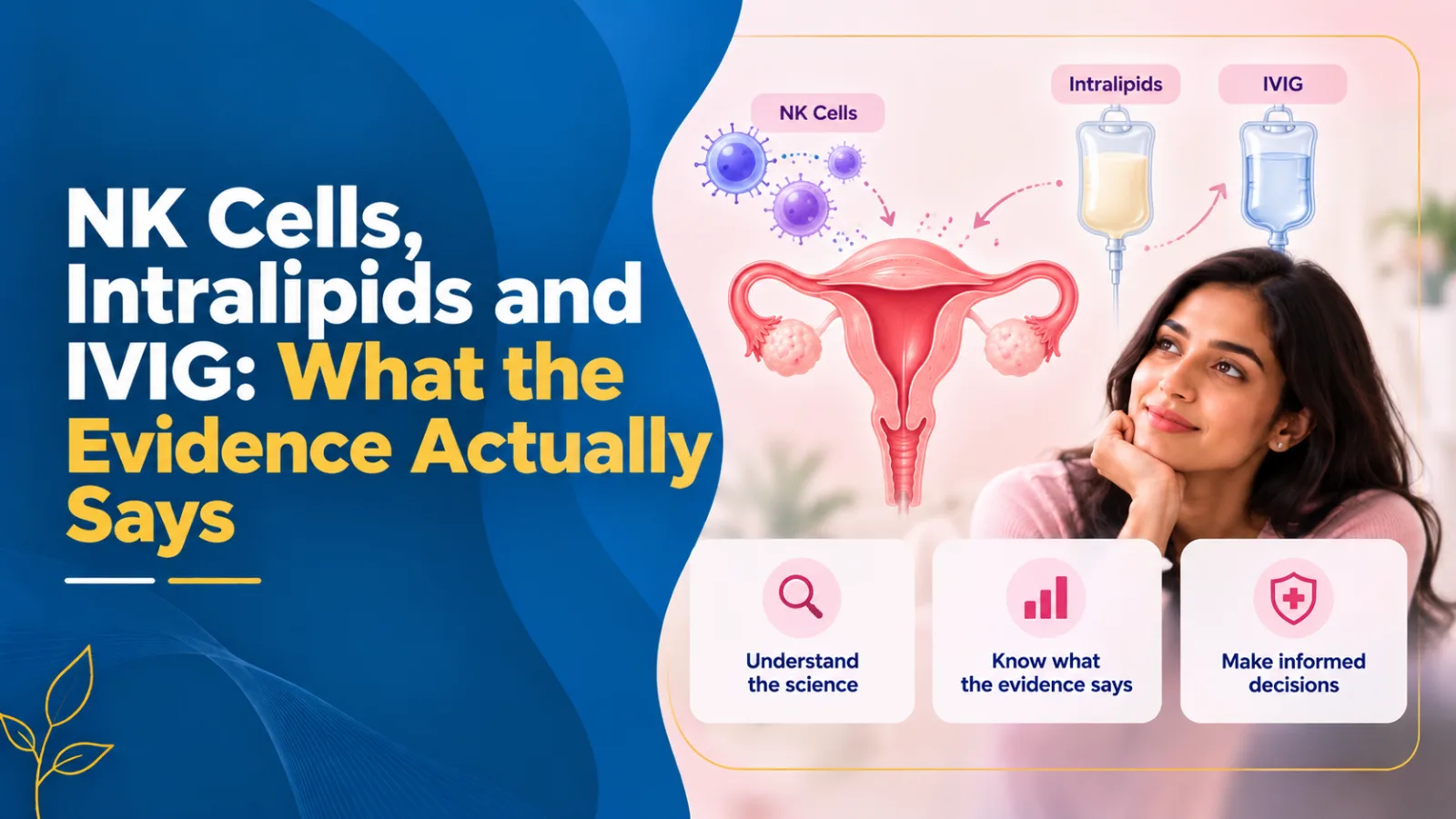
After a failed IVF transfer or recurrent pregnancy loss, it is natural to look for an explanation. One explanation that has become increasingly common is that the immune system is “attacking” the embryo.
This has led to tests for NK cells and treatments such as intralipids, IVIG and corticosteroids.
But what does the evidence actually show?
The biology of implantation is more complicated than the idea that the immune system simply “rejects” an embryo. Current evidence does not establish routine NK-cell testing or immune-suppressing treatment as an effective way to improve IVF outcomes. 24 - NK Cells Intralipids and I…
What Are NK Cells?
Natural killer, or NK, cells are part of the immune system.
The common explanation is that high NK-cell activity attacks embryos and prevents implantation. However, the biology of pregnancy is considerably more complex.
Uterine NK cells are actually among the most abundant immune cells present at the implantation site during a healthy pregnancy. Rather than simply attacking the embryo, they participate in preparing the uterine environment, including helping remodel blood vessels that supply the developing placenta. 24 - NK Cells Intralipids and I…
So the question is not simply:
“Are my NK cells high?”
The more important question is:
“Does this test provide information that changes treatment or improves the chance of a live birth?”
Why NK-Cell Testing Is Difficult to Interpret
One of the biggest problems is that blood NK cells are not the same as uterine NK cells.
A blood test measures immune cells circulating in your bloodstream. It does not directly tell us what is happening inside the uterine lining.
There is also no universally validated “abnormal” NK-cell threshold that reliably predicts implantation failure or tells doctors which treatment should be given. NK-cell levels can vary according to the menstrual cycle, laboratory methods and testing techniques. 24 - NK Cells Intralipids and I…
That means a report saying “NK cells are high” does not automatically identify the cause of an unsuccessful IVF cycle.
What About Intralipids?
Intralipids are intravenous emulsions containing soya oil and other components. They have been proposed as an immune-modulating treatment during fertility treatment.
The theory is that intralipids may reduce or modify NK-cell activity.
However, according to the source's evidence summary, the benefit remains unproven. The HFEA February 2026 review categorises intralipids as grey, meaning there is insufficient evidence to establish their effectiveness. 24 - NK Cells Intralipids and I…
Intralipids are also not completely risk-free. Infusion and allergic reactions can occur, and the treatment adds cost to an IVF cycle.
What About IVIG?
IVIG, or intravenous immunoglobulin, is a blood-derived medical product used for several established medical conditions.
It has also been used in some fertility settings with the theory that it could reduce an inappropriate immune response against an embryo.
For implantation failure, however, the source reports that evidence has not established a live-birth benefit sufficient to justify routine use. The HFEA review gives IVIG a red rating because of safety concerns. 24 - NK Cells Intralipids and I…
IVIG is a legitimate and important treatment in other areas of medicine. That does not automatically establish it as an effective treatment for unexplained implantation failure.
What About Steroids Such as Prednisolone?
Corticosteroids are another commonly discussed fertility “immune treatment.”
The proposed idea is straightforward: suppress immune activity and potentially make implantation easier.
But broad immune suppression is not the same as treating a diagnosed immune disease.
The source notes that routine corticosteroid use for implantation lacks supporting evidence and carries potential consequences, particularly during pregnancy. The HFEA review categorises steroids as red because of safety concerns. 24 - NK Cells Intralipids and I…
If a steroid has been prescribed, an important question is:
“What specific diagnosed condition is this medication treating?”
That is different from taking steroids simply because an NK-cell test was reported as abnormal.
What Does the Evidence Show Overall?
The evidence becomes clearer when the tests and treatments are looked at together:
| Approach | Proposed purpose | Evidence described in the source |
|---|---|---|
| NK-cell blood testing | Identify immune-related implantation problems | No validated treatment-selection role |
| Intralipids | Modify NK-cell activity | Insufficient evidence |
| IVIG | Suppress presumed immune rejection | Safety concerns; no demonstrated live-birth benefit |
| Corticosteroids | Broad immune suppression | Routine use not supported; safety concerns |
The important issue is that an abnormal test has not been shown to reliably lead to a treatment that results in more babies. 24 - NK Cells Intralipids and I…
What If You Have Actually Been Diagnosed With an Autoimmune Disease?
This is an important distinction.
Not every immune-related condition is unproven.
For example, antiphospholipid syndrome (APS) is a diagnosed condition associated with recurrent pregnancy loss, and appropriate treatment can include aspirin and heparin when diagnostic criteria are met.
Similarly, people with conditions such as lupus or thyroid autoimmunity may require appropriate specialist management before and during pregnancy. 24 - NK Cells Intralipids and I…
The issue is not whether the immune system matters in pregnancy.
It does.
The issue is whether suppressing a normal immune system on the basis of an unvalidated fertility test improves outcomes.
What Should You Do After Repeated IVF Failure?
After unsuccessful embryo transfers, it can be tempting to add another test or another medication.
A more structured review can be useful.
The source recommends considering:
1. Embryology first
Embryo quality is an important part of understanding implantation failure.
2. Review the uterine cavity
Conditions such as polyps, adhesions and hydrosalpinx can affect fertility and may be identifiable and treatable.
3. Review basic medical factors
Depending on the situation, this may include thyroid function, prolactin and sperm-related factors.
4. Review the treatment protocol
Only after the important basics have been assessed should protocol changes be considered. 24 - NK Cells Intralipids and I…
For couples dealing with recurrent pregnancy loss rather than implantation failure, the appropriate evaluation can be different and may include testing for antiphospholipid antibodies, thyroid assessment and parental karyotyping where clinically indicated. 24 - NK Cells Intralipids and I…
You can also learn more about IVF treatment at Renew Healthcare.
Questions to Ask Before Paying for an Immune Add-On
If a clinic recommends NK-cell testing, intralipids, IVIG or steroids, ask:
- What specific problem is this treatment addressing?
- What is the evidence that it improves live-birth rates?
- Is the test validated for deciding this treatment?
- What are the risks?
- What will the treatment cost?
- Would the recommendation change if the test result were normal?
- Have the embryo, uterus, thyroid, prolactin and sperm factors been properly reviewed?
One particularly useful question from the source is:
“What is the live-birth evidence for this, and what does it cost?” 24 - NK Cells Intralipids and I…
Frequently Asked Questions
My NK-cell test came back “high.” What does that mean?
A high blood NK-cell result does not by itself establish that your immune system is causing implantation failure. Blood and uterine NK cells are different populations, and there is no validated threshold that reliably determines treatment. 24 - NK Cells Intralipids and I…
Are intralipids completely harmless?
No treatment is completely risk-free. Intralipids can cause infusion or allergic reactions and add cost, while their benefit for implantation remains unproven according to the evidence summary in the source. 24 - NK Cells Intralipids and I…
Should I take steroids after a failed IVF transfer?
Routine steroid use for implantation is not supported by the evidence described in the source and carries potential downsides. However, steroids prescribed for a diagnosed medical condition are a different situation. 24 - NK Cells Intralipids and I…
Is IVIG ever useful?
IVIG has established uses in other medical conditions. For implantation failure specifically, the source states that evidence has not established sufficient benefit to justify its costs and risks. 24 - NK Cells Intralipids and I…
What if I really have an autoimmune disease?
A diagnosed autoimmune condition should be managed with the appropriate specialist. This article is specifically addressing immune treatments offered for fertility problems on the basis of unvalidated tests, rather than established autoimmune disease. 24 - NK Cells Intralipids and I…
The Bottom Line
The idea that an embryo is simply being “attacked” by the mother's immune system is an oversimplification of implantation biology.
Blood NK-cell testing does not currently provide a validated way to identify who needs immune treatment, while the evidence for intralipids remains insufficient and the source reports safety concerns for routine IVIG and steroid use. 24 - NK Cells Intralipids and I…
After repeated IVF failure, the more useful approach is usually to systematically review the embryo, uterine cavity, basic medical factors and treatment protocol before automatically adding immune tests or infusions.
For specialist fertility evaluation, you can consult Dr. Arnab Kundu at Renew Healthcare.
Evidence should come before an add-on treatment. Ask what the treatment is intended to achieve, what the live-birth evidence shows, and what risks and costs it carries.