
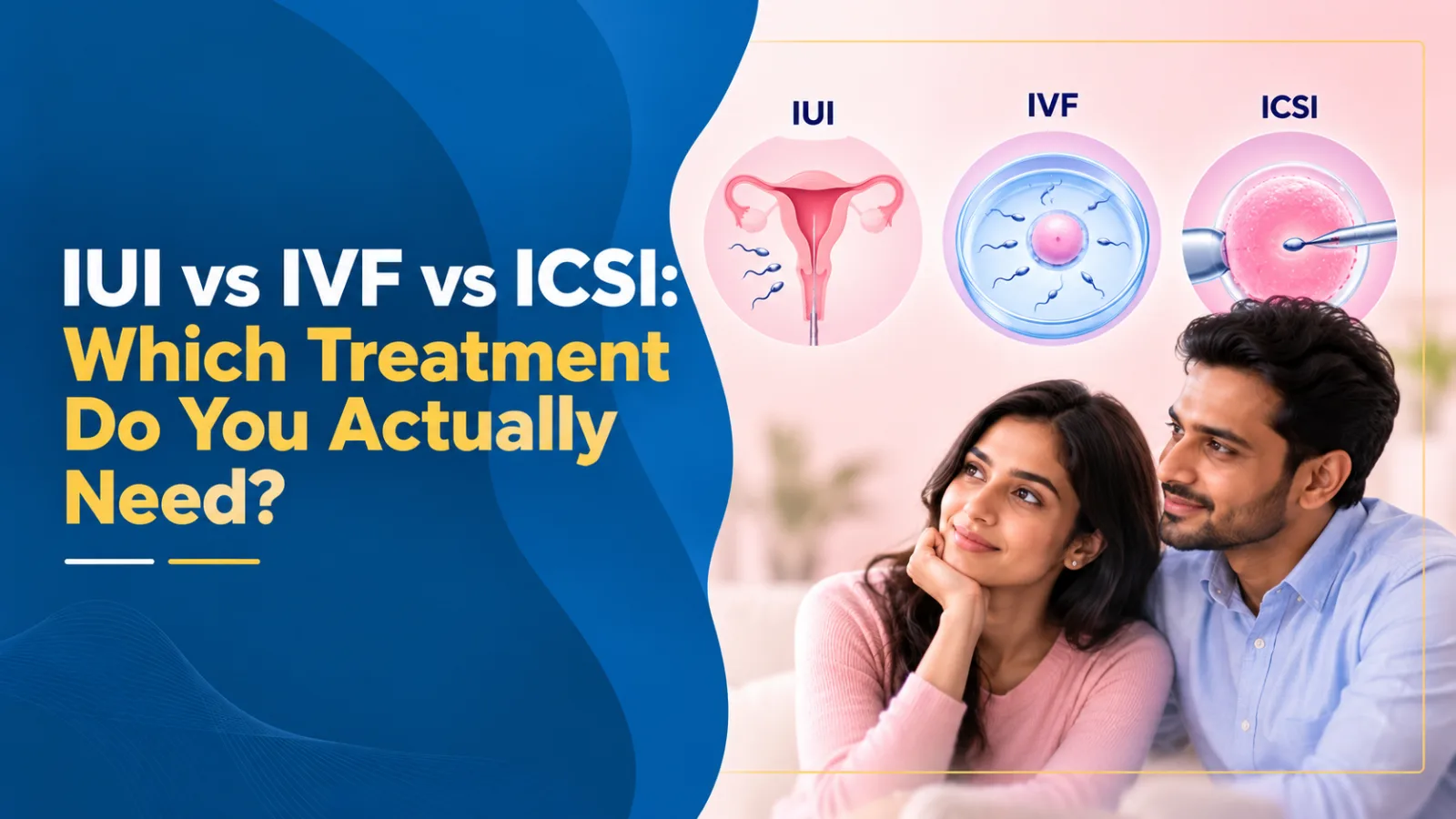
IUI, IVF and ICSI are often presented as three different fertility treatments that couples have to choose between. But that is not quite accurate.
IUI is a separate fertility procedure. IVF is a treatment cycle. ICSI is a laboratory fertilisation technique performed within an IVF cycle. 07 - IUI vs IVF vs ICSI - Which…
Understanding this difference matters because the right treatment depends on your diagnosis, age, ovarian reserve, fallopian tubes, sperm parameters and how long you have been trying to conceive.
IUI vs IVF vs ICSI: What Is the Difference?
| IUI | IVF | ICSI | |
|---|---|---|---|
| What is it? | Fertility procedure | Fertility treatment cycle | Laboratory fertilisation technique |
| Where does fertilisation happen? | Inside the body | In the laboratory | In the laboratory |
| How does sperm meet the egg? | Naturally inside the fallopian tube | Sperm and eggs are placed together | One sperm is injected directly into an egg |
| Are eggs collected? | No | Yes | Yes |
| Part of IVF? | No | Yes | Yes |
The key difference is that ICSI is not an alternative to IVF. It is a technique used during an IVF cycle when there is a specific reason to inject a sperm directly into an egg. 07 - IUI vs IVF vs ICSI - Which…
IUI: The Simpler Fertility Treatment
What Happens During IUI?
During an IUI cycle, ovulation is monitored and may be supported with medication.
Around ovulation, a semen sample is prepared in the laboratory. The more motile sperm are concentrated and then placed directly into the uterus using a thin catheter.
The procedure usually takes only a few minutes and generally does not require anaesthesia.
Importantly, fertilisation still happens naturally inside the fallopian tube. IUI simply reduces the distance the sperm has to travel. 07 - IUI vs IVF vs ICSI - Which…
Who May Benefit From IUI?
IUI may be considered for:
- Mild male-factor infertility
- Unexplained infertility, particularly in younger women
- Ovulation problems when combined with ovulation induction
- Certain cervical factors
- Difficulty with intercourse
- Donor sperm treatment
- Same-sex couples and single women where legally applicable
IUI may not be appropriate when both fallopian tubes are blocked, in significant male-factor infertility, with low ovarian reserve or advanced female age, or in moderate-to-severe endometriosis. 07 - IUI vs IVF vs ICSI - Which…
You can also read more about fertility treatment options and IUI treatment at Renew Healthcare.
How Many IUI Cycles Should You Try?
There is no universal number that works for every couple.
The source evidence is mixed, and the appropriate number of cycles depends on factors such as age, diagnosis and ovarian reserve. The important point is to agree on a clear treatment plan with your fertility specialist rather than continuing IUI indefinitely. 07 - IUI vs IVF vs ICSI - Which…
If several appropriately planned IUI cycles have failed, IVF may become a more suitable next step.
IVF: When a More Advanced Treatment May Be Needed
What Happens During IVF?
IVF involves stimulating the ovaries so that multiple follicles develop.
The follicles are monitored using ultrasound and blood tests. Once they are ready, a trigger medication is given and the eggs are collected approximately 36 hours later under sedation.
In the laboratory, the eggs and prepared sperm are placed together. If fertilisation occurs, embryos are developed for several days before an embryo is transferred into the uterus. Suitable remaining embryos may be frozen. 07 - IUI vs IVF vs ICSI - Which…
When Is IVF Considered?
IVF may be considered for:
- Blocked, damaged or absent fallopian tubes
- Previous unsuccessful IUI cycles
- Endometriosis affecting fertility
- Reduced ovarian reserve
- Age-related fertility decline
- Unexplained infertility after other approaches
- Situations where embryo genetic testing is indicated
- Moderate male-factor infertility where suitable sperm are available 07 - IUI vs IVF vs ICSI - Which…
If endometriosis is part of your fertility diagnosis, our detailed guide on Endometriosis and Fertility: From Diagnosis to IVF explains how the condition can affect fertility and how surgery and IVF may fit into treatment planning.
ICSI: What Does It Actually Add to IVF?
ICSI stands for Intracytoplasmic Sperm Injection.
During ICSI, an embryologist selects a single sperm and injects it directly into a mature egg using a microscopic needle.
The rest of the process is essentially the same as IVF:
Ovarian stimulation → Egg collection → Fertilisation → Embryo culture → Embryo transfer
The difference is how fertilisation is performed in the laboratory. 07 - IUI vs IVF vs ICSI - Which…
Who May Actually Need ICSI?
ICSI may be considered when there is a specific fertilisation problem, including:
- Severe male-factor infertility
- Very low sperm count
- Poor sperm motility or morphology
- Surgically retrieved sperm, including some cases of azoospermia
- Previous total or near-total fertilisation failure with conventional IVF
- Frozen-thawed eggs
- Certain cycles involving genetic testing of embryos 07 - IUI vs IVF vs ICSI - Which…
If sperm needs to be retrieved surgically because sperm are absent from the ejaculate, you can read more about sperm extraction procedures in azoospermia.
Is ICSI Better Than IVF?
Not necessarily.
ICSI is designed to overcome a specific problem: when sperm may not be able to fertilise an egg effectively on its own.
The source document notes that for couples without male-factor infertility, large randomised trials and a Cochrane review have not established a live-birth advantage from routinely using ICSI instead of conventional IVF. 07 - IUI vs IVF vs ICSI - Which…
Therefore, if ICSI has been recommended, it is reasonable to ask:
“What specific finding in our fertility tests makes ICSI necessary?”
The explanation should relate to your individual results, such as a semen parameter, previous fertilisation failure or a planned genetic test.
For a deeper discussion of sperm-related fertility problems, you can also read Role of Semen Analysis in Male Infertility Treatment.
The Three Tests That Help Decide Between IUI, IVF and ICSI
There are three particularly important areas to assess.
1. Are the Fallopian Tubes Open?
Tubal patency testing, such as HSG or appropriate evaluation, helps determine whether the tubes are open.
Blocked tubes generally rule out IUI because IUI still requires fertilisation to occur naturally inside the fallopian tube.
IVF can bypass the fallopian tubes. 07 - IUI vs IVF vs ICSI - Which…
2. How Is the Sperm?
A semen analysis helps assess:
- Sperm concentration
- Motility
- Morphology
- Overall sperm parameters
Severe male-factor infertility may make IVF with ICSI more appropriate.
For more information, see Role of Semen Analysis in Male Infertility Treatment. 07 - IUI vs IVF vs ICSI - Which…
3. How Will the Ovaries Respond?
AMH and antral follicle count, considered alongside age, help assess ovarian reserve.
Lower ovarian reserve or increasing age may make spending many months on lower-yield IUI cycles less appropriate. 07 - IUI vs IVF vs ICSI - Which…
You can learn more about AMH and ovarian reserve in What Is a Good AMH Level to Get Pregnant?.
IUI, IVF or ICSI? A Simple Way to Understand It
As a general framework:
Open tubes + reasonable sperm + younger age + unexplained or mild fertility problem
IUI may be considered as an initial treatment, usually for a defined number of cycles.
Blocked or significantly damaged tubes
IVF may be considered, because IVF bypasses the fallopian tubes.
Several unsuccessful IUI cycles
IVF may become the next treatment option.
Severe male-factor infertility or surgically retrieved sperm
IVF with ICSI may be considered.
Older female partner or reduced ovarian reserve
Your specialist may recommend considering IVF sooner rather than spending substantial time on IUI.
Previous fertilisation failure during IVF
ICSI may be considered to address a specific fertilisation problem. 07 - IUI vs IVF vs ICSI - Which…
These are general frameworks, not a substitute for an individual fertility assessment.
What About Cost?
The overall cost generally increases as treatment becomes more complex.
IUI is usually less expensive than IVF, while ICSI adds an additional laboratory component to an IVF cycle.
Instead of asking only:
“How much does one cycle cost?”
also ask:
“What could the complete treatment plan cost?”
An itemised estimate should clarify expenses such as:
- Fertility medications
- Monitoring
- Egg collection
- Laboratory charges
- ICSI
- Embryo freezing
- Embryo storage
- Frozen embryo transfer
The source recommends considering the potential cost of the overall treatment plan rather than looking at only one cycle. 07 - IUI vs IVF vs ICSI - Which…
For questions to discuss before starting IVF, you can also read Questions to Ask Your IVF Doctor Before Starting Treatment.
Frequently Asked Questions
Is ICSI better than IVF?
Not automatically. ICSI is a specific laboratory technique designed to help overcome certain fertilisation problems. When there is no relevant indication, current evidence cited in the source does not establish a general live-birth advantage over conventional IVF. 07 - IUI vs IVF vs ICSI - Which…
Is IUI worth trying before IVF?
It can be considered when the fallopian tubes are open, sperm parameters are reasonably preserved and the female partner is younger. It may be less suitable with blocked tubes, significant male-factor infertility, low ovarian reserve or advancing age. 07 - IUI vs IVF vs ICSI - Which…
How many IUI cycles should I try before IVF?
The source describes three to four cycles as a common framework, but the appropriate number should be confirmed with your fertility specialist based on your age, diagnosis and treatment response. 07 - IUI vs IVF vs ICSI - Which…
Does IUI hurt?
Most women describe IUI as involving brief discomfort or cramping similar to a cervical examination. Anaesthesia is generally not required, and normal activities can usually be resumed the same day. 07 - IUI vs IVF vs ICSI - Which…
Can we choose ICSI ourselves?
You can discuss ICSI with your fertility specialist, but it is important to understand why it is being recommended and whether your particular fertility results provide a clinical reason for it. 07 - IUI vs IVF vs ICSI - Which…
Is IVF or ICSI riskier for the baby?
The source describes overall outcomes as broadly reassuring but notes that the relationship between fertility treatment techniques and reported risks can be complex. This should be discussed individually with your fertility specialist, particularly when a genetic cause of male-factor infertility is present. 07 - IUI vs IVF vs ICSI - Which…
Our clinic says ICSI is standard. Is that normal?
ICSI is commonly used in many fertility centres. However, the source recommends asking what specific finding in your results makes ICSI appropriate rather than assuming that it is automatically required for every IVF cycle. 07 - IUI vs IVF vs ICSI - Which…
The Bottom Line
The first step is to understand the categories:
IUI is a separate fertility procedure. IVF is a treatment cycle. ICSI is a laboratory technique used within IVF when there is a specific reason to use it.
The decision between these approaches is influenced by:
- Fallopian tube condition
- Semen analysis
- Ovarian reserve
- Age
- Duration of infertility
- Previous fertility treatment
- Specific diagnosis
If you have been advised to undergo IUI, IVF or ICSI, ask your fertility specialist why that particular treatment has been recommended for your results.
For personalised fertility evaluation and treatment planning, consult Dr. Arnab Kundu at Renew Healthcare.
The goal is not simply to choose the most advanced treatment. It is to understand which treatment fits your specific fertility situation.
This article is for general educational purposes and does not replace individual medical advice. Please consult a qualified fertility specialist for an assessment and treatment plan tailored to your situation.