
Medically reviewed by: Dr. Arnab Kundu, MBBS, DGO, DNB (OBY-GYN), Infertility Specialist and IVF Expert at Renew Healthcare.
In Brief
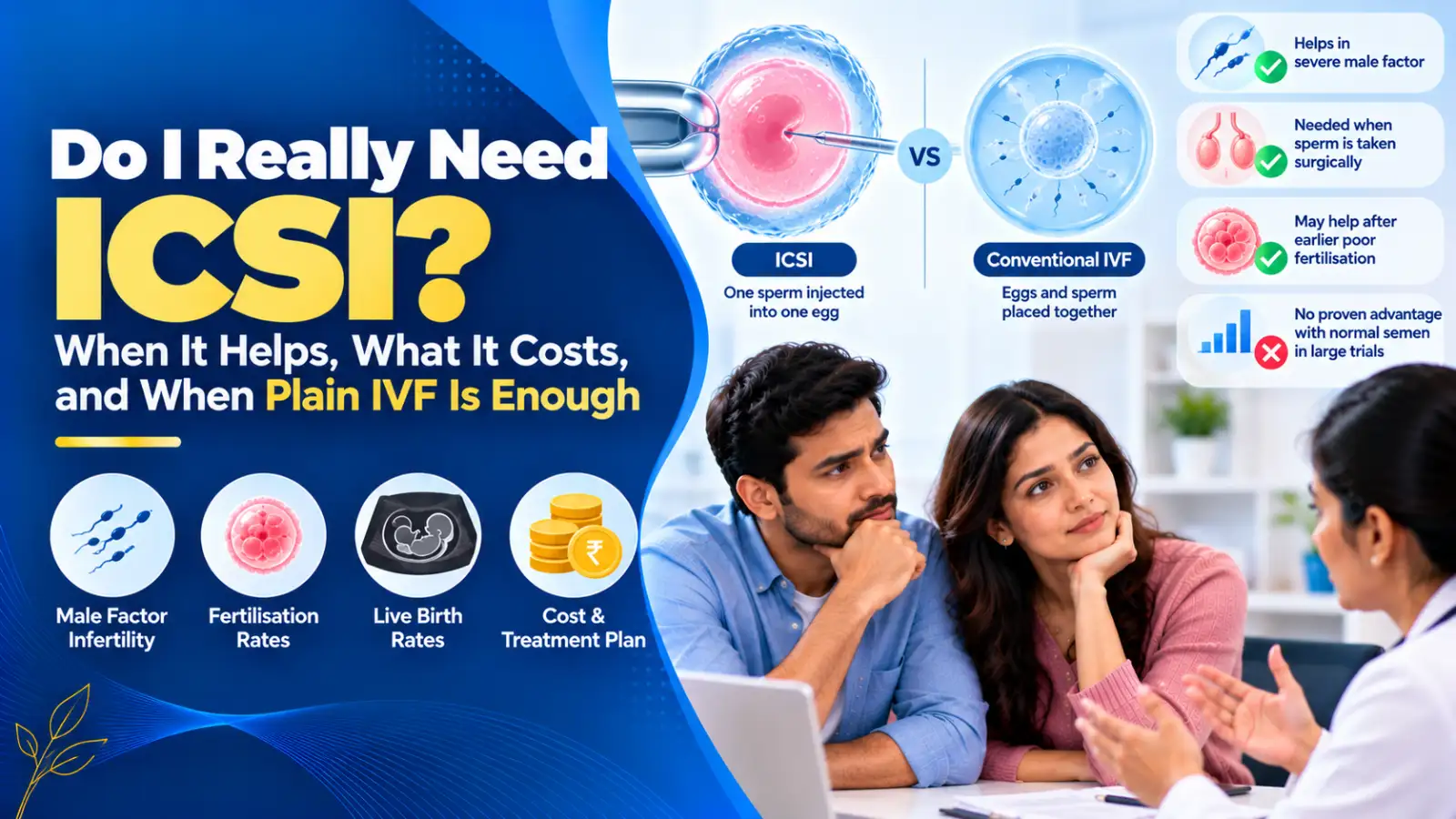
ICSI injects one sperm into one egg. It has a clear role when there is severe male-factor infertility or sperm must be retrieved surgically. It may also help selected couples after poor fertilisation in an earlier IVF cycle.
However, large trials have not shown a live-birth advantage over conventional IVF when semen results are normal or near-normal. The right choice depends on your reports and treatment history—not simply on which technique is more advanced.
Why Does ICSI Come Up During IVF Consultation?
If your doctor has discussed ICSI alongside IVF, it is reasonable to ask whether it is essential in your case or simply part of the clinic's routine.
The answer depends on your semen report, any previous fertilisation problems and the reason your specialist recommends the technique.
What Is the Difference Between ICSI and Conventional IVF?
In conventional IVF, eggs and sperm are placed together in the laboratory, allowing fertilisation to happen naturally.
In ICSI, the embryologist selects a single sperm and injects it into an egg.
Both approaches are used during IVF treatment, but they differ in how fertilisation is attempted. Fertilisation is a laboratory outcome; live birth is the outcome that matters to patients. A technique may change the first without necessarily improving the second.
For more information about the procedure itself, see our related guide: [How ICSI Is Performed — link to the existing ICSI explainer once its URL is confirmed].
When Does ICSI Have a Clear Role?
ICSI has an established role in specific clinical situations.
| Situation | What the evidence supports |
|---|---|
| Severe male-factor infertility, such as very low sperm count, very poor movement or severely abnormal sperm shape | ICSI is the standard method for this group. |
| Sperm obtained through surgical retrieval | ICSI is used because very few sperm may be available. This is standard practice based on expert consensus. |
| Poor or failed fertilisation during an earlier IVF cycle | ICSI may help selected couples, although the source document notes that no large trial has tested this group. |
ICSI is particularly important when sperm-related factors make conventional fertilisation difficult. It has not been shown to be better in every IVF case.
When Can Conventional IVF Be a Reasonable Choice?
Conventional IVF may be a reasonable first option when:
The semen result is within or close to the laboratory's reference values.
There is no severe male-factor infertility.
There was no poor fertilisation in an earlier IVF cycle.
Semen reference values should not be treated as strict pass-or-fail boundaries. The WHO laboratory manual, sixth edition (2021), describes lower reference limits based on the fifth centile of a reference group. These values are not a direct dividing line between fertility and infertility.
A slightly low semen result, by itself, does not automatically mean that ICSI is necessary.
Your doctor and embryology team should interpret the result alongside the rest of your clinical history.
What Do Studies Say About ICSI When Semen Is Normal or Near-Normal?
The evidence summarised in the source document does not establish a live-birth advantage for routine ICSI in couples without severe male-factor infertility.
The studies cited include:
Dang et al. (2021): Roughly one in three couples had a live birth in both treatment groups, with no significant difference.
Berntsen et al. (2025): Among 824 women, cumulative live birth was 43.2% with ICSI and 47.3% with conventional IVF. The trial concluded that ICSI did not improve cumulative live birth in this group.
Wang et al. (2024): Live-birth rates were 33.8% with ICSI and 36.6% with conventional IVF; the difference was not statistically significant.
Kayimu et al. (2026): A pooled analysis of six randomised trials reported rates of 32.8% with ICSI and 34.5% with conventional IVF.
Cutting et al. (2023): The Cochrane review reported uncertainty about the effect, with low certainty of evidence.
Taken together, these findings do not demonstrate that ICSI improves live birth for couples without severe male-factor infertility. The confidence intervals cannot rule out a small benefit or harm.
The American Society for Reproductive Medicine's 2026 committee opinion, as cited in the source document, states that routine ICSI for non-male-factor infertility is not recommended.
ICSI remains common in clinical practice, but how frequently a technique is used does not prove that it benefits every patient.
For a related explanation of how to interpret treatment outcomes, read [How to Read an IVF Clinic's Success Rate Without Being Misled — link to the related article once its URL is confirmed].
When Should You Consider ICSI—and When Should You Question It?
ICSI may be appropriate when:
There is severe male-factor infertility.
Sperm have been obtained through surgical retrieval.
An earlier IVF cycle resulted in poor or failed fertilisation.
Your clinic should be able to explain its criteria and the fertilisation threshold it uses.
On the other hand, if your semen results are normal or near-normal, there was no earlier poor fertilisation, and no clear reason has been provided, ask why ICSI is being recommended.
Request a written explanation rather than relying on a general promise that ICSI is always better.
You can also review [Questions to Ask Before You Agree to IVF — link to the related clinic-red-flags article once its URL is confirmed].
What Does ICSI Cost, and How Long Does It Take?
ICSI is usually charged as an additional step on top of an IVF cycle. The exact fee depends on the clinic's itemised pricing, so a specific amount should not be assumed without a written quotation.
The overall treatment cost may also depend on:
The number of treatment cycles.
Surgical sperm retrieval, if required.
Genetic testing, if planned.
Medicines and other treatment components.
Before agreeing to treatment, ask for an itemised price list. Confirm whether the ICSI charge is calculated per cycle or per egg and whether surgical sperm retrieval is billed separately.
For a detailed breakdown, see [IVF Cost Breakdown — link to the IVF cost guide when it is published and its URL is confirmed].
How Long Does an ICSI Cycle Take?
A fresh IVF cycle usually takes around six weeks from the first injection to the pregnancy test.
If semen needs to improve before treatment, the source document advises allowing approximately two to two and a half months for new sperm to develop before a repeat semen test can show the effect of a change.
Your individual schedule will depend on the treatment plan recommended by your clinical team.
Questions to Ask Before Agreeing to ICSI
Before making a decision, consider asking your specialist:
Which result in our reports makes ICSI necessary?
Is the recommendation based on a male-factor reason, or is ICSI routine for every case at this clinic?
Can you show us live-birth outcomes from your own cycles for patients in a similar situation, with and without ICSI?
These questions can help you understand the reason for the recommendation and the evidence behind it.
Frequently Asked Questions
Is ICSI always better than IVF?
No. ICSI has a clear role when sperm are severely affected or obtained through surgical retrieval. For couples with normal or near-normal semen results, randomised trials have not shown that ICSI produces more live births than conventional IVF.
Does ICSI improve my chances if my semen report is normal?
A benefit has not been demonstrated so far in this group. Trials and a 2026 pooled analysis found no significant live-birth difference among couples without severe male-factor infertility. A small effect in either direction cannot be ruled out, so ask your specialist for a clear reason for recommending it.
What if my semen report is mildly abnormal?
This is a grey area. Conventional IVF may still be reasonable when there is no severe male factor and fertilisation is expected to be adequate. Ask the embryologist to explain your results and what the clinic would do if fertilisation were poor. A reference value is a guide, not a strict treatment cut-off.
What if conventional IVF fails to fertilise my eggs?
ICSI may be offered in a subsequent cycle. However, the source document describes the evidence for this situation as weak because no large trial has tested this specific group. Ask your doctor why ICSI is being recommended and what the next step would be if fertilisation also fails with ICSI.
Does ICSI cost much more than IVF?
ICSI is usually charged as an additional fee on top of the IVF cycle. The exact amount must come from the clinic's itemised quotation. Ask whether the charge is per cycle or per egg and whether surgical sperm retrieval is billed separately.
How long does an ICSI cycle take?
A fresh cycle usually takes around six weeks from the first injection to the pregnancy test. If semen needs to improve first, allow about two to two and a half months before a repeat semen test can show the effect of a change.
The Bottom Line
ICSI has a clear role in severe male-factor infertility and when sperm are obtained through surgical retrieval. It may also be considered in selected cases after poor fertilisation during an earlier IVF cycle.
For couples with normal or near-normal semen results, ICSI has not been shown to increase live birth compared with conventional IVF.
The most useful question is not whether ICSI is more advanced, but why it is recommended for your particular case. Ask your specialist to explain the reason, discuss the evidence and provide an itemised cost estimate.
Talk to a Specialist Before You Decide
Dr. Arnab Kundu, an infertility specialist and IVF expert at Renew Healthcare, can help you understand your reports and discuss whether ICSI is appropriate for your treatment history.
Bring your semen report and notes from any earlier IVF cycle to your consultation.
Visit Renew Healthcare to learn more about the clinic and its fertility services.
This article is for general education and does not replace individual medical advice. Please consult a qualified specialist about your own situation.
References
World Health Organization. WHO Laboratory Manual for the Examination and Processing of Human Semen. 6th ed. Geneva: WHO; 2021.
Dang VQ, Vuong LN, Luu TM, et al. Intracytoplasmic sperm injection versus conventional in-vitro fertilisation in couples with infertility in whom the male partner has normal total sperm count and motility: an open-label, randomised controlled trial. Lancet. 2021;397:1554–1563. doi:10.1016/S0140-6736(21)00535-3.
Berntsen S, Zedeler A, Nøhr B, et al. IVF versus ICSI in patients without severe male factor infertility: a randomized clinical trial. Nature Medicine. 2025;31(6):1939–1948. doi:10.1038/s41591-025-03621-x.
Wang Y, et al. Intracytoplasmic sperm injection versus conventional in-vitro fertilisation for couples with infertility with non-severe male factor: a multicentre, open-label, randomised controlled trial. Lancet. 2024. PubMed 38330980. Bibliographic details require verification before publication.
Kayimu K, et al. Does intracytoplasmic sperm injection outperform conventional in vitro fertilization in couples without severe male factor infertility? A systematic review and meta-analysis of randomized controlled trials. Human Reproduction. 2026;41(7):1173–1182. doi:10.1093/humrep/deag066.
Cutting E, Horta F, Dang V, van Rumste MME, Mol BWJ. ICSI versus conventional IVF for couples whose male partners have normal total sperm count and motility. Cochrane Database of Systematic Reviews. 2023;(8). doi:10.1002/14651858.CD001301.pub2.
ASRM Practice Committee. Intracytoplasmic sperm injection for nonmale factor indications: a Committee opinion. Fertility and Sterility. 2026;126:49–56. DOI requires verification.
Baker VL, Dyer S, Chambers GM, et al. International Committee for Monitoring Assisted Reproductive Technologies (ICMART): world report for cycles conducted in 2017–2018. Human Reproduction. 2025;40(6):1110–1126. doi:10.1093/humrep/deaf049.
Publication note: Complete the reference checks flagged in the source document and obtain the required clinical sign-off before publishing. The source also requires confirmation that Dr. Arnab Kundu is the intended reviewer and that the clinic can substantiate its own ICSI criteria and fertilisation threshold.