
By Dr. Neha Yadav | Infertility Specialist & IVF Expert | Salt Lake, Kolkata
When you are undergoing a fertility evaluation, one important question is whether your fallopian tubes are open.
Think of the tubes as two pathways between the ovaries and uterus. The egg travels through the tube, fertilisation normally occurs there, and the early embryo then travels toward the uterus. If a tube is blocked or significantly damaged, natural conception can become difficult.
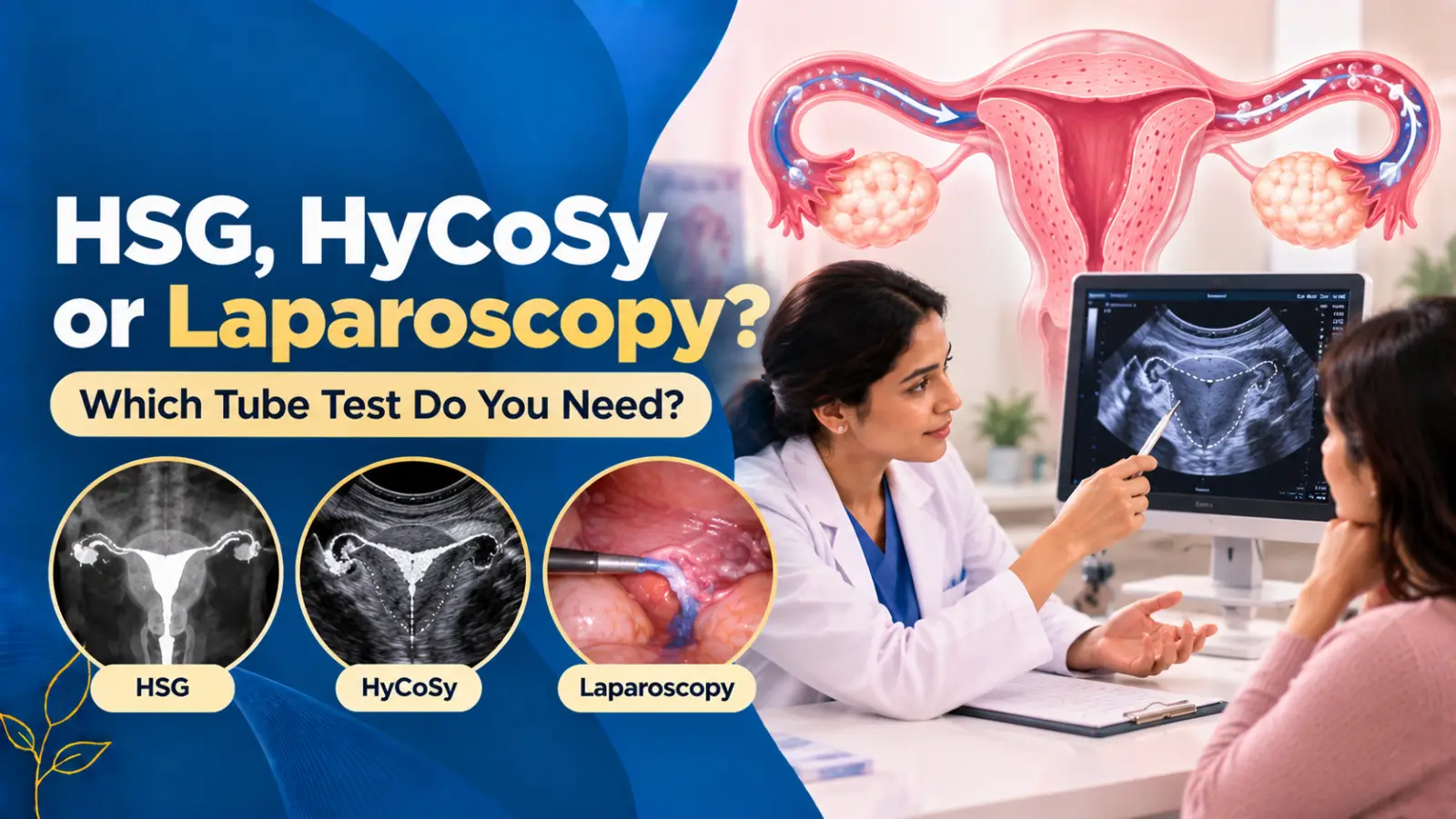
The good news is that there are several ways to check tubal patency. HSG, HyCoSy/HyFoSy and laparoscopy all have a role—but they are not interchangeable in every situation.
Key Takeaways
- Tubal problems are an important cause of female infertility and are routinely considered during fertility evaluation.
- HSG uses X-ray and contrast to assess the uterine cavity and fallopian tubes.
- HyCoSy/HyFoSy uses ultrasound and contrast or foam, without radiation.
- Laparoscopy is more invasive but allows the doctor to see the pelvis directly and treat conditions such as endometriosis or adhesions during the same procedure.
- For women without significant risk factors for tubal disease, HSG or HyCoSy is generally considered before diagnostic laparoscopy. Current WHO guidance supports either HSG or HyCoSy for assessing tubal patency. NCBI
Why Do the Fallopian Tubes Matter?
The fallopian tubes are more than simple passageways.
They help:
- Pick up the egg after ovulation.
- Provide the usual site for fertilisation.
- Transport the early embryo toward the uterus.
Tubal damage can occur because of previous pelvic infection, endometriosis, abdominal or pelvic surgery, or a previous ectopic pregnancy.
Importantly, blocked tubes do not always cause noticeable symptoms. A woman may have regular periods and no pelvic pain and still have tubal blockage. That is why tubal assessment can be an important part of a fertility work-up.
The Three Main Tube Tests
1. HSG — Hysterosalpingography
HSG is an X-ray-based test.
A thin catheter is placed through the cervix and contrast dye is introduced into the uterus. X-ray images then show whether the contrast passes through the fallopian tubes and spills into the pelvis.
HSG can provide information about both:
- The shape of the uterine cavity
- Whether the fallopian tubes appear open
The procedure usually takes only a few minutes, although many women experience cramping or discomfort.
The source article reports an average pain score of approximately 5.4/10 in the FOAM trial. HSG also involves radiation and iodinated contrast. Phase2_Blog_Part1_Tests_Explain…
HSG may be useful when:
- A straightforward first-line tubal assessment is needed
- X-ray facilities are readily available
- There is no relevant contrast allergy
2. HyCoSy or HyFoSy — Ultrasound Tube Testing
HyCoSy stands for hysterosalpingo-contrast sonography.
Instead of using X-rays, the doctor watches the passage of contrast through the tubes using transvaginal ultrasound.
HyFoSy is a related technique that uses an echogenic foam.
The major advantage is that there is no ionising radiation. HyCoSy can provide information about tubal patency while the procedure is being watched in real time on ultrasound.
Current AIUM guidance states that properly performed HyCoSy can assess tubal patency and has demonstrated accuracy essentially equivalent to HSG and laparoscopic chromopertubation in the appropriate setting. PubMed Central (PMC)
The source article reports lower average pain in the FOAM trial, around 3.1/10, although individual experiences vary. Phase2_Blog_Part1_Tests_Explain…
HyCoSy may be particularly attractive when:
- You want to avoid radiation
- Iodinated contrast is a concern
- A skilled sonographer experienced in the procedure is available
One limitation is that results can be more dependent on the operator's experience.
3. Laparoscopy With Dye Test
Laparoscopy is a surgical procedure performed under anaesthesia.
A small camera is inserted through an abdominal incision, usually near the navel. Dye is then passed through the uterus and tubes while the surgeon directly observes whether it passes through the tubes.
The major advantage is that laparoscopy can show more than tubal patency.
It can also identify conditions such as:
- Endometriosis
- Pelvic adhesions
- Some pelvic anatomical abnormalities
And when appropriate, treatment can sometimes be performed during the same operation.
The trade-off is that laparoscopy is invasive, requires anaesthesia and has surgical risks, so it is not routinely recommended as the first tubal test for every woman.
WHO similarly describes laparoscopic chromopertubation as a reference method for suspected tubal disease while noting its invasive nature and the need for general anaesthesia. NCBI
HSG vs HyCoSy vs Laparoscopy
| Feature | HSG | HyCoSy / HyFoSy | Laparoscopy |
|---|---|---|---|
| Main method | X-ray + contrast | Ultrasound + contrast/foam | Camera + dye |
| Radiation | Yes | No | No |
| Anaesthesia | Usually not required | Usually not required | General anaesthesia |
| Checks tubal patency | Yes | Yes | Yes |
| Views the wider pelvis | Limited | Limited | Yes |
| Can treat pelvic disease | No | No | Yes |
| Invasiveness | Lower | Lower | Higher |
| Typical role | Initial assessment | Initial assessment | Selected/high-risk cases |
HSG and HyCoSy are both recognised approaches for assessing tubal patency. WHO recommends considering factors such as availability, trained expertise and potential allergy when choosing between them. NCBI
So, Which Test Do You Actually Need?
There is no single test that is best for every woman.
Your medical history matters.
HSG or HyCoSy may be a reasonable first step if:
- Your cycles are relatively regular
- You have no history suggesting pelvic infection
- You have not had a previous ectopic pregnancy
- You have no significant pelvic or abdominal surgery history
- There is no strong suspicion of endometriosis or extensive pelvic disease
Both HSG and HyCoSy are accepted methods for tubal assessment. NCBI
HyCoSy may be attractive if:
- You want to avoid radiation
- Iodinated contrast is a concern
- An experienced operator is available
Laparoscopy deserves earlier discussion when:
- You have a history of pelvic infection
- You have had a previous ectopic pregnancy
- You have undergone tubal or abdominal surgery
- You have significant period pain
- Endometriosis is suspected
- An earlier tube test is abnormal or inconclusive
Guidelines specifically caution against routine laparoscopy for everyone because of its surgical and anaesthetic risks, while recognising that it can be useful in women at higher risk of tubal pathology or endometriosis. OUP Academic
What If You Are Going Straight to IVF?
This is an important situation.
If IVF is already planned, your doctor may decide that a complete tubal patency test is not necessary in the same way it would be for someone trying to conceive naturally.
However, hydrosalpinx—a fluid-filled, damaged fallopian tube—can be important before embryo transfer because it may affect IVF outcomes.
Therefore, your doctor may tailor tubal assessment according to your ultrasound findings, medical history and IVF plan
If you are considering IVF, you can learn more about the treatment here:
Learn more about IVF at Renew Healthcare
Can the Tube-Flushing Test Itself Improve Fertility?
This is an interesting area of fertility research.
The Dutch H2Oil trial, involving 1,119 women, compared oil-based and water-based contrast during tubal flushing. The source article reports ongoing pregnancy at six months of 39.7% with oil-based contrast versus 29.1% with water-based contrast. Five-year follow-up also favoured oil-based contrast for live birth. Phase2_Blog_Part1_Tests_Explain…
However, an important distinction is needed:
The trial compared oil-based contrast with water-based contrast—it did not compare flushing with no test at all.
So this should not be interpreted as proof that every woman should undergo oil-based tubal flushing simply to improve fertility.
Ask your fertility specialist whether it is appropriate and available for your particular situation.
Common Myths About Tube Testing
Myth 1: “A normal HSG means my pelvis is completely normal.”
Fact: A normal HSG primarily tells us about tubal patency and the uterine cavity. It does not reliably exclude conditions such as mild endometriosis or pelvic adhesions. OUP Academic
Myth 2: “HyCoSy is not as reliable as HSG.”
Fact: Current guidance recognises HyCoSy as a valid method of assessing tubal patency, with appropriate expertise and technique. PubMed Central (PMC)
Myth 3: “Everyone with infertility should have laparoscopy.”
Fact: No. Because laparoscopy is invasive, it is generally reserved for selected women rather than routinely performed in every infertility evaluation. OUP Academic
Myth 4: “If my HSG hurts, my tubes must be blocked.”
Fact: Pain during HSG reflects the experience of the procedure and does not by itself tell you whether the tubes are blocked. Phase2_Blog_Part1_Tests_Explain…
What Should You Ask Before Booking the Test?
Before scheduling a tube test, ask:
- Which test do you recommend for me?
- Why is this test better for my situation?
- Who will perform it?
- How experienced are they with the procedure?
- What happens if the result is inconclusive?
- Do I need a pregnancy test beforehand?
- What day of my cycle should I schedule it?
- Do I need to mention any previous pelvic infection, ectopic pregnancy or surgery?
- Should I report any iodine or contrast allergy?
The timing is important because these procedures should not be performed when pregnancy is possible. HyCoSy is generally scheduled before ovulation, and pregnancy testing may be appropriate depending on the circumstances. PubMed Central (PMC)
Frequently Asked Questions
Is HSG painful?
HSG can cause temporary cramping or discomfort. Pain varies significantly between individuals. Ultrasound-based tests such as HyCoSy may be better tolerated on average. Phase2_Blog_Part1_Tests_Explain…
If my HSG is normal, do I still need laparoscopy?
Not necessarily. Your symptoms, medical history and risk of pelvic disease determine whether further investigation is useful.
Is HyCoSy as good as HSG?
For assessing tubal patency, evidence supports both methods. The choice can depend on availability, operator expertise, patient preference and clinical circumstances. NCBI
Can a blocked tube be treated during laparoscopy?
Laparoscopy allows the surgeon to directly examine the pelvis and, when appropriate, treat conditions such as adhesions or endometriosis during the same procedure. Phase2_Blog_Part1_Tests_Explain…
The Bottom Line
The best tube test is usually the least invasive test that can answer the clinical question you actually have.
For many women, that means starting with HSG or HyCoSy. For women with a higher risk of endometriosis, adhesions, previous ectopic pregnancy, pelvic infection or previous surgery, laparoscopy may deserve earlier consideration.
There is no need to choose a test simply because it sounds more advanced. The right choice depends on your history, symptoms, fertility plan and the question your doctor needs the test to answer.
If you are unsure which investigation is appropriate, a personalised fertility consultation can help you avoid unnecessary tests and focus on the next useful step.
About the Expert
Dr. Neha Yadav is an Infertility Specialist and IVF Expert at Renew Healthcare, Salt Lake, Kolkata. She provides personalised fertility evaluation and treatment, helping patients understand their diagnosis and make informed decisions about conception and assisted reproductive treatment.
Related Reading
Suggested SEO slug: hsg-hycosy-laparoscopy-which-tube-test
Suggested meta title: HSG vs HyCoSy vs Laparoscopy: Which Tube Test Do You Need?
Suggested meta description: HSG, HyCoSy or laparoscopy—which fallopian tube test is right for you? Learn how each test works, who needs it, pain, risks and fertility implications.