
Medically Reviewed By: Dr. Arnab Kundu, Infertility Specialist, IVF Expert and Gynaecologist at Renew Healthcare.
In Brief: HSG, HyCoSy or Laparoscopy—which test do you need?
For an initial assessment of whether your fallopian tubes are open, an X-ray test called HSG and an ultrasound-based test called sono-HSG or HyCoSy give similar results in the evidence discussed here. Both are short outpatient procedures.
Laparoscopy with dye provides a more direct view of the tubes and pelvis, but it is surgery and is usually considered when earlier results are unclear or when a problem may need treatment during the same operation.
The right test depends on the question your doctor needs to answer.
Why Are Three Different Tube Tests Being Discussed?
If your doctor has recommended a “tube test” during an infertility evaluation, you may hear three names: HSG, HyCoSy and laparoscopy.
These tests are not interchangeable. Each has a different method, offers different information and has its own limitations.
Most tube tests aim to answer two questions:
Can fluid or contrast pass through the fallopian tubes?
Does the inside of the uterus look normal?
Some tests can also show structures outside the tubes, such as pelvic adhesions, but others cannot assess these areas directly.
An open or blocked result is one part of the fertility assessment—not a complete fertility check.
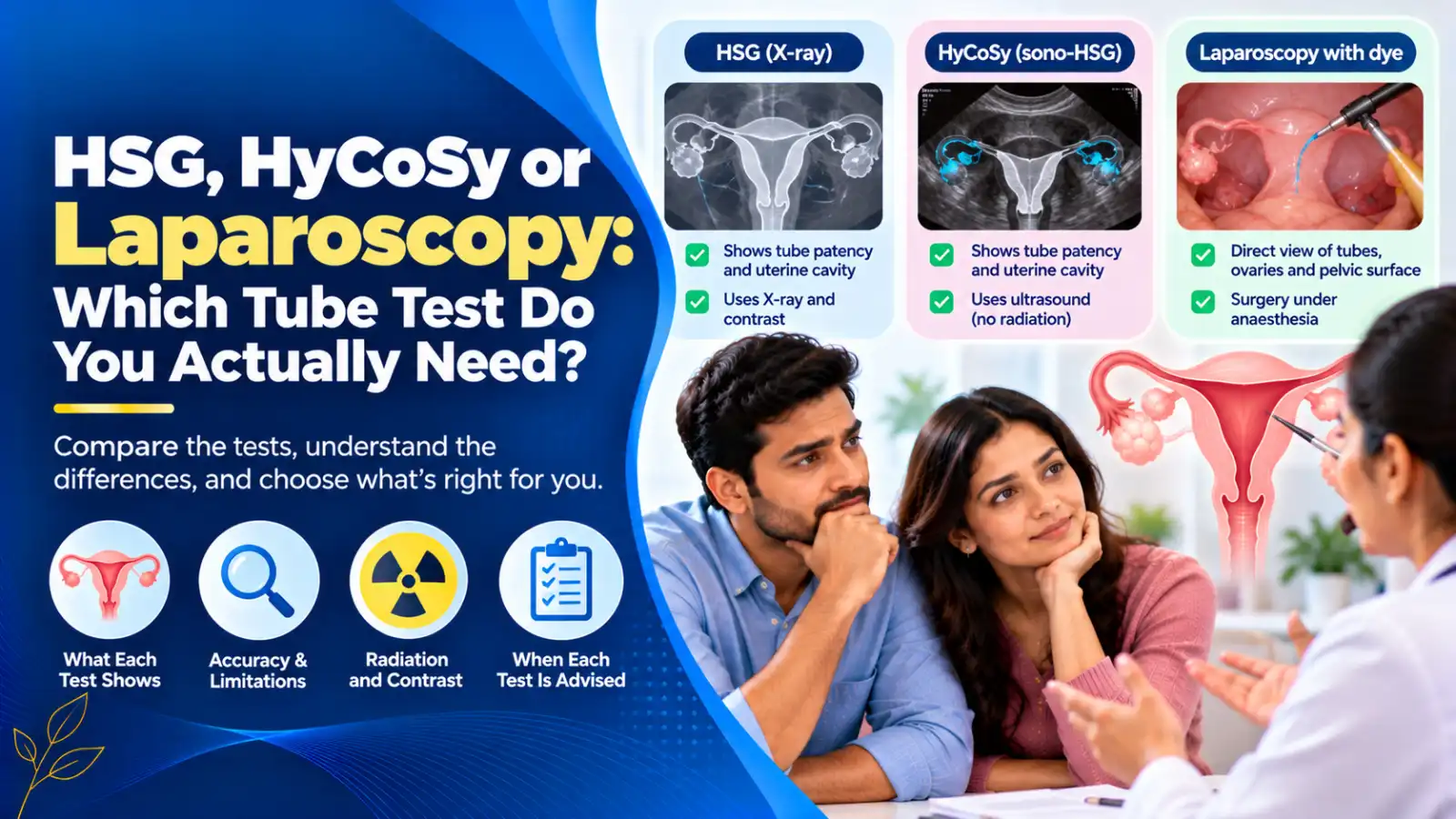
HSG vs HyCoSy vs Laparoscopy: What Is the Difference?
| Feature | HSG | HyCoSy (sono-HSG) | Laparoscopy with dye |
|---|---|---|---|
| Method | X-ray with iodine-based contrast | Ultrasound | Surgery with dye |
| What it shows | Tube patency and the outline of the uterine cavity | Tube patency and the uterine cavity using ultrasound | Tubes, ovaries and pelvic surface seen directly |
| Main limitation | Does not show structures outside the cavity and tubes | Limited detail of structures outside the tubes | Requires surgery and anaesthesia |
| Radiation | Uses X-rays | No ionising radiation | No X-ray |
| Setting | Outpatient visit | Outpatient visit | Operating theatre |
| Accuracy against laparoscopy | Sensitivity 94%; specificity 92% | Sensitivity 95%; specificity 93% | Used as the reference standard in the comparison |
| Cost | Confirm the clinic's itemised price | Confirm the clinic's itemised price | Confirm the clinic's itemised price |
The accuracy figures come from a 2014 meta-analysis of nine studies involving 582 women. The confidence intervals were wide, and study quality varied considerably. The evidence should therefore be interpreted with these limitations in mind.
HSG: The X-Ray Test for Fallopian Tubes
Hysterosalpingography, commonly called HSG, uses X-rays and iodine-based contrast to assess whether the fallopian tubes are open and examine the outline of the uterine cavity.
The 2014 review found that HSG had a sensitivity of 94% and a specificity of 92% when compared with laparoscopy and dye in the included studies.
HSG is an outpatient test, but it involves ionising radiation and iodine-based contrast. Cramping can occur during the procedure, so ask your clinic what pain-control options it offers.
If your doctor has recommended HSG, you can also read our related guide on what to expect during your first visit to an IVF clinic to prepare for discussing your fertility evaluation.
HyCoSy: An Ultrasound-Based Tube Test
HyCoSy, also called sono-HSG, uses ultrasound to assess whether the fallopian tubes are open and examine the uterine cavity.
The 2014 meta-analysis reported sensitivity of 95% and specificity of 93% for sono-HSG compared with laparoscopy and dye. These results were broadly similar to those reported for HSG.
One practical difference is that HyCoSy avoids ionising radiation and iodine contrast. It can also show the ovaries and uterine wall during the same visit.
The review's authors argued that sono-HSG should replace HSG as the first test. However, clinics still differ in their approach, and the choice may depend on local experience and available equipment.
Both HSG and HyCoSy are described in the source review as short, generally well-tolerated outpatient procedures. Cramping may occur during either test.
There is no single test that is automatically the best choice for every patient. Ask your doctor why a particular method is suitable for your situation.
HyCoSy and HyFoSy Are Not the Same Test
Although their names sound similar, HyCoSy and HyFoSy are different techniques.
HyCoSy (sono-HSG) uses fluid during ultrasound.
HyFoSy (foam sonography) uses foam instead of fluid.
A Dutch randomised trial involving 1,026 women compared HyFoSy with HSG.
The two tests produced matching conclusive results in 73% of women. Estimated live birth within 12 months was 46% when management followed HyFoSy and 47% when management followed HSG. The difference was −1.2 percentage points, with a 95% confidence interval from −3.4 to 1.5.
The trial did not meet its pre-set margin for showing that HyFoSy was no worse than HSG. Therefore, the findings do not prove equivalence for live birth.
The trial also found a lower average pain score with HyFoSy: 3.1 out of 10, compared with 5.4 for HSG.
Importantly, this study compared outcomes after the tests. It was not designed to prove that either test improves the chance of conception.
The findings for HyFoSy should not automatically be applied to HyCoSy.
Oil-Based or Water-Based Contrast: What Should You Ask?
Some tubal tests use oil-based contrast, while others use water-based contrast.
A Cochrane review found that oil-based contrast was associated with higher odds of clinical pregnancy than water-based contrast:
Clinical pregnancy odds ratio: 1.42.
95% confidence interval: 1.10–1.85.
Six trials involving 2,598 women.
Evidence quality: low.
The same review found that oil-based contrast was more likely to leak into blood vessels without symptoms.
This is both a diagnostic and a treatment-related question. The findings alone do not mean that you should choose one test over another.
Ask your doctor which contrast your clinic uses, why it is being recommended and how the benefits and risks apply to your case.
When Is Laparoscopy the Right Next Step?
Laparoscopy with dye is the most direct way among these options to examine the fallopian tubes and pelvic surface. However, it involves surgery, anaesthesia and recovery.
Your doctor may consider laparoscopy when:
Earlier tests are unclear: The results do not provide a clear answer or do not fit your clinical history.
Endometriosis or adhesions are suspected: The ESHRE 2022 endometriosis guideline suggests that clinicians consider laparoscopy for the diagnosis and treatment of suspected endometriosis.
Treatment may be needed during the same operation: A problem, such as a blocked tube, may be treated during the procedure.
Laparoscopy is not a routine first test for every couple. The decision should be made in consultation with your doctor and surgeon.
For related information, read about IVF treatment at Renew Healthcare and discuss how your tube-test findings may affect the next step in your treatment plan.
When Should HSG or HyCoSy Be Scheduled?
HSG and HyCoSy are usually performed after your period ends and before ovulation, and only after pregnancy has been excluded.
The exact day depends on your menstrual cycle and your clinic's protocol. Confirm the timing with the clinic when booking the appointment.
Do not assume that the same cycle day is suitable for everyone.
Frequently Asked Questions
1. Which tube test is the best?
There is no single best test for everyone. A 2014 meta-analysis found that sono-HSG and HSG performed similarly when compared with laparoscopy.
Your choice should consider what needs to be assessed, your comfort with radiation and pain, and the clinic's experience and equipment.
Ask your doctor why the recommended test suits your situation.
2. Is HyCoSy the same as HyFoSy?
No. HyCoSy uses fluid during an ultrasound scan, while HyFoSy uses foam. Both avoid X-rays, but they are different techniques.
Evidence from a trial of HyFoSy should not automatically be treated as evidence for HyCoSy. Confirm which technique your clinic uses.
3. Does the HSG test hurt?
Cramping may occur during HSG. In the randomised trial comparing foam sonography with HSG, the average pain score was 5.4 out of 10 for HSG and 3.1 for HyFoSy.
Pain varies from person to person. Ask your clinic what pain-control options it offers before the procedure.
4. Does a normal tube test mean my tubes are fine?
Not always. A tubal test assesses whether fluid or contrast passes through the tubes, but it does not reveal every possible problem outside the tubes or elsewhere in the pelvis.
If the result does not match your history, your doctor may recommend another test. A normal result is useful, but it is not a complete fertility assessment.
5. Is oil-based contrast better?
Some trials suggest that oil-based contrast may increase the odds of pregnancy compared with water-based contrast. However, the evidence is low quality, and oil-based contrast has a higher chance of leaking into blood vessels without symptoms.
Ask whether your clinic uses oil-based contrast and why it is being recommended.
6. When is laparoscopy needed?
Laparoscopy may be considered when other tests are unclear, when endometriosis or adhesions are suspected, or when a blocked tube might be treated during the same operation.
Because it requires anaesthesia and recovery, the decision should be made with your doctor based on your individual situation.
The Bottom Line
HSG and sono-HSG (HyCoSy) give similar results for detecting tubal blockage in the evidence reviewed, and both are short outpatient tests.
HyFoSy uses foam and was found to be less painful than HSG in one randomised trial, but that trial did not establish equivalence for live birth. Laparoscopy provides a direct view of the tubes and pelvis, but it is surgery and is usually reserved for unclear results or situations where treatment may be needed during the same operation.
Choose the test based on what your doctor needs to find out—not simply on which test sounds more advanced.
Discuss Your Tube-Test Options with Dr. Arnab Kundu
If you have been advised to undergo a tube test, bring your medical history, previous investigation reports and questions to a consultation with Dr. Arnab Kundu, an infertility specialist and IVF expert at Renew Healthcare.
Your doctor can explain what each test can and cannot show, which option fits your situation, and what the next step may be if the result is unclear.
Visit Renew Healthcare to learn more about the clinic and its fertility services.
This article is for general education and does not replace individual medical advice. Please consult a qualified specialist about your own situation.
References
Maheux-Lacroix S, Boutin A, Moore L, et al. Hysterosalpingosonography for diagnosing tubal occlusion in subfertile women: a systematic review with meta-analysis. Human Reproduction. 2014;29(5):953–963. doi:10.1093/humrep/deu024.
van Welie N, van Rijswijk J, Dreyer K, et al. Can hysterosalpingo-foam sonography replace hysterosalpingography as first-choice tubal patency test? A randomized non-inferiority trial. Human Reproduction. 2022;37(5):969–979. doi:10.1093/humrep/deac034.
Wang R, Watson A, Johnson N, et al. Tubal flushing for subfertility. Cochrane Database of Systematic Reviews. 2020;10. doi:10.1002/14651858.CD003718.pub5.
Becker CM, Bokor A, Heikinheimo O, et al. ESHRE guideline: endometriosis. Human Reproduction Open. 2022;2022(2). doi:10.1093/hropen/hoac009.
Publication note: The source document flags the 2014 evidence as dated and asks for a check for newer tubal-patency reviews. It also requires clinical confirmation of cycle timing and several procedural statements. Complete those checks and obtain doctor sign-off before publication.