
A patient asked me this week: "Doctor, is 8 eggs bad? My friend got 20." It's one of the most common questions I hear in my Salt Lake clinic — and one of the most misunderstood numbers in fertility care. Here is what the evidence actually says.
Key Takeaways
- Under 35: 10–15 mature eggs is a commonly cited "good" range; some clinics target up to 15–20.
- Average retrieval falls from roughly 16 eggs (under 35) to under 8 eggs (over 42).
- Live birth rates plateau (and OHSS risk rises) beyond about 18–20 eggs — more is not always better.
- Egg quality, driven largely by age, matters more than raw count for a healthy pregnancy.
What Counts as a "Good" Egg Number?
Most reproductive medicine literature places a "good" retrieval in the range of 10–15 mature eggs, with success rates rising steadily up to about 15 eggs and then levelling off. There is no single magic number — what matters is how that number compares to what is realistic for your age and ovarian reserve, not to a stranger's cycle.
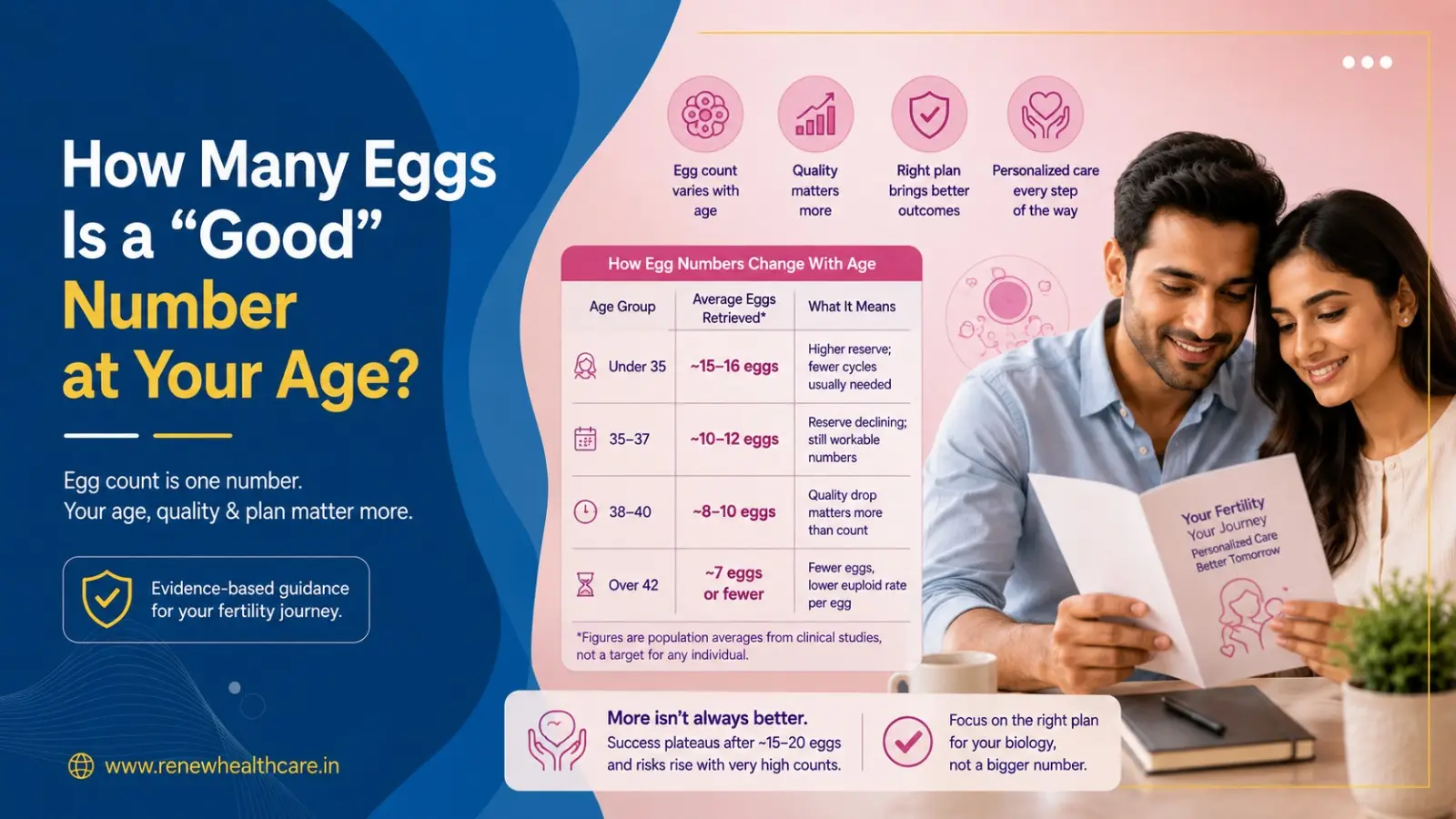
How Egg Numbers Change With Age
- Under 35 — about 15–16 eggs on average: higher reserve; fewer cycles usually needed.
- 35–37 — about 10–12 eggs: reserve declining, but still workable numbers.
- 38–40 — about 8–10 eggs: the quality drop matters more than the count.
- Over 42 — about 7 eggs or fewer: fewer eggs, and a lower euploid rate per egg.
These figures are population averages from clinical studies, not a target for any individual. Your AMH and antral follicle count give a far more personal estimate.
Why More Isn't Always Better
Beyond roughly 18–20 eggs, live birth rates stop improving in most studies, while the risk of ovarian hyperstimulation syndrome (OHSS) rises. A very high count — 20, 25, 30 or more — can also signal PCOS, where egg quality is often more variable. Chasing a bigger number is not the goal; chasing the right protocol for your biology is.
Quality Over Quantity, Especially After 35
A 32-year-old with 6 eggs often has better odds than a 41-year-old with 12, because the proportion of chromosomally normal (euploid) eggs falls with age. Recent ASRM 2025 data reinforced this: women under 38 can still see good outcomes from just 3–6 eggs when quality is favourable. This is why I counsel patients on their individual AMH and age trend, not a borrowed benchmark.
Myth vs Fact
- Myth: More eggs always means a higher chance of a baby.
- Fact: Success plateaus after about 15–20 eggs; quality outweighs quantity beyond that point.
What You Can Do
- Ask for your AMH and antral follicle count before your first cycle — they predict your likely range.
- Don't compare your number to another patient's; ages and diagnoses differ.
- Discuss a personalised stimulation protocol rather than a "more is better" approach.
A Quick FAQ
Is 5 eggs too few to succeed with IVF?
Not necessarily — especially under 35, a smaller number of good-quality eggs can still lead to a healthy pregnancy.
Does a high egg count mean better quality?
No — very high counts (often linked to PCOS) can include a higher share of immature or lower-quality eggs.
The Bottom Line
Your egg number is one data point, not a verdict. What matters is how it's interpreted alongside your age, AMH, and treatment plan. If you're unsure what your numbers mean for your journey, I'd be glad to walk through them with you at my Salt Lake clinic.
Book a consultation with Dr. Neha Yadav to understand your personal egg-count and AMH trends before starting treatment.
References
Tan TY et al. Female ageing and reproductive outcome in assisted reproduction cycles. Singapore Med J. 2014;55(6):305–309.
ASRM 2025 Annual Meeting proceedings, San Antonio — oocyte number and live birth outcomes by age (2025).
Sunkara SK et al. Association between the number of eggs and live birth in IVF. Hum Reprod. 2011;26(7):1768–1774.
Dr. Neha Yadav — Infertility Specialist, IVF Expert & Gynecologist, Salt Lake, Kolkata.