
Medically reviewed by Dr. Arnab Kundu — Infertility Specialist, IVF Expert & Gynaecologist at Renew Healthcare
There is no single “good number” of eggs for IVF. The number retrieved is only the beginning of the fertility journey. What ultimately matters is how many eggs mature, fertilise, develop into blastocysts, and become usable embryos.
A retrieval of 8–14 eggs can be a comfortable range for many patients, but fewer eggs can absolutely result in a successful pregnancy. More eggs are not automatically better, particularly because the risk of ovarian hyperstimulation syndrome (OHSS) can increase with very high responses. 27 - How Many Eggs Is Good at Y…
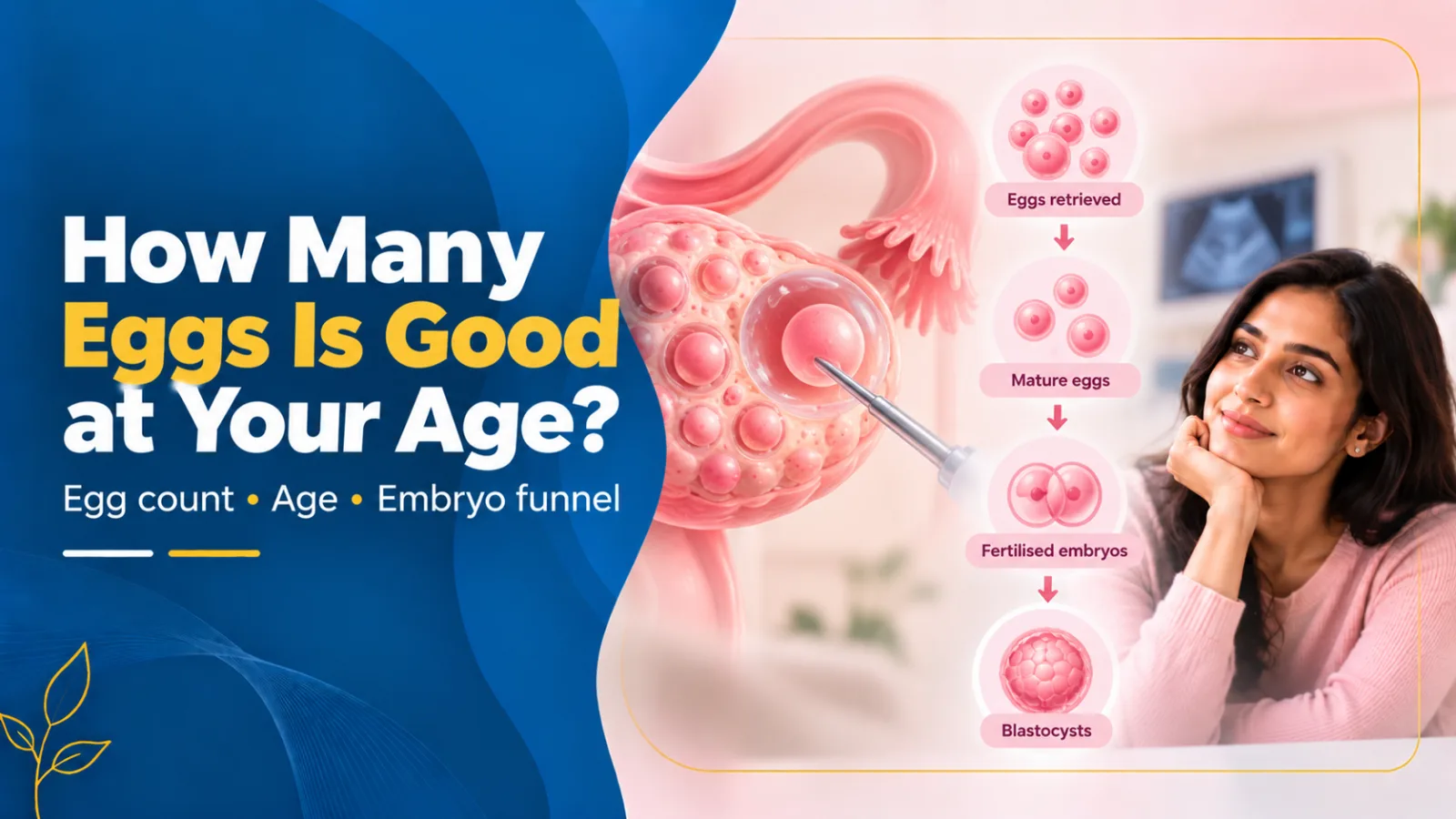
The IVF Egg-to-Embryo Funnel
When your doctor tells you, “We retrieved nine eggs,” that number is only the first stage.
The usual IVF funnel is:
- Eggs retrieved
- Mature eggs
- Fertilised eggs
- Blastocysts on Day 5–6
- Usable embryos for transfer or freezing
Not every egg will make it through every stage. The source notes that roughly half of fertilised embryos reaching the blastocyst stage is common, with development generally becoming less favourable with increasing age. 27 - How Many Eggs Is Good at Y…
So, a retrieval of nine eggs does not necessarily mean a poor result. The complete funnel gives a much more meaningful picture.
Why Age Changes What an Egg Count Means
Egg quantity and egg quality are different.
The number of eggs retrieved largely reflects ovarian reserve and the response to stimulation. However, the ability of an embryo to continue developing and implant is strongly influenced by egg quality, which changes with age. The proportion of chromosomally abnormal eggs increases through the 30s and more rapidly after approximately 37–38. 27 - How Many Eggs Is Good at Y…
Under 35
Younger patients generally have a higher proportion of chromosomally normal eggs. Even a retrieval of 5–8 eggs can produce usable blastocysts. 27 - How Many Eggs Is Good at Y…
Age 35–37
Conversion from eggs to embryos can still be good, although it gradually begins to decline. Mid-sized retrievals can remain quite workable. 27 - How Many Eggs Is Good at Y…
Age 38–40
The proportion of chromosomally normal eggs becomes lower. Having more eggs can therefore provide more opportunities for embryos to continue developing. 27 - How Many Eggs Is Good at Y…
Over 40
Only a minority of eggs may be chromosomally normal. For some patients, the strategy may therefore involve accumulating embryos over multiple cycles rather than focusing on achieving a very large retrieval in one cycle. 27 - How Many Eggs Is Good at Y…
So, What Is a “Good” Egg Retrieval?
The source describes 8–14 eggs as a comfortable working range rather than a target that every patient must reach.
- 8–14 eggs: A comfortable range for many patients.
- 4–7 eggs: Still a workable retrieval, particularly in younger patients.
- 1–3 eggs: Not automatically futile; the complete funnel and age matter.
- 20+ eggs: A high response that may raise OHSS concerns and can lead to discussion of approaches such as freeze-all. 27 - How Many Eggs Is Good at Y…
The important point is that egg count should not be treated as a score.
One woman may retrieve 15 eggs and end up with one blastocyst, while another may retrieve three eggs and obtain two blastocysts. Looking at what happened at every stage can provide much more useful information than comparing retrieval numbers alone. 27 - How Many Eggs Is Good at Y…
Is 5 Eggs Enough for IVF?
Yes, five eggs can still result in transferable blastocysts and pregnancy, particularly in younger patients.
The important question is not simply:
“How many eggs did I get?”
Instead, ask:
- How many were mature?
- How many fertilised?
- How many developed into blastocysts?
- How many were suitable for transfer or freezing?
The funnel matters more than the retrieval headline. 27 - How Many Eggs Is Good at Y…
Why Did Someone Else Get 20 Eggs While I Got 8?
Egg retrieval numbers vary considerably between women, even at the same age.
Ovarian reserve, AMH, antral follicle count, stimulation response and the treatment protocol can all influence the number retrieved. Comparing your retrieval directly with another person's number can therefore be misleading. 27 - How Many Eggs Is Good at Y…
What If Your Egg Count Was Lower Than Expected?
A lower-than-expected retrieval is information, not necessarily treatment failure.
Your fertility specialist can review:
- Whether AMH and antral follicle count predicted the retrieval
- Whether the stimulation dose was appropriate
- The protocol used
- Trigger timing
- How efficiently the eggs converted into embryos
- Whether changes should be considered in a future cycle
A cycle producing fewer eggs than expected should therefore lead to a discussion about the entire treatment process rather than focusing on one number. 27 - How Many Eggs Is Good at Y…
Can You Increase Your Egg Count?
Ovarian reserve itself cannot simply be increased.
The source recommends focusing on general health measures such as stopping smoking and maintaining a healthy weight, while noting that supplements marketed specifically to increase egg counts are not supported by the biology described in the article. 27 - How Many Eggs Is Good at Y…
The Bottom Line
The number you hear immediately after egg retrieval is the beginning of the funnel, not the final result.
A more useful way to understand your IVF cycle is to consider:
Eggs retrieved → mature eggs → fertilisation → blastocysts → usable embryos
Age matters because egg quality changes over time. So rather than comparing your retrieval number with someone else's, discuss what your age, AMH, follicle count and complete embryo-development funnel mean for your individual treatment plan. 27 - How Many Eggs Is Good at Y…
For personalised fertility and IVF guidance, you can consult Dr. Arnab Kundu at Renew Healthcare.
Related IVF resources:
- IVF Treatment at Renew Healthcare
- Low AMH and fertility — link to your existing AMH article
- Antagonist vs Long Agonist Protocol — link to your IVF protocol article
- OHSS — link when the dedicated article is published
This article is for general educational purposes and does not replace individual medical advice. Please consult a qualified fertility specialist regarding your own treatment.