
By Dr. Neha Yadav | Infertility Specialist & IVF Expert | Salt Lake, Kolkata
Your embryos are ready. Your doctor says, “Let’s freeze them and transfer next month.” You wanted the transfer today. Who is right?
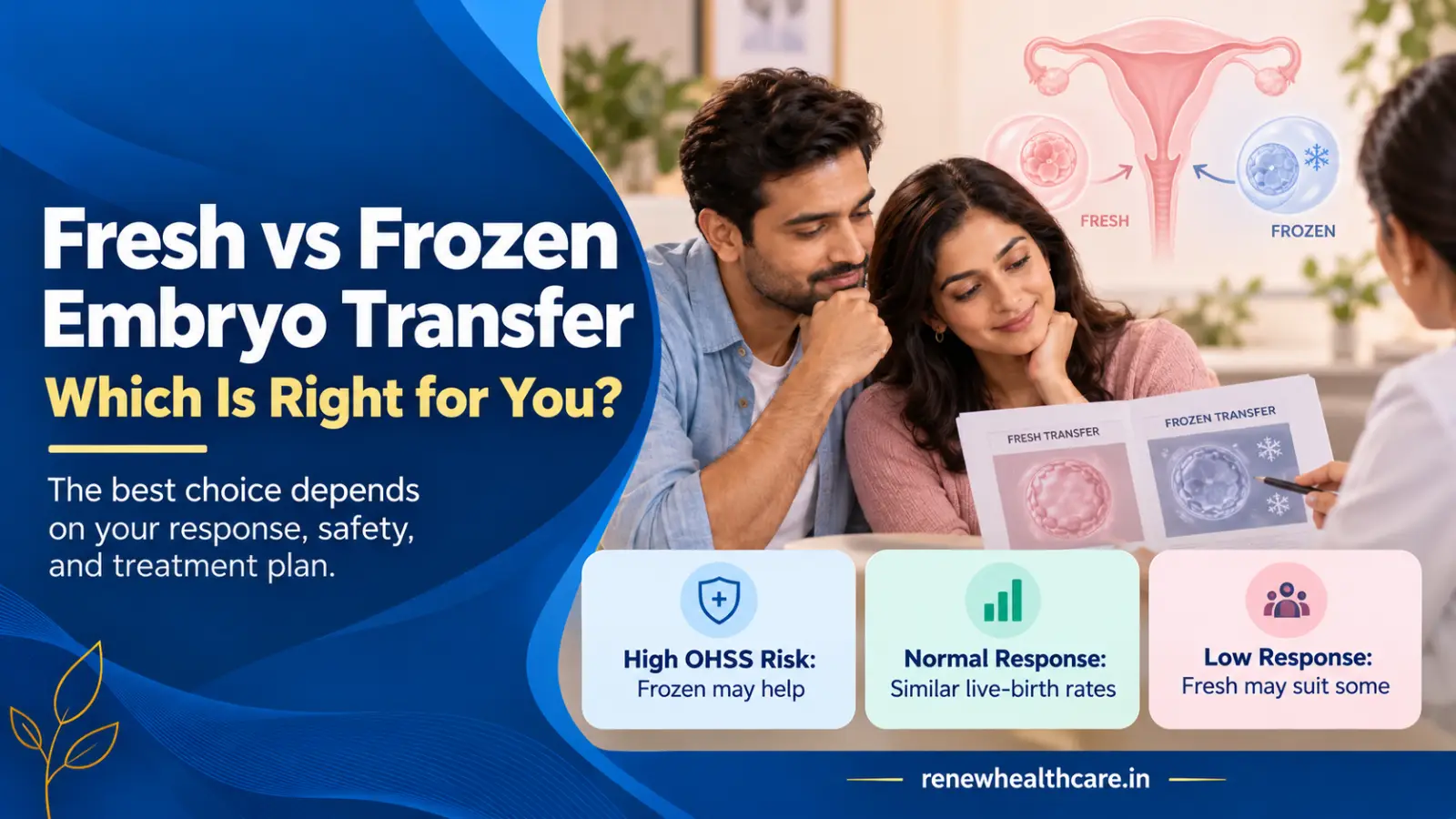
Often, both approaches can be right. The best choice depends on your ovarian response, hormone levels, uterine lining and individual pregnancy risks.
Key Takeaways
For most women with a normal ovarian response, live-birth outcomes are similar with fresh and frozen embryo transfer.
A freeze-all approach clearly helps prevent severe ovarian hyperstimulation syndrome (OHSS) in high responders.
Women who produce few eggs may benefit from a fresh transfer.
Frozen embryo transfer also has potential risks, including pre-eclampsia.
The best transfer strategy is the one matched to your individual clinical situation.
What Is the Difference Between Fresh and Frozen Embryo Transfer?
A fresh embryo transfer takes place a few days after egg collection, while hormone levels from ovarian stimulation may still be high.
A frozen embryo transfer (FET) takes place during a separate cycle after the embryo has been frozen and stored. This allows the uterine environment and timing to be managed separately from ovarian stimulation.
The embryo is the same; the uterine environment is not.
You can learn more about the overall treatment process in our guide to embryo transfer.
Who Usually Benefits From Fresh or Frozen Embryo Transfer?
| Patient profile | Usually favoured | Why |
|---|---|---|
| High ovarian response with OHSS risk | Frozen transfer | Strongest evidence for reducing OHSS |
| Normal response with a good uterine lining | Either | Similar live-birth outcomes |
| Low response with few eggs | Often fresh transfer | Avoids waiting for another cycle; a trial favoured fresh transfer |
| PGT-A planned | Frozen transfer | Time is needed for biopsy results |
| Uterine lining out of step at trigger | Frozen transfer | Allows better timing |
These are general patterns, not rules that apply to every patient.
When deciding between fresh and frozen transfer, I consider ovarian response, progesterone levels, uterine lining, embryo number and pregnancy risk factors.
Consider two illustrative composite examples. Priya, 31, has PCOS and produces 24 eggs. She experiences bloating on trigger day, so all embryos are frozen and one is transferred safely in the next cycle. Meera, 38, produces four eggs and proceeds with a fresh transfer, avoiding an additional month of waiting.
The appropriate approach differs because their clinical circumstances differ.
Risks to Know Before Choosing
Fresh and frozen transfers each have considerations that should be discussed before treatment.
Frozen embryo transfer
Programmed frozen cycles using hormone replacement showed a higher pre-eclampsia rate than natural cycles in one retrospective study: 8.6% versus 3.8%.
Natural frozen cycles may carry a lower pre-eclampsia risk, although the available evidence is observational.
Fresh embryo transfer
Fresh transfer has been associated with higher rates of small-for-gestational-age babies and preterm birth.
Most of the data in this area is observational, so individual circumstances remain important when interpreting these findings.
Fresh vs Frozen Embryo Transfer: Myths and Facts
Myth 1: Frozen embryo transfer is always better.
Fact: A 2026 guideline advises against using a freeze-all strategy simply to increase live-birth rates. For women with a normal ovarian response, fresh and frozen transfers can have similar outcomes.
Myth 2: Freezing damages embryos.
Fact: Modern vitrification is a reliable freezing technique that preserves most embryos well. Survival varies by laboratory. The practical considerations of a frozen approach include additional time and cost.
Cost and Time in India
A frozen transfer route adds embryo freezing, storage and a separate transfer cycle. Before deciding, ask your clinic for an itemised estimate covering these costs.
One small, single-centre Indian study involving 108 women with high oestradiol levels found more pregnancies after frozen transfer. However, this should be treated as a hint rather than definitive proof that frozen transfer is better for everyone.
Frequently Asked Questions
Is frozen embryo transfer more successful?
Not for everyone. For women with a normal ovarian response, live-birth outcomes are similar. The benefit of frozen transfer is clearest for high responders and patients who need to delay transfer.
Does freezing damage embryos?
Modern vitrification preserves most embryos well, although survival rates vary by laboratory.
Will frozen embryo transfer delay pregnancy?
Yes. It usually delays transfer by one cycle or more. Cumulative live-birth outcomes are similar.
Is frozen embryo transfer more expensive in India?
It often costs more because freezing, storage and a separate transfer cycle add expenses. Ask your clinic for an itemised estimate.
Which frozen transfer cycle is safer?
Natural cycles may carry a lower pre-eclampsia risk than programmed hormone-replacement cycles. However, the available evidence is observational.
Can I ask for a fresh embryo transfer?
Yes, if there is no OHSS risk or PGT-A requirement that makes a fresh transfer unsuitable. Discuss your circumstances with your fertility specialist.
Does age change the answer?
Age affects embryo quality more than transfer type. One large cohort found no age-based difference in live-birth outcomes between fresh and frozen transfer.
Does PGT-A require frozen embryo transfer?
Usually, yes. Biopsy results take time, so embryos are generally frozen while awaiting the results.
Common Mistakes to Avoid
Assuming fresh embryo transfer is outdated.
Assuming frozen embryo transfer is safer for everyone.
Choosing a transfer method based on cost alone.
Checklist for Your Fertility Consultation
Before deciding, ask your clinic:
How did I respond to ovarian stimulation, and am I at risk of OHSS?
Is PGT-A planned?
If I need frozen transfer, would a natural or programmed cycle be appropriate?
What additional cost and delay should I expect?
Trials have mostly enrolled women with normal or high ovarian responses, and conclusions may change as new research becomes available.
Conclusion
The best embryo transfer is the one matched to your clinical situation. Fresh transfer may suit some women, while frozen transfer offers important benefits for others, particularly those at risk of OHSS or who need additional time before transfer.
The decision should be made through clear discussion between you and your fertility specialist, considering your ovarian response, hormone levels, uterine lining, embryo number and pregnancy risk factors.
For guidance on your individual treatment plan, consult Dr. Neha Yadav at Renew Healthcare.
You can also explore IVF treatment at Renew Healthcare and read our related guide, Embryo Transfer: How Does It Happen?.
Educational information, not individual medical advice.
Dr. Neha Yadav
Infertility Specialist & IVF Expert
Salt Lake, Kolkata