
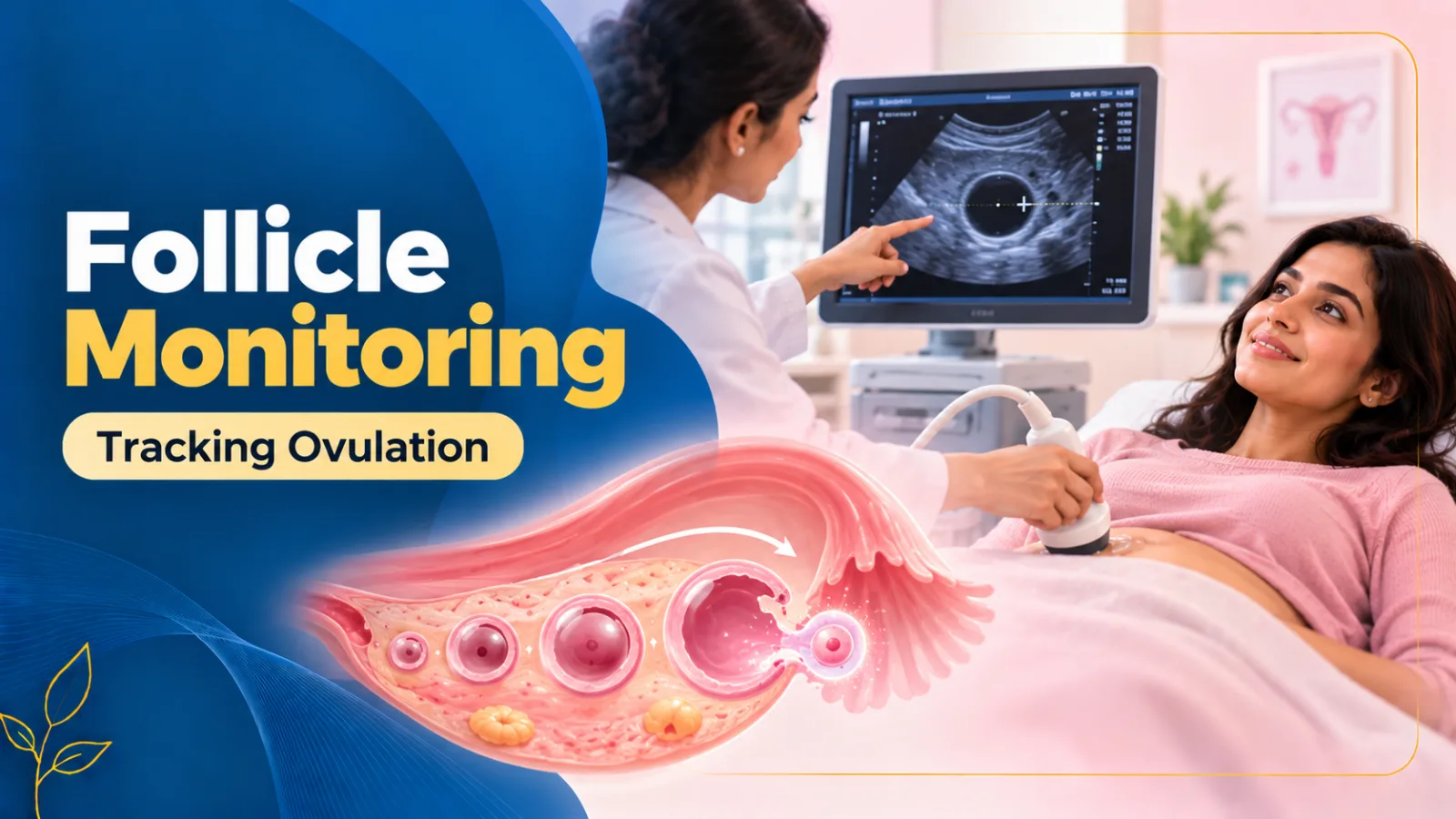
By Dr. Neha Yadav | Infertility Specialist & IVF Consultant | Salt Lake, Kolkata
“Right ovary, 14 mm. Come back day after tomorrow.” You nod, walk out, and wonder: fourteen millimetres of what, and what does it mean for tonight?
Key Takeaways
- A scan shows a follicle is ready; a later scan showing it collapsed confirms ovulation.
- The lead follicle usually grows about 1–3 mm a day and ovulates around 18–24 mm.
- The uterine lining usually thickens toward 7–12 mm; there is no single magic number.
- Ovulation typically follows an LH surge by 24–36 hours; sperm can live up to 5 days.
- Most women need 2–4 scans in a cycle, not daily scans.
Why Scan at All?
Apps and calendars guess. Cycles vary, and ovulation may come late, or not at all, in conditions like PCOS.
A scan lets us watch the follicle, the fluid-filled sac holding the egg. LH kits catch the hormone surge; the scan shows the follicle behind it.
What Each Scan Tells You
| Scan | Typical Timing* | What We Look For | What It Means |
|---|---|---|---|
| 1. Baseline | Day 2–3 | Antral follicles, cysts, uterine shape | Clean start |
| 2. First tracking | Day 9–11 | Lead follicle ~10–14 mm; lining ~5–7 mm | Growth is on track; next date set |
| 3. Approach | Day 12–14 | Follicle ~16–18 mm; lining 7–9 mm | Ovulation likely within days |
| 4. Peak | Day 13–16 | Follicle 18–24 mm; layered “triple-line” lining | Ovulation close; time intercourse, IUI or trigger |
| 5. Confirmation | 1–3 days later | Collapsed follicle, small free fluid | Ovulation probably happened |
*Based on a 28-day cycle. Longer cycles, or tablets such as letrozole, shift scans later. Phase1_Follicle_Monitoring_Arti…
So When Will You Ovulate?
Three clues, read together:
Size
One Indian series of 86 women found growth of about 2 mm a day, rising to about 3 mm in the final two days, with ovulation at a mean of 24 mm.
LH Kit
A positive test usually means ovulation within 24–36 hours.
Trigger Injection
If given, ovulation generally follows in roughly 36–40 hours, though protocols vary.
Timing Intimacy Without the Pressure
Sperm outlast the egg, so there is no single perfect hour. Intercourse every 1–2 days from about five days before ovulation through ovulation day works well.
A Real-Life Pattern (Composite Example)
Riya, 31, has 35-day cycles. Her app said “ovulation day 14,” but her scan that day showed 12 mm; the follicle reached 20 mm on day 22.
She was not infertile. She was early.
What Scans Cannot Tell You
Scans cannot judge egg quality, and a perfect-looking follicle may not release. Unruptured follicles are a debated diagnosis, so a follow-up scan or mid-luteal progesterone test helps.
Myth vs Fact
| Myth | Fact |
|---|---|
| Everyone ovulates on day 14. | Ovulation day tracks your cycle length, and can shift between cycles. |
| A bigger follicle is always better. | Beyond roughly 24–25 mm it may be over-mature or a cyst; timing matters more than size. |
Your Action Checklist
☐ Note your cycle length and first day of bleeding.
☐ Book the first tracking scan around day 9–11 (later if cycles are long).
☐ Use an LH kit alongside, if advised.
Trying for 12 months (6 if over 35)? Seek a fertility evaluation.
Book a Consultation
If your scans feel confusing, I am happy to walk through them with you at my Salt Lake, Kolkata clinic.
Dr. Neha Yadav – Infertility Specialist & IVF Consultant