
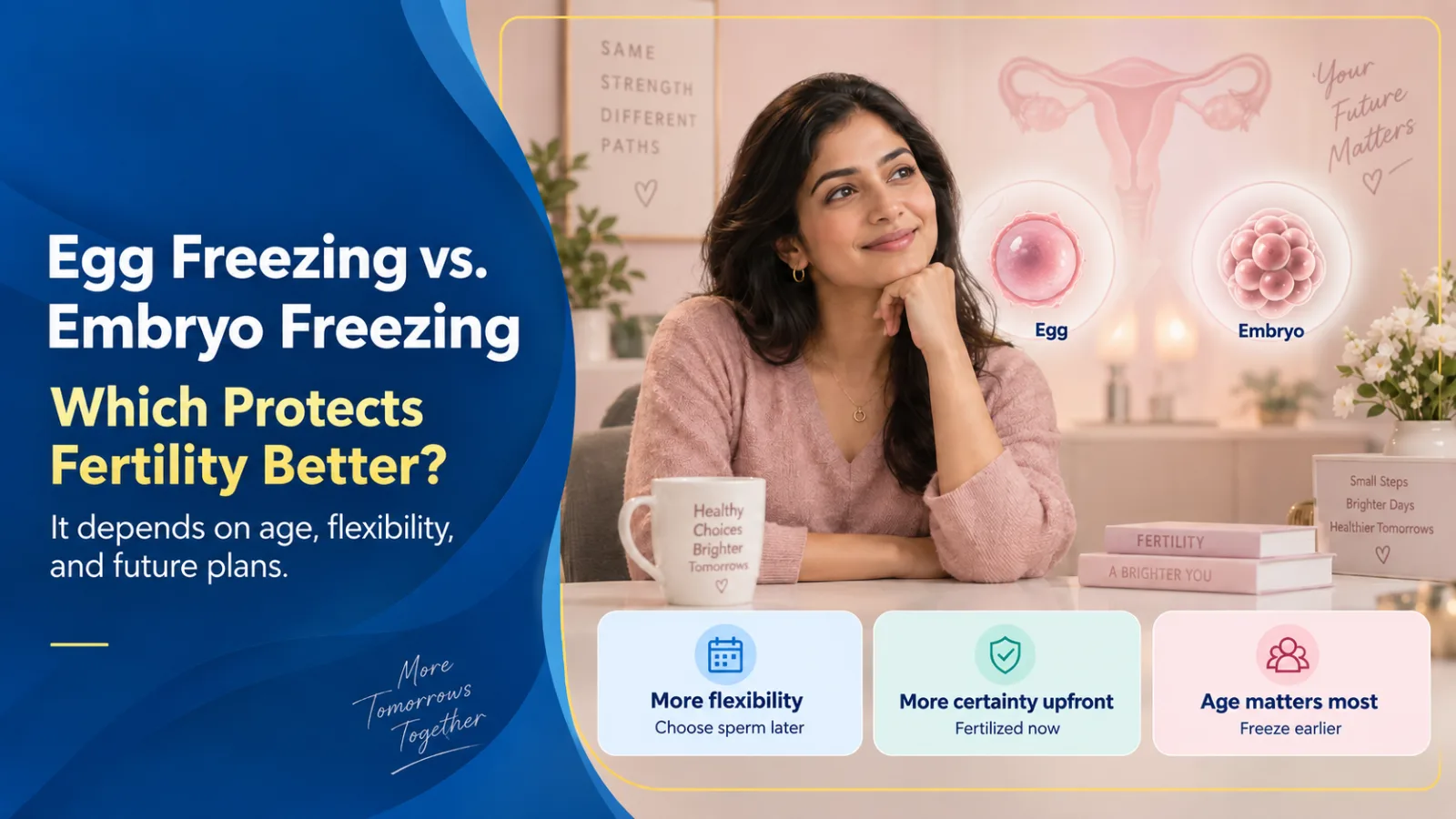
A patient asked me last week: “Doctor, if I freeze my eggs today, is my future baby already ‘safer’ than if I wait and freeze embryos later?”
It's one of the most common—and most misunderstood—questions in fertility preservation. The honest answer isn't “egg freezing” or “embryo freezing.” It's: it depends on your age, your relationship status, and how much certainty you're willing to trade for flexibility.
Key Takeaways
Embryos generally survive freeze-thaw slightly better than unfertilized eggs, but the gap has narrowed sharply with vitrification.
Age at freezing predicts outcome far more than the method itself — live birth rates run roughly 52% at ≤35, 34% at 36–39, and 19% at ≥40 per woman, per a pooled analysis of oocyte cryopreservation outcomes.
Egg freezing keeps your options open if you don't yet have a partner or sperm source; embryo freezing commits that decision now.
In India, embryo storage and use fall under the ART (Regulation) Act, 2021, which has documentation and consent implications egg freezing does not — this is worth discussing before you choose.
What's Actually Being Frozen
Egg freezing Best Age to Freeze Your Eggs, also called oocyte freezing, preserves unfertilized eggs collected after ovarian stimulation.
Embryo freezing Embryo Freezing Service goes one step further — those eggs are fertilized with sperm, either a partner's or donor's, and cultured for several days before freezing.
That single extra step is the crux of the whole decision: fertilization happens now, or it happens later.
The fertilization and embryo-development process is also part of IVF treatment. In Vitro Fertilization (IVF)
Survival and Success: What the Evidence Shows
Vitrification — today's rapid-freezing technique — has narrowed the gap between the two considerably.
Well-run labs report egg survival rates in the mid-90s percent, and blastocyst or embryo survival slightly higher, often cited around 95–99% in high-volume centres.
A large single-centre NYU study following 543 women found 39% eventually had at least one child from their frozen eggs — comparable to age-matched IVF outcomes overall.
But the number that matters most to patients is age-stratified: pooled data across studies puts live birth rate per woman at roughly:
52% when eggs were frozen at 35 or younger
34% between 36–39
19% at 40 or older
Embryo freezing shows a similar age gradient, because embryo quality still traces back to egg quality at retrieval.
For more context on how age affects egg freezing, see: Best Age to Freeze Your Eggs
You can also read more about how embryos are assessed after fertilization here: What Makes a Good Embryo? Understanding Embryo Grading
The Trade-Off That Isn't About Biology
Here is where most patient blogs stop short: the bigger difference between the two options isn't survival percentages — it's what you're deciding, and when.
Freezing eggs defers the fertilization decision, which matters if you're single, between partners, or simply not ready to choose a sperm source.
Freezing embryos gives you more information up front. You can see which embryos reach blastocyst stage and, if you choose, run genetic screening.
But it also locks in a decision about whose sperm was used, which carries emotional and, in India, legal weight if a relationship later changes.
If genetic screening is part of your decision, read about PGT counselling here: Preimplantation Genetic Testing (PGT) Counselling
The India-Specific Piece Competitor Blogs Skip
Under the ART (Regulation) Act, 2021, fertility clinics must maintain detailed consent and identity documentation for gamete and embryo storage.
Embryo-related consent involves both partners in a way single-gamete, or egg, storage does not.
This isn't a reason to avoid embryo freezing — many couples prefer the added certainty — but it's a conversation to have with your clinic before, not after, you commit.
Egg Freezing vs. Embryo Freezing, Side by Side
| Factor | Egg Freezing | Embryo Freezing |
|---|---|---|
| Sperm needed now? | No | Yes |
| Typical post-thaw survival | ~90–97% (top labs) | ~95–99% (blastocyst) |
| Pre-freeze genetic screening | Not possible | Possible (PGT-A, optional) |
| Flexibility if partner changes | High | Low — consent tied to both gamete sources |
| Best suited for | Single women, undecided partner status | Couples certain of their sperm source |
Myth vs. Fact
Myth: “Embryo freezing guarantees a baby later.”
Fact: No method guarantees a live birth; age at freezing remains the strongest predictor for both.
Myth: “Egg freezing is basically obsolete now.”
Fact: Vitrification has closed most of the survival gap; egg freezing remains a strong, flexible option, especially without a settled partner.
Myth: “Freezing more eggs always means a better outcome.”
Fact: Quantity helps, but egg quality, driven by age, still determines how many become usable embryos.
Action Checklist Before You Decide
Get an AMH and antral follicle count to understand your ovarian reserve before choosing a path. For more on AMH: The Link Between AMH Levels and IVF Success
Ask your clinic for their own lab's egg and embryo survival rates — not just published averages.
Discuss ART Act, 2021 consent requirements for embryo storage with your clinic upfront.
If undecided on a partner, consider egg freezing now and revisit embryo creation later.
Freeze earlier rather than later — age at freezing outweighs the method you choose.
If you want to understand the collection stage before freezing, see: Egg Retrieval Process: A Complete Guide
Frequently Asked Questions
Is embryo freezing more successful than egg freezing?
Slightly, in post-thaw survival — but overall live birth rate depends more on the age at which the eggs were originally retrieved than on whether they were frozen as eggs or embryos.
Can I freeze eggs first and make embryos later?
Yes. This is one of the most common paths — eggs are thawed and fertilized only when you're ready to use them.
Does egg freezing require a male partner?
No. Egg freezing needs no sperm source at the time of freezing, which is precisely why many single women choose it.
Not Sure Which Path Fits Your Situation?
Dr. Neha Yadav offers personalised fertility preservation counselling at her Salt Lake, Kolkata clinic — reviewing your ovarian reserve, age, and goals before recommending a path, never before.
References
ASRM Ethics Committee. Planned oocyte cryopreservation to preserve future reproductive potential: an Ethics Committee opinion. Fertil Steril. 2024;121:604–612.
Cascante SD, et al. Fifteen years of autologous oocyte thaw outcomes from a large university-based fertility center. Fertil Steril / NYU Langone, 2024.
Trends in patient age at planned oocyte cryopreservation — pooled live birth rate analysis. PMC, 2024 (PMC11621261).
Outcomes of Social Egg Freezing: A Cohort Study and Comprehensive Literature Review. PMC, 2023 (PMC10342811).
ART (Regulation) Act, 2021, Government of India — consent and documentation provisions for gamete and embryo storage.
Verification flag: Confirm current-year (2026) India-specific embryo storage duration limits under ART Rules before publication, as state-level clinic guidance has varied.