
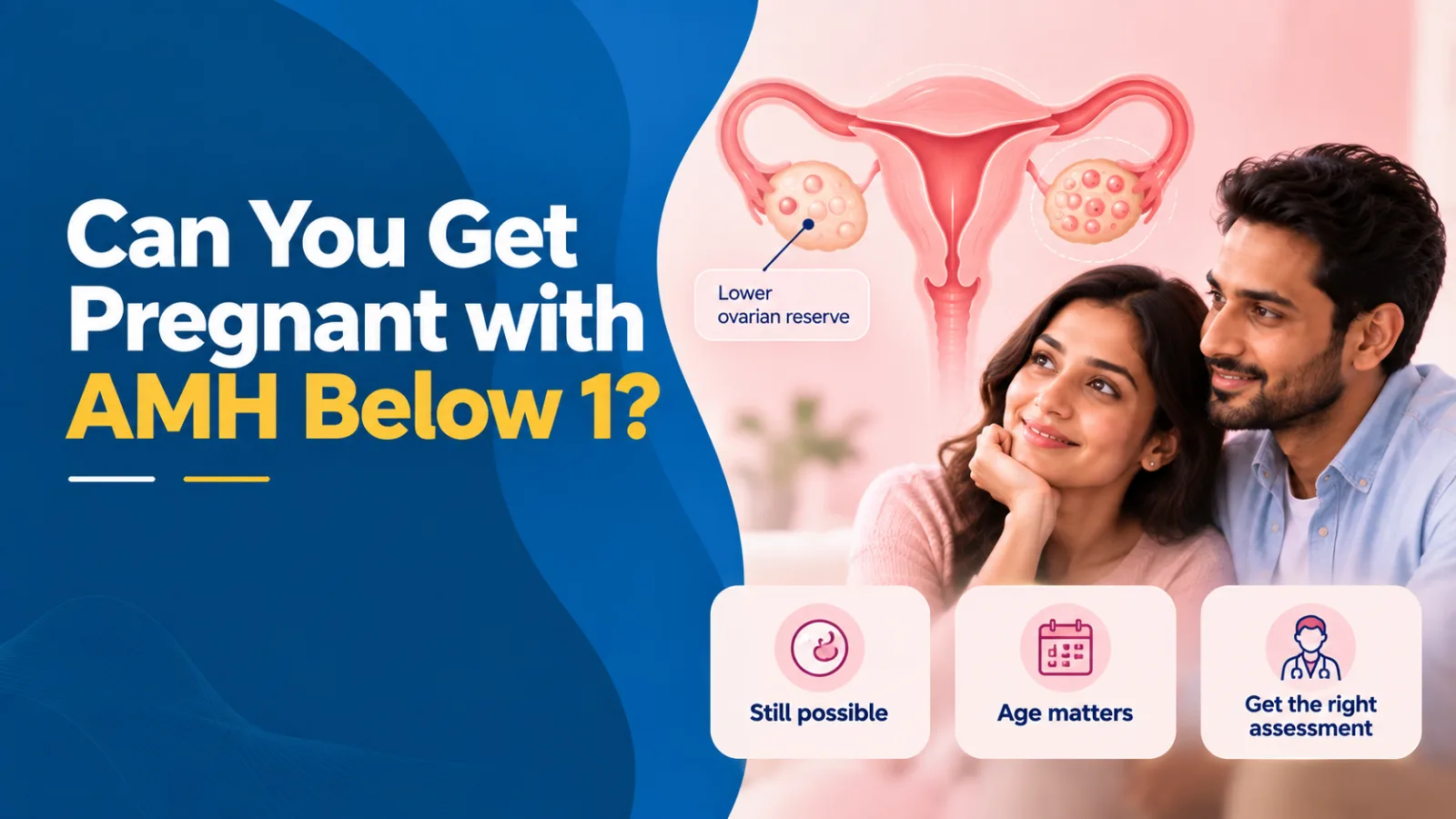
Women with AMH below 1 ng/mL can conceive — both naturally and with fertility treatment. AMH mainly helps predict how many eggs may respond to stimulation during IVF. It is a much weaker predictor of whether you can conceive, particularly when you are under 35.
What a low AMH changes is your timeline and treatment strategy, not whether pregnancy is possible.
What Does AMH Below 1 Actually Mean?
Anti-Müllerian hormone (AMH) is produced by small follicles in the ovaries. Testing AMH provides an estimate of the number of follicles that may be available for recruitment.
AMH is particularly useful when planning an IVF cycle, because it can help doctors estimate how many eggs the ovaries may produce during stimulation.
An AMH below 1 ng/mL generally suggests that an IVF cycle may produce a more modest number of eggs rather than a large number.
However, AMH does not reliably tell you:
- Whether your eggs are good quality
- Whether you can conceive naturally
- Whether you need IVF
- Exactly when you will reach menopause
Age is more important when considering egg quality.
Can You Get Pregnant Naturally with Low AMH?
Yes.
The source document cites a prospective study of 750 women aged 30–44 with no history of infertility. Women with AMH below 0.7 ng/mL were compared with women who had normal AMH levels.
The study found no significant difference in natural conception rates. By six cycles, 65% of women in the low-AMH group had conceived compared with 62% in the normal-AMH group. By twelve cycles, the figures were 84% and 75%, respectively.
Natural conception does not require a large number of eggs at the same time. Ovulation of one healthy egg can be enough for pregnancy when other factors, such as the fallopian tubes and sperm quality, are favourable.
IVF is different because the goal is to collect multiple eggs during one cycle. This is why AMH is more useful for IVF planning than for predicting natural conception.
If you are considering fertility treatment, you can learn more about IVF treatment at Renew Healthcare.
Why Does Age Matter?
Two women can have exactly the same AMH level but have very different fertility situations.
For example, a 31-year-old with an AMH of 0.6 ng/mL and a 41-year-old with the same AMH may have different fertility considerations.
The AMH may indicate lower ovarian reserve in both women, but age has a major influence on egg quality and reproductive potential.
That is why an AMH result should always be interpreted in the context of your age and your overall fertility assessment.
What Should You Do If Your AMH Is Below 1?
Your next step depends on your age, how long you have been trying to conceive, and your overall fertility history.
If You Are Under 35
Low AMH alone does not automatically mean that you need IVF.
However, it is important not to postpone a fertility evaluation for several years. A complete assessment can include checking ovulation, the fallopian tubes and your partner's semen analysis.
A proper fertility assessment can help identify factors that may be affecting conception beyond your AMH level.
If You Are 35–39
The source recommends considering a full fertility assessment after six months of trying. A low AMH may be one factor to discuss when deciding how quickly to move forward.
If You Are 40 or Older
It is reasonable to seek a fertility assessment and discuss treatment options sooner because both ovarian reserve and age-related egg quality can affect fertility.
Could IUI Be an Option?
Depending on your overall fertility assessment, your doctor may discuss different treatment options.
Intrauterine insemination (IUI) is a fertility treatment in which prepared sperm is placed directly into the uterus around the time of ovulation. The appropriate treatment depends on factors such as age, ovulation, sperm quality and fallopian tube status.
You can learn more about IUI treatment at Renew Healthcare.
Before You Worry About Your AMH Result
A single AMH result should not be interpreted in isolation.
Hormonal contraception can lower measured AMH, different laboratories may use different testing methods, and AMH can fluctuate.
An antral follicle count (AFC) through ultrasound is an important companion assessment. Comparing AMH and AFC can provide a more complete picture of ovarian reserve.
Your doctor may therefore consider your AMH alongside your age, ultrasound findings, menstrual history and other fertility tests rather than relying on one number.
Can You Increase AMH?
There is currently no reliable treatment or supplement that can restore the number of follicles in the ovaries or meaningfully increase the available egg supply.
Instead, the focus should be on:
- Completing a full fertility assessment
- Identifying and treating other fertility factors
- Avoiding unnecessary delays
- Choosing a treatment strategy appropriate for your ovarian reserve
- Having regular, well-timed intercourse when trying naturally
What If IVF Is Recommended?
A low AMH does not automatically mean that IVF cannot work.
It may mean that fewer eggs are retrieved during an IVF cycle. In some situations, your fertility specialist may discuss a strategy involving more than one cycle rather than expecting one large egg collection.
You can learn more about IVF treatment and the process at Renew Healthcare.
The Emotional Side of Low AMH
Being told that you have diminished ovarian reserve can understandably feel frightening.
But an AMH result is a measurement and a prediction, not a final outcome.
A low number does not define your fertility journey, your future or your ability to become a parent. Some women with very low AMH conceive, while others with reassuring AMH levels may experience fertility difficulties.
The purpose of AMH testing is to help guide your treatment plan — not to determine your future.
Frequently Asked Questions
Can I Get Pregnant Naturally With AMH 0.5?
Yes. Low AMH does not automatically mean that natural pregnancy is impossible. Age, fallopian tube health and your partner's semen analysis are also important factors.
Is AMH Below 1 Considered Very Low?
It generally indicates reduced ovarian reserve, but the result should be interpreted according to your age, laboratory method and units. Antral follicle count can provide additional information.
Can I Increase My AMH Before IVF?
There is no reliable way to permanently increase the number of follicles available. Supplements marketed for this purpose should not be considered a way to restore ovarian reserve.
Does Low AMH Cause Miscarriage?
AMH is primarily a marker of egg quantity and is not itself considered a direct cause of miscarriage. Egg quality is more closely associated with age.
Can IVF Work If My AMH Is Below 1?
It can. However, a lower AMH may mean fewer eggs are collected during each IVF cycle, and some treatment plans may involve more than one cycle.
Should I Freeze My Eggs If My AMH Is Low?
This is something to discuss with a fertility specialist. Lower AMH can mean fewer eggs are collected per cycle, so more than one cycle may sometimes be required.
My AMH Dropped Significantly in One Year. Should I Worry?
AMH can vary because of laboratory and assay differences. Results are best interpreted alongside your antral follicle count rather than reacting to the change in isolation.
The Bottom Line
Yes, you can get pregnant with an AMH below 1.
A low AMH mainly suggests that an IVF cycle may produce fewer eggs. It does not tell you whether you can conceive this year, whether your eggs are healthy, or exactly when your fertility will end.
The important thing is to understand your AMH alongside your age and a complete fertility assessment, rather than looking at the number alone.
If you are concerned about a low AMH result, speaking with a fertility specialist can help you understand what the result means in the context of your individual situation.
You can also learn more about Dr. Sonam Agarwal.
Medical Disclaimer: This article is for general educational purposes and does not replace individual medical advice. Please consult a qualified fertility specialist for advice based on your personal situation.