
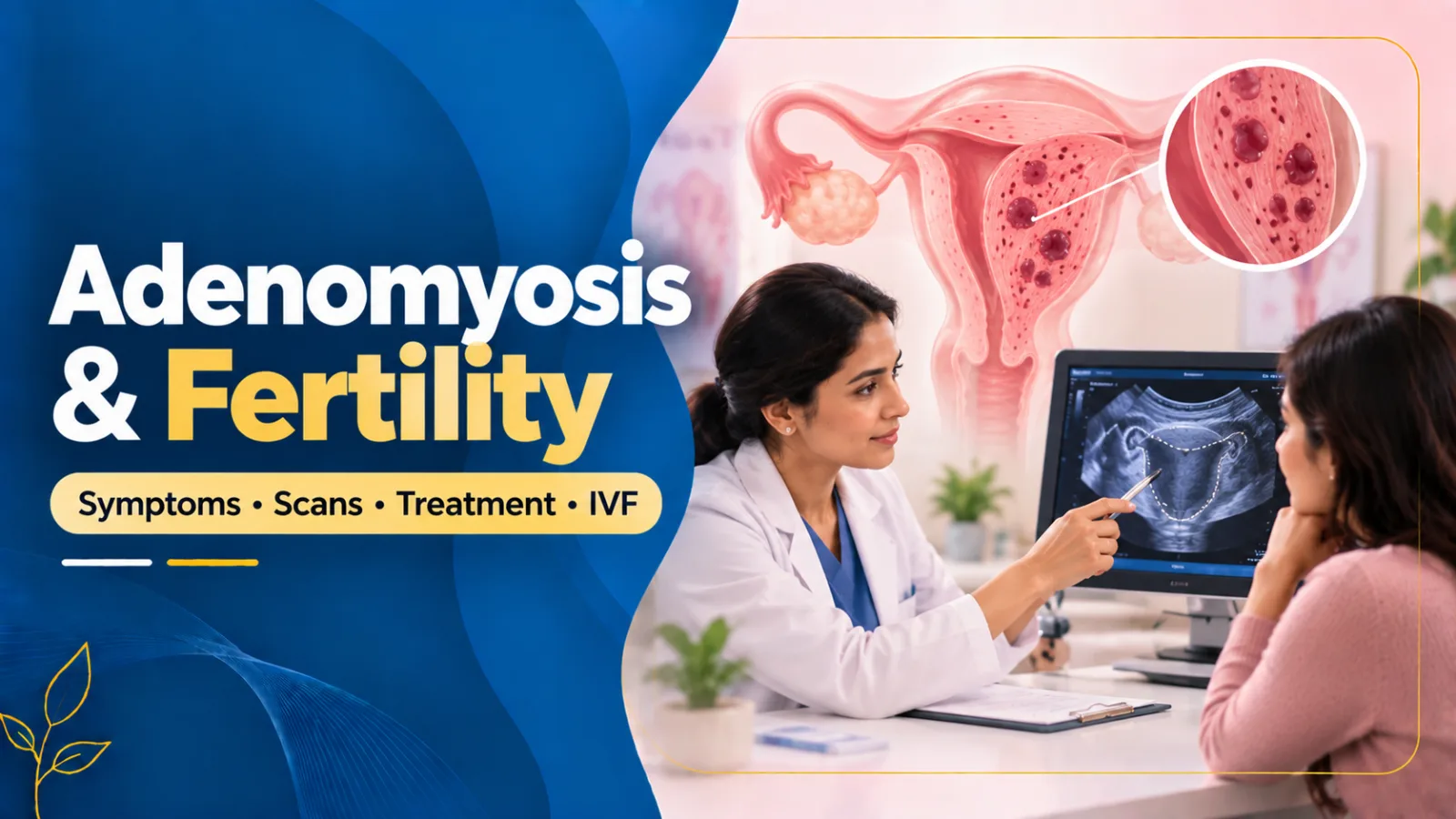
By Dr. Neha Yadav | Infertility Specialist & IVF Consultant | Salt Lake, Kolkata
Priya, 34, had painful periods for years. Her family called it normal. Then a routine scan before IVF said one word she had never heard: adenomyosis.
Her first question was the one most couples ask:
“Does this mean we cannot have a baby?”
The honest answer is more hopeful, and more nuanced, than most websites suggest.
Key Takeaways
- Adenomyosis is common in women who struggle to conceive, but it does not mean pregnancy is impossible.
- Diagnosis relies on expert ultrasound, sometimes MRI. Neither is perfect.
- The impact on IVF appears to depend on symptoms and disease pattern, not just the diagnosis.
- Treatment choices should be individual. Some commonly used approaches do not have strong evidence behind them.
What Is Adenomyosis?
Normally, the endometrium lines the inside of the uterus. In adenomyosis, endometrial tissue grows into the uterine muscle, called the myometrium.
Think of grass seed pushed into a lawn: the muscle thickens, becomes stiff, and tends to bleed and cramp more.
Adenomyosis can occur alongside endometriosis or fibroids, which can make symptoms difficult to distinguish. Researchers believe the junctional zone, the muscle layer closest to the uterine lining, may undergo repeated damage and repair, although the exact trigger remains unclear.
Symptoms: What Women Actually Notice
Some women with adenomyosis have significant symptoms, while others have none at all.
Common symptoms include:
- Heavy or prolonged periods
- Severe period cramps that worsen over time
- Pelvic pain or pressure outside periods
- Pain during intercourse
- An enlarged or tender uterus
- Difficulty conceiving
- Repeated early miscarriage
Some women discover adenomyosis incidentally during a scan. This distinction can become important when deciding whether treatment is necessary before fertility treatment.
Scans: Ultrasound Versus MRI
Transvaginal ultrasound is usually the first investigation.
An experienced operator may look for features such as:
- A globular uterus
- Asymmetric thickening of the uterine walls
- Cysts within the uterine muscle
- Changes in the junctional zone
The quality of the assessment depends heavily on the operator.
Transvaginal Ultrasound
It is widely available and usually the first-line investigation. Three-dimensional ultrasound can also improve assessment of the junctional zone.
MRI
MRI can be useful when the ultrasound findings are unclear, when the disease appears complex, or when additional information about the extent of disease and coexisting conditions is required.
A definitive diagnosis traditionally relies on tissue examination after surgery, but this is rarely how adenomyosis is diagnosed in fertility care. In practice, doctors combine symptoms and imaging and then ask a more important question:
How much is the adenomyosis actually affecting you?
How Might Adenomyosis Affect Fertility?
Several mechanisms have been proposed.
Adenomyosis may be associated with:
- Abnormal uterine contractions
- A chronic inflammatory environment
- Changes in the receptivity of the uterine lining
These mechanisms are plausible, but they are not completely proven. Much of the available evidence is observational, meaning that an association does not necessarily prove that adenomyosis directly causes infertility.
What Does the Research Say About IVF?
Research suggests that adenomyosis can be associated with lower IVF success, particularly in women with symptomatic or diffuse disease.
It has also been associated with a higher risk of miscarriage in pooled studies.
Pregnancy in women with adenomyosis has also been linked with conditions such as:
- Pre-eclampsia
- Preterm birth
- Caesarean delivery
- Small babies
- Postpartum bleeding
However, the strength of evidence varies, and not every woman with adenomyosis has the same fertility outlook.
For women considering assisted reproduction, treatment should therefore be individualised rather than based on the diagnosis alone.
If IVF is recommended as part of your fertility plan, you can learn more about IVF treatment at Renew Healthcare.
Treatment Options
Pain and Bleeding Relief
Anti-inflammatory medicines and tranexamic acid can be used to manage pain and heavy bleeding. Their suitability depends on the individual's circumstances and whether she is actively trying to conceive.
Hormonal Suppression
Treatments such as progestins and hormonal IUDs can reduce symptoms.
However, they prevent pregnancy while being used, so they are more suitable for women who are not currently trying to conceive.
GnRH Agonist Pretreatment Before Frozen Embryo Transfer
GnRH agonist treatment before frozen embryo transfer has been studied extensively, but the evidence does not currently establish a clear live-birth benefit.
A pooled analysis of eight studies, mostly retrospective, found no clear benefit. A 140-woman randomised trial also found no difference, with more estrogen exposure in the pretreatment group.
Larger studies are still needed.
Uterine-Sparing Surgery or Focused Ultrasound
These approaches may be considered in selected situations, but evidence remains limited.
Pregnancy following uterine surgery also requires careful monitoring.
These treatments should therefore be considered only after a specialist discussion of the potential benefits and risks.
Fresh or Frozen Embryo Transfer?
This is an area where the evidence remains unresolved.
Results from different studies have not been completely consistent. Some research has found comparable outcomes between fresh and freeze-all approaches, while other analyses have suggested potential advantages with frozen transfer.
There is no single approach that is automatically right for every woman with adenomyosis.
The decision should be individualised according to age, symptoms, uterine findings, ovarian reserve, embryo availability and previous treatment history.
Expert Insight
“In clinic, I look beyond the label: symptom burden, uterine size, coexisting endometriosis, age and ovarian reserve. A 31-year-old with mild disease and good embryos has a very different outlook from a 39-year-old with severe pain and low reserve.”
— Dr. Neha Yadav, Infertility Specialist & IVF Consultant, Salt Lake, Kolkata
Adenomyosis: Myth vs Fact
| Myth | Fact |
|---|---|
| Adenomyosis means you cannot conceive. | Many women conceive, naturally or with IVF. |
| Every case needs months of GnRH injections first. | The benefit before frozen embryo transfer remains unproven. |
| Only MRI can diagnose adenomyosis. | Expert transvaginal ultrasound is usually the first step. |
| Surgery is the best fertility treatment. | Evidence is limited, and potential risks need to be discussed. |
Common Mistakes to Avoid
- Accepting severe period pain as simply “normal”
- Delaying fertility treatment indefinitely when age is becoming an important factor
- Starting prolonged hormonal suppression without a clear fertility plan
- Skipping appropriate antenatal monitoring after becoming pregnant
Your Action Checklist
If you have been diagnosed with adenomyosis and are planning pregnancy:
- Request a MUSA-informed ultrasound from an experienced operator.
- Keep a record of your bleeding, pain and cycle length.
- Check ovarian reserve when appropriate.
- Review your partner's semen analysis.
- Discuss whether GnRH pretreatment is appropriate for your situation.
- Discuss fresh versus frozen embryo transfer.
- Plan appropriate antenatal monitoring if pregnancy occurs.
Frequently Asked Questions
Can I conceive naturally with adenomyosis?
Often, yes. Adenomyosis does not automatically mean that natural pregnancy is impossible. However, time is important, particularly as age increases.
Does adenomyosis cause miscarriage?
Adenomyosis has been associated with an increased risk of miscarriage, but most pregnancies do not necessarily end in miscarriage.
Is adenomyosis the same as endometriosis?
No.
Both conditions involve endometrial-like tissue, but adenomyosis involves tissue within the uterine muscle. Endometriosis involves tissue outside the uterus. The two conditions can occur together.
Will pregnancy cure adenomyosis?
No. Symptoms may improve during pregnancy or after menopause, but pregnancy does not reliably cure adenomyosis.
Is hysterectomy necessary for adenomyosis?
Not if you want to have children. Hysterectomy is a definitive treatment but is generally considered only after completing childbearing.
Conclusion
Adenomyosis deserves respect, not panic.
The diagnosis can affect fertility planning, but it does not automatically mean that pregnancy is impossible. A thoughtful plan based on symptoms, imaging, age, ovarian reserve and the overall fertility picture can provide a realistic path forward.
When Should You See a Fertility Specialist?
If you have painful periods, heavy bleeding, an adenomyosis finding on ultrasound or MRI, or difficulty conceiving, it is worth discussing your individual situation with a fertility specialist.
Book a consultation with Dr. Neha Yadav at her Salt Lake, Kolkata clinic and bring your scan reports and cycle records.
This article is for general educational purposes and does not replace individual medical advice.