
By Dr. Neha Yadav — Infertility Specialist & IVF Consultant, Salt Lake, Kolkata
A patient once told me she was quietly hoping for twins from her IVF cycle — "two for the price of one," she smiled, "and we're done trying." I understood the hope. What I had to explain, gently, is that a twin pregnancy is not a bonus outcome. It is the single biggest modifiable risk factor in IVF today — and, increasingly, it is a risk couples can choose to avoid.
Key Takeaways
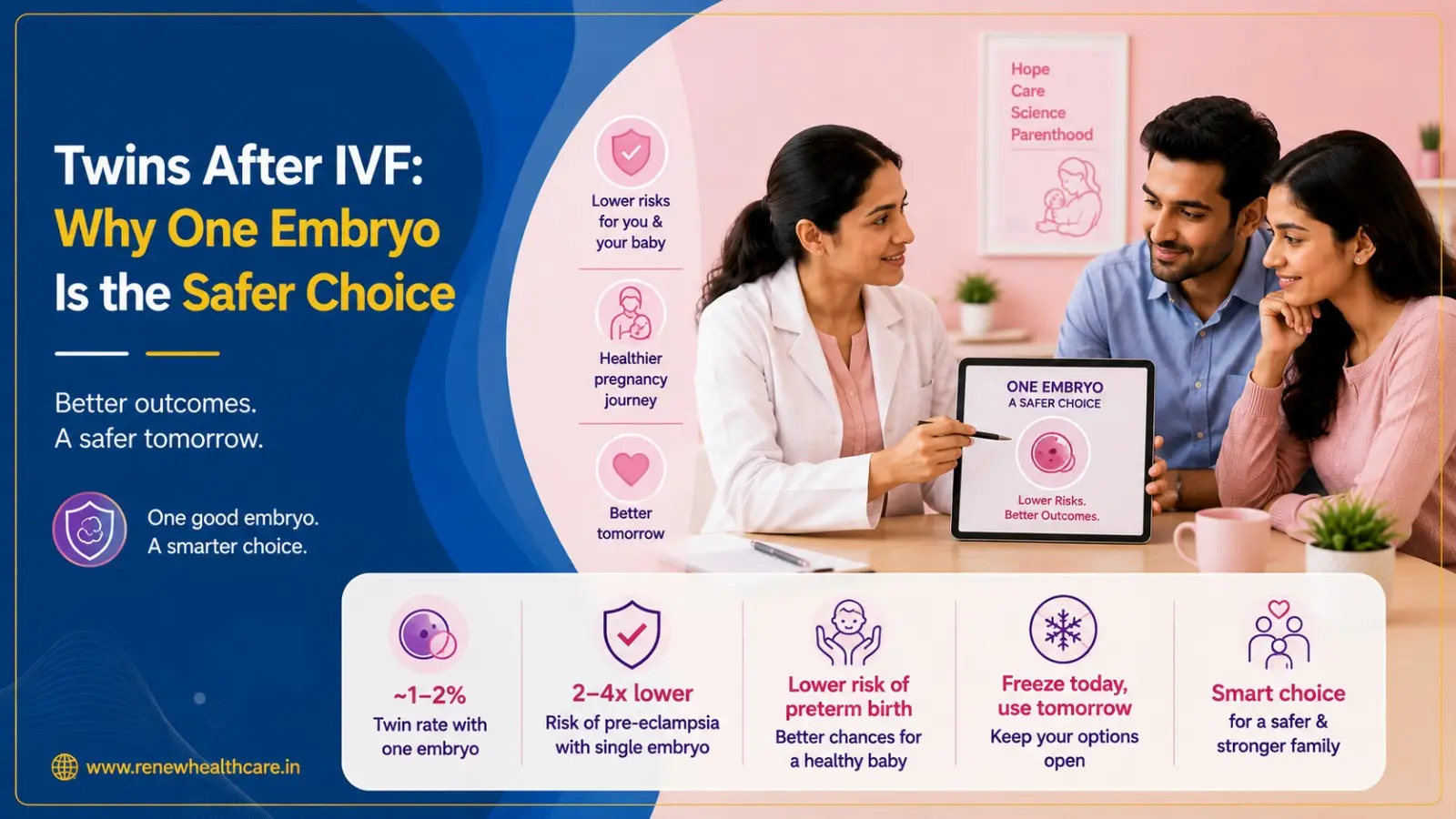
- Transferring two embryos raises twin pregnancy rates to roughly 35 to 55%, versus about 1 to 2% with single embryo transfer.
- Twin pregnancies carry a two- to fourfold higher risk of pre-eclampsia and substantially higher preterm birth rates.
- ASRM guidance (2021, still current) recommends single embryo transfer as the default in good-prognosis patients.
- Freezing surplus embryos preserves cumulative pregnancy chances without twin-pregnancy risk.
- The final decision remains a shared one — informed by age, embryo quality and personal circumstances.
Why Two Embryos Feels Like the Logical Choice
For years, transferring two embryos was standard practice — a way to compensate for uncertain embryo viability in the pre-vitrification era. Financially and emotionally, "two at once" can still feel efficient: one cycle, potentially two babies, one maternity leave. It is a completely understandable instinct, and I never dismiss it. But the evidence on outcomes has moved a long way since that logic first took hold.
What the Data Actually Shows
The numbers are consistent across large registries. Historic US data reported by ReproductiveFacts.org, ASRM's patient education arm, shows twin rates of only around 1 to 2% after elective single embryo transfer (eSET), compared with a range that clinic-outcome analyses put at roughly 35 to 55% when two embryos are transferred. ASRM's 2021 committee opinion notes that even as national twin rates have declined with wider eSET adoption, nearly half of all US ART multiple births still occur in women under 35 who received two embryos — precisely the group with the best prognosis for single-embryo success.
The Real Cost of "Two for One"
A twin pregnancy is obstetrically a different pregnancy, not simply double a singleton one. Large cohort data places pre-eclampsia at roughly two to fourfold more common in twins than singletons — one BMJ Open analysis found rates of 11.8% versus 3.4%. Preterm birth is the more dominant risk: multiple studies put delivery before 37 weeks at well over half of twin pregnancies, with meaningful proportions delivering before 34 or even 32 weeks, raising the likelihood of NICU admission. IVF-conceived twins with pre-eclampsia appear to fare worse still — one study found deliveries before 34 weeks in 29.9% of ART twin pregnancies with pre-eclampsia, against 12.5% in non-ART twin pre-eclampsia.
Single Embryo Transfer, Explained Simply
eSET means transferring one good-quality embryo per cycle and cryopreserving the rest for future use if needed. With modern vitrification, frozen embryos survive thaw and implant at rates close to fresh ones, so choosing eSET is not giving up a chance — it is spreading the same overall chance across safer, sequential attempts rather than one higher-risk attempt.
Single vs. Double Embryo Transfer, At a Glance
| Factor | Single embryo transfer | Double embryo transfer |
|---|---|---|
| Twin pregnancy rate | About 1–2% | About 35–55% |
| Pre-eclampsia risk | Baseline singleton risk | 2–4x higher (twin pregnancy) |
| Preterm birth risk | Lower, singleton-level | Majority deliver before 37 weeks |
| Cumulative live birth (fresh + frozen) | Comparable over multiple cycles | Not meaningfully higher |
Myth vs. Fact
| Myth | Fact |
|---|---|
| Two embryos double my chance of a baby. | Cumulative live birth rates with sequential single transfers are comparable — you are not sacrificing your odds. |
| Twins are just two healthy babies at once. | Twin pregnancies carry meaningfully higher rates of pre-eclampsia and preterm delivery, even when both babies are healthy at conception. |
| Frozen embryos are less likely to work than fresh ones. | With current vitrification techniques, frozen embryo transfer outcomes are generally comparable to fresh transfers. |
Common Mistakes Couples Make
- Choosing double transfer mainly to reduce the number of paid cycles, without discussing cumulative frozen-transfer success rates.
- Assuming a twin pregnancy will simply be two normal pregnancies happening together.
- Not asking the clinic for its own age- and embryo-quality-specific single-transfer success data before deciding.
Action Checklist Before Your Transfer
- Ask your clinic for its eSET success rates by your specific age group and embryo grade.
- Discuss embryo quality and the number of embryos available for freezing.
- Review your personal risk factors — uterine shape, prior preterm birth, hypertension — that could raise twin-pregnancy risk further.
- Have an honest conversation about the financial and emotional trade-offs of a possible second frozen cycle.
Frequently Asked Questions
Does single embryo transfer lower my overall chance of having a baby?
Not meaningfully, when frozen embryos are available. Cumulative pregnancy rates across a fresh transfer plus later frozen transfers are broadly comparable to double transfer, without the added twin-pregnancy risk.
Is there ever a case for transferring two embryos?
Occasionally — for example, in select patients over 40 with lower-quality embryos and no remaining embryos to freeze, after a full discussion of risks. This should always be an individualised decision, not a default.
Are IVF twins riskier than naturally conceived twins?
The multiple-pregnancy risks themselves are the same biology, but some data suggests ART-conceived twins with pre-eclampsia may have worse outcomes than non-ART twins with pre-eclampsia — an area of ongoing research rather than settled fact.
A Balanced Closing Thought
Wanting to complete your family in one cycle is a reasonable wish, and I take it seriously in every consultation. But the evidence is consistent: the safest path to a healthy baby — and, over time, to a second child if you want one — is usually one embryo at a time. My role is to help you weigh that evidence against your own circumstances, not to make the decision feel smaller than it is.
Considering IVF and unsure about single versus double embryo transfer? Dr. Neha Yadav offers personalised, evidence-based consultations at her Salt Lake, Kolkata clinic to help you make the safest, most informed choice for your family.
References
ASRM Practice Committee. Guidance on the limits to the number of embryos to transfer: a committee opinion. Fertility and Sterility, 2021.
ReproductiveFacts.org (ASRM). Elective single-embryo transfer (eSET) patient fact sheet.
Chen P, et al. Risk factors for twin pregnancy in women undergoing double cleavage embryo transfer. BMC Pregnancy and Childbirth, 2022.
Francisco C, et al. Pre-eclampsia and gestational hypertension in twin versus singleton pregnancies. BMJ Open, 2019.
Retrospective ART and pre-eclampsia twin outcomes study (2013–2021 cohort).
Wang Y, et al. Double blastocyst transfer and clinical pregnancy loss in singleton FET pregnancies. Frontiers in Endocrinology, 2025.
This article is for patient education and does not replace individualised medical advice. Please consult Dr. Neha Yadav or your treating specialist before making treatment decisions.