
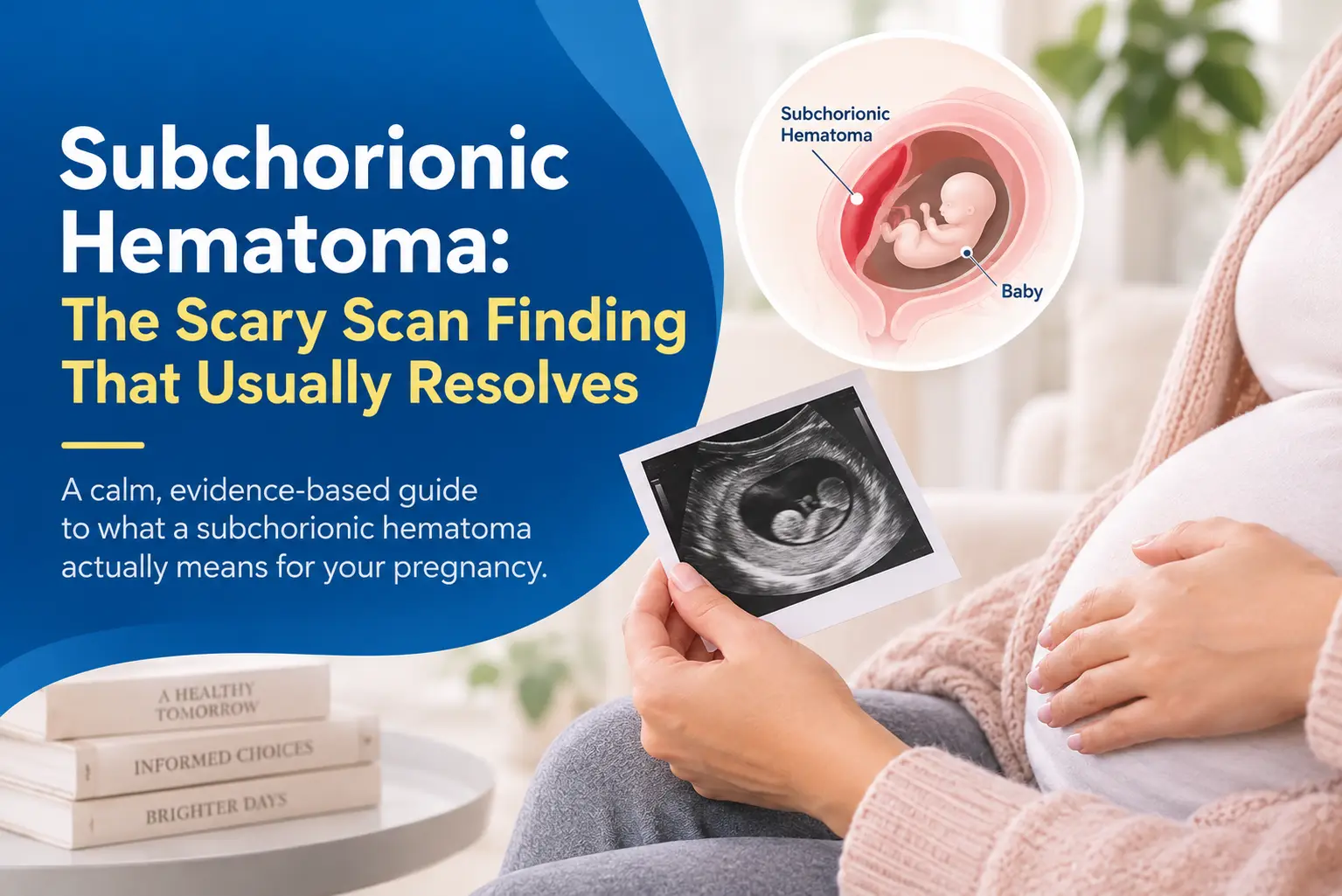
Seeing the words “subchorionic hematoma” on your ultrasound report can make an already anxious early pregnancy feel unbearable.
As an infertility specialist, this is one of the findings I explain most often, and one that, in the majority of cases, I explain with genuine reassurance.
Here is what the current evidence actually shows, without minimising your worry or exaggerating your risk.
For personalised guidance on an early-pregnancy scan, you can consult Dr. Neha Yadav, Infertility Specialist & IVF Consultant in Salt Lake, Kolkata.
Key Takeaways
- A subchorionic hematoma (SCH) is bleeding trapped between the chorionic membrane and the uterine wall.
- It is a common first-trimester scan finding, not automatically a sign that the pregnancy will be lost.
- Most small and moderate SCHs resolve on their own, much like a bruise being reabsorbed.
- Studies show an association with somewhat higher miscarriage and preterm-labour rates, but results are inconsistent, and most affected pregnancies still result in a healthy delivery.
- There is no good evidence that strict bed rest improves the outcome.
- Bleeding that lasts more than 14 days, becomes heavier, or occurs with pain or dizziness needs prompt clinical review.
For broader monitoring and support during pregnancy, see Renew Healthcare’s pregnancy-care service. Pregnancy Care in Kolkata
What Exactly Is a Subchorionic Hematoma?
A subchorionic hematoma is a pocket of blood that collects between the chorionic membrane, the outer layer surrounding the gestational sac, and the wall of the uterus.
It usually forms when a small area of the membrane partially separates from the uterine wall.
SCH is one of the more frequently seen abnormal findings on an early-pregnancy ultrasound. It can also explain the spotting or bleeding that brings many women in for an unexpected scan during the first trimester.
Does IVF Make Subchorionic Hematoma More Likely?
Some published data suggest that SCH may be seen more often in IVF pregnancies than in naturally conceived pregnancies.
One possible explanation is the way the endometrium responds around implantation.
Importantly, if you conceived through IVF and an SCH appears on the scan, it does not mean something went wrong with your embryo transfer.
It means the pregnancy may be monitored somewhat more closely.
Patients who conceived through assisted reproduction can also read more about the treatment pathway here: In Vitro Fertilization (IVF)
What Does the Research Actually Say About Risk?
Multiple cohort studies have associated SCH with a modestly higher chance of early miscarriage and preterm labour.
The document notes adjusted odds ratios in published research broadly around 1.9–2.0.
That does not mean your personal miscarriage risk automatically doubles.
Research findings are inconsistent, and a normal ongoing pregnancy with a visible fetal heartbeat remains one of the most reassuring findings.
Larger or rapidly enlarging hematomas, particularly those occupying a substantial proportion of the gestational-sac area, carry more uncertainty and generally need closer surveillance than a small, stable SCH.
Where closer maternal and fetal monitoring is required, Renew Healthcare also offers dedicated high-risk pregnancy care. High-Risk Pregnancy Management
Treatment: What Helps and What Doesn't
This is an area where outdated advice still circulates.
Strict Bed Rest
Current evidence cited in the source does not support strict bed rest as a treatment that changes the outcome of a subchorionic hematoma.
Normal daily activity is generally acceptable unless your own doctor recommends otherwise.
Progesterone
Routine progesterone supplementation has not been shown to improve the resolution of SCH itself.
Your doctor may still prescribe progesterone for another reason, particularly if you have a history of pregnancy loss, but that is different from using it specifically to make the hematoma disappear.
What May Be Recommended
The document advises:
- Avoid strenuous exercise while active bleeding continues.
- Avoid intercourse until the bleeding settles or your doctor clears you.
- If you are Rh-negative and bleeding, discuss whether Rh-D immunoglobulin is appropriate with your treating doctor.
Small vs. Large Subchorionic Hematoma
Small or Moderate SCH
Typical findings may include:
- Light spotting
- Brown discharge
- Reabsorption over approximately 2–4 weeks
- Routine antenatal follow-up may often be sufficient
Large SCH
The document defines the comparison category as a hematoma involving more than 50% of the gestational sac.
It may be associated with:
- Moderate-to-heavy or ongoing bleeding
- Slower reabsorption
- Repeat ultrasound monitoring
- Specialist input, particularly where there is also a history of recurrent pregnancy loss
Myth vs. Fact
Myth: “Bed rest will shrink the hematoma faster.”
Fact: There is no good evidence in the source that bed rest changes the outcome of an SCH.
Myth: “Any subchorionic hematoma means I will miscarry.”
Fact: Most SCHs, particularly smaller ones where a normal fetal heartbeat is visible, resolve without pregnancy loss.
Myth: “Progesterone will dissolve the hematoma.”
Fact: Current data cited in the document have not shown progesterone to improve SCH resolution itself.
What Should You Do After an SCH Diagnosis?
-
Confirm the size and location.
Check whether your ultrasound report describes the hematoma as small, moderate or large and whether its relationship to the gestational sac is documented. -
Temporarily avoid strenuous activity.
Avoid strenuous exercise, heavy lifting and intercourse until bleeding settles or your doctor clears you. -
Track the bleeding.
Pay attention to the colour, quantity and whether it is improving or worsening. -
Confirm your Rh status.
If you are Rh-negative and bleeding, ask your doctor about anti-D immunoglobulin. -
Know when to contact your clinic.
Seek medical review if bleeding continues beyond 14 days, becomes heavier, or occurs alongside pain, fever or dizziness.
Frequently Asked Questions
Can a subchorionic hematoma cause a miscarriage?
Some studies associate SCH with a somewhat higher risk of miscarriage.
However, the majority of pregnancies affected by an SCH, particularly small hematomas with a normal fetal heartbeat, continue and result in a healthy birth.
How long does a subchorionic hematoma take to go away?
Most small-to-moderate hematomas reabsorb within approximately two to four weeks.
Larger SCHs can take longer and may need repeat scans to make sure they are resolving.
Is spotting always caused by a subchorionic hematoma?
No.
First-trimester spotting can have several causes. SCH is one common possibility, but it should be identified on ultrasound rather than assumed from bleeding alone.
Should I stop working or travelling?
For most small, stable SCHs, the source states that normal routine is generally fine.
Your own doctor may modify this advice depending on:
- How much you are bleeding
- The size of the hematoma
- Your pregnancy history
- Other clinical findings
What If You've Had Previous Pregnancy Losses?
A history of recurrent miscarriage can change how closely an SCH is monitored.
If you have experienced two or more pregnancy losses, a wider evaluation may also be appropriate depending on your history.
Renew Healthcare has a dedicated recurrent-pregnancy-loss service for this purpose. Recurrent Miscarriage Evaluation
Had a Scan Showing a Subchorionic Hematoma?
Dr. Neha Yadav's clinic in Salt Lake, Kolkata offers focused early-pregnancy monitoring and individualised guidance for patients with SCH.
The aim is to review the actual scan, assess the size and location of the hematoma, understand your bleeding pattern and pregnancy history, and determine whether routine follow-up or closer monitoring is appropriate.
References
The document cites:
- SOGC Clinical Practice Guideline No. 460, June 2025, with a pre-publication verification flag on the quoted adjusted odds ratio.
- Wang W, Zhao Q, Liu Y, et al., BMC Pregnancy and Childbirth, 2024, studying SCH following euploid embryo transfer.
- Asato K, et al., European Journal of Obstetrics & Gynecology and Reproductive Biology, 2014.
- StatPearls, NCBI Bookshelf, Subchorionic Hemorrhage.
- Patient guidance from Chelsea and Westminster Hospital NHS Foundation Trust and NHS Aneurin Bevan University Health Board.
- Xu T, Lun W, Wang P, He Y., Medicine, 2023.
- A 2024/2025 systematic review and meta-analysis cited with a verification flag for final pooled estimates.
The article is intended for patient education and does not replace individual medical advice.