
By Dr. Neha Yadav · Infertility Specialist & IVF Consultant · Salt Lake, Kolkata
A faint second line. A missed period that never quite arrives on schedule. Then, days later, bleeding — and a test that turns negative again. Many women are told, in one breath, “it wasn't a real pregnancy, don't worry about it.” That sentence is medically outdated, and it dismisses a loss that was real enough to register on a hormone test and real enough to hurt.
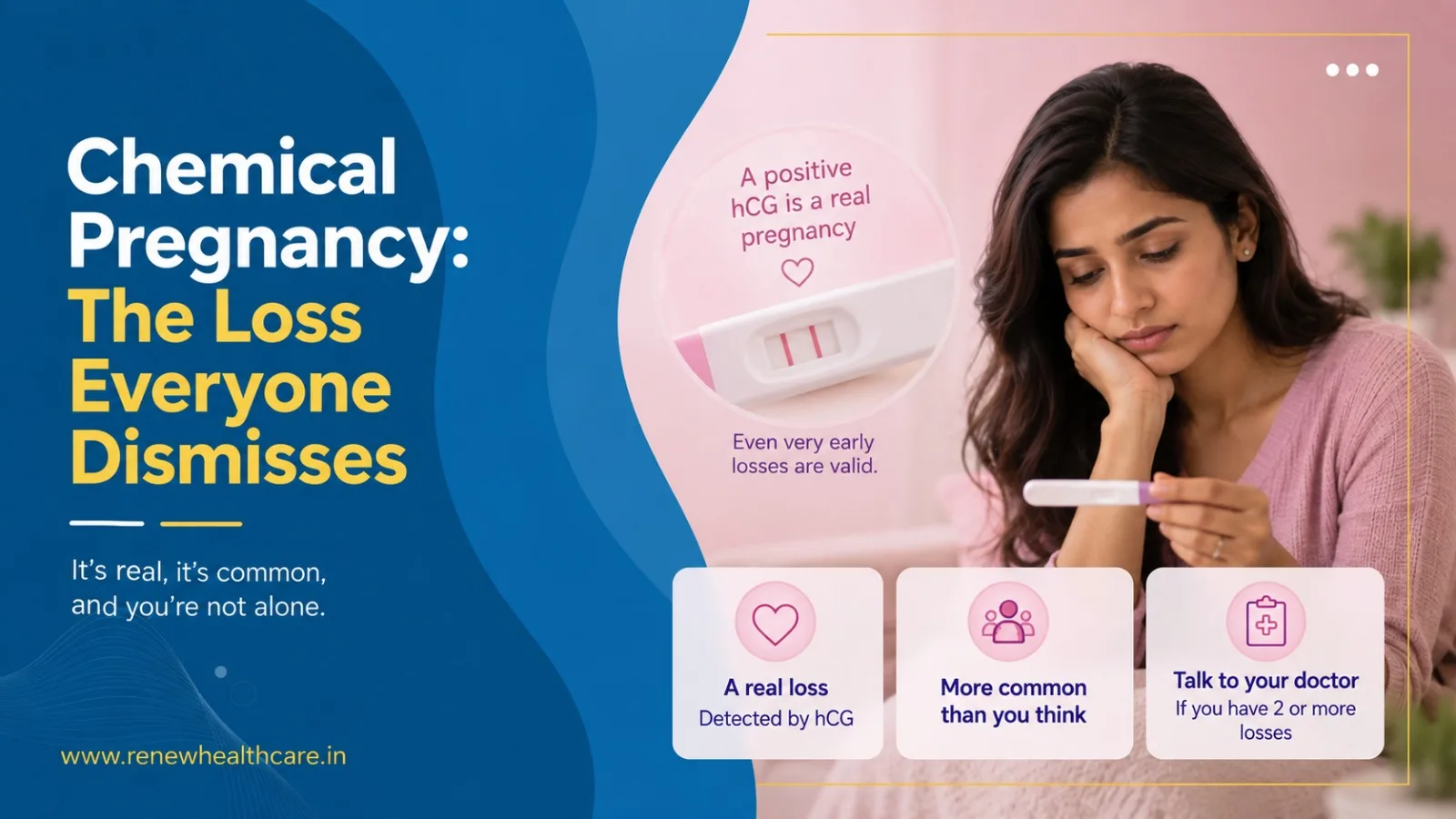
A chemical pregnancy — also called a biochemical pregnancy — is an early loss confirmed only by a positive hCG test, ending before an ultrasound could ever see a gestational sac, usually before five to six weeks.
Key Takeaways
- A chemical pregnancy is a confirmed pregnancy loss, detected by hCG before ultrasound could show a sac — it is real, not a false alarm.
- It is common: sensitive home tests now detect very early losses that would once have passed as a slightly late, heavier period.
- ASRM's 2026 guidance formally counts biochemical losses toward the recurrent pregnancy loss (RPL) diagnosis, alongside clinical miscarriages.
- One chemical pregnancy rarely needs investigation. Two or more losses (biochemical or clinical, combined) is when a structured workup is worthwhile.
- Persistent or unusually slow-rising hCG should always be checked to rule out an ectopic pregnancy, which needs urgent care.
What Actually Happens in a Chemical Pregnancy
Fertilisation and implantation occur normally, and the embryo begins producing hCG — enough to turn a test positive. Then development stops, most often because of a random chromosomal error in that particular embryo, and hCG falls instead of doubling every 48–72 hours as it should in an ongoing pregnancy. The bleeding that follows can look and feel like a slightly delayed, sometimes heavier, period.
Why It Gets Dismissed — and Why That's Outdated
For decades, clinical practice only “counted” a loss once it was visible on ultrasound, so biochemical losses were treated as background noise. In its most recent committee opinion, the American Society for Reproductive Medicine revised this stance: biochemical losses confirmed by blood or urine hCG now formally count toward the diagnosis of recurrent pregnancy loss (RPL), on the basis that they carry a similar impact on future recurrence risk as clinical miscarriages. In plain terms — the evidence has moved to match what patients have always known: this loss was real.
What Causes It — and What Doesn't
The great majority of chemical pregnancies trace back to a chromosomal error in the embryo itself — not to something the mother did or didn't do. Contributing factors researched in the literature include advancing maternal age, thin or receding endometrial lining, thyroid or prolactin imbalance, and, less consistently, uterine or implantation-window factors. A single stressful week, one missed pill, or moderate exercise does not cause a chemical pregnancy — that reassurance is grounded in evidence, not sentiment.
When One Loss Becomes a Pattern
A single chemical pregnancy, in isolation, does not usually warrant a fertility workup — it is common enough that many women experience one without ever knowing it happened. The threshold that matters is two or more pregnancy losses of any confirmed type (biochemical or clinical), which is when ASRM recommends genetic, hormonal, and uterine evaluation begin. Keeping a simple record — test dates, approximate hCG values if drawn, and how each pregnancy ended — makes that conversation far more useful if it's ever needed.
How the Three Early-Pregnancy Outcomes Compare
| Chemical Pregnancy | Clinical Miscarriage | Ectopic Pregnancy | |
|---|---|---|---|
| Detected by | hCG on urine/blood test only | Ultrasound shows gestational sac | hCG present, sac not in uterus |
| Typical timing | Before 5–6 weeks | After 5–6 weeks, before 20 weeks | Usually 6–8 weeks |
| hCG pattern | Rises then falls, often plateaus early | Rises, then falls after fetal demise confirmed | Rises slowly or abnormally (<66% in 48h) |
| Needs medical attention? | Usually no — self-resolves like a period | Often monitored; may need medication or procedure | Yes — emergency evaluation, always |
| Counts toward RPL diagnosis (ASRM 2026) | Yes | Yes | No — excluded from RPL definition |
Persistent or unusually slow hCG rise should always prompt a same-day call to your clinic to rule out ectopic pregnancy.
Myth vs. Fact
| Myth | Fact |
|---|---|
| “It wasn't a real pregnancy, so it doesn't count as a loss.” | It was a fertilised embryo that implanted. ASRM's 2026 guidance formally counts biochemical losses toward the recurrent pregnancy loss (RPL) diagnosis — the medical definition has caught up with what patients have felt all along. |
| “It means something is seriously wrong with your fertility.” | A single chemical pregnancy is common and usually reflects a one-off chromosomal error in that particular embryo — not a marker of infertility. |
| “You need a full infertility workup after just one.” | One chemical pregnancy generally doesn't need investigation. Repeated losses (two or more) are when a structured evaluation becomes worthwhile. |
| “There's nothing a doctor can do, so don't bother mentioning it.” | Even a single chemical pregnancy is worth noting in your history — patterns only become visible when they're tracked. |
What To Do After a Chemical Pregnancy
- Let your body pass the tissue naturally — no procedure is usually needed.
- Recheck a urine or blood hCG after 1–2 weeks if you want confirmation it has returned to zero.
- Note the date, and whether it was confirmed by urine or blood test, in your personal record.
- Watch for one-sided pain, dizziness, or shoulder-tip pain — these need same-day medical review to rule out ectopic pregnancy.
- Give yourself at least one full cycle before trying again, or as advised by your clinician, so dating of the next pregnancy is clear.
- If this is your second confirmed loss of any kind, ask your doctor about baseline RPL evaluation rather than waiting for a third.
Frequently Asked Questions
Does a chemical pregnancy mean I'm infertile?
No. A single chemical pregnancy generally reflects a one-time chromosomal event and is not, by itself, evidence of an underlying fertility problem.
How soon can I try again?
Most clinicians suggest waiting for at least one normal cycle so that the dating of your next pregnancy is unambiguous — discuss timing specific to your situation with your doctor.
Will it happen again?
Most women who have one chemical pregnancy go on to have a typical pregnancy afterward. Risk of recurrence rises mainly with repeated losses, not a single one.
Should I get my hCG levels tested to “prove” it happened?
It isn't medically necessary for a single episode, but a documented blood hCG level can be useful if you're already tracking a pattern of losses.
Had More Than One Early Loss?
Dr. Neha Yadav offers evidence-based recurrent pregnancy loss evaluation at her Salt Lake, Kolkata clinic — a calm, unhurried first conversation to understand your history before recommending any test.
References
- American Society for Reproductive Medicine. Recurrent Pregnancy Loss: A Committee Opinion (2026) — biochemical losses formally included in RPL definition. [Verify: exact publication date and citation before publishing.]
- ASRM Practice Committee (2012). Evaluation and Treatment of Recurrent Pregnancy Loss: A Committee Opinion. Fertility & Sterility, 98(5), 1103–1111.
- Cleveland Clinic. Chemical Pregnancy: Causes, Symptoms & Treatment. [Verify current revision date before publishing.]
- Zhu J, et al. (2025). Embryological perspectives on biochemical pregnancy and early miscarriage risks: a retrospective cohort study. European Journal of Obstetrics & Gynecology and Reproductive Biology. [Verify volume/issue/page numbers before publishing.]
- Goktas O. (2025). Evaluation of the relationships between β-hCG blood levels and pregnancy: a retrospective study. Pakistan Journal of Medical Sciences, 41(7). DOI: 10.12669/pjms.41.7.12250.
This article is for patient education and does not replace individual medical advice. Please consult Dr. Neha Yadav or your treating specialist for guidance specific to your situation.