
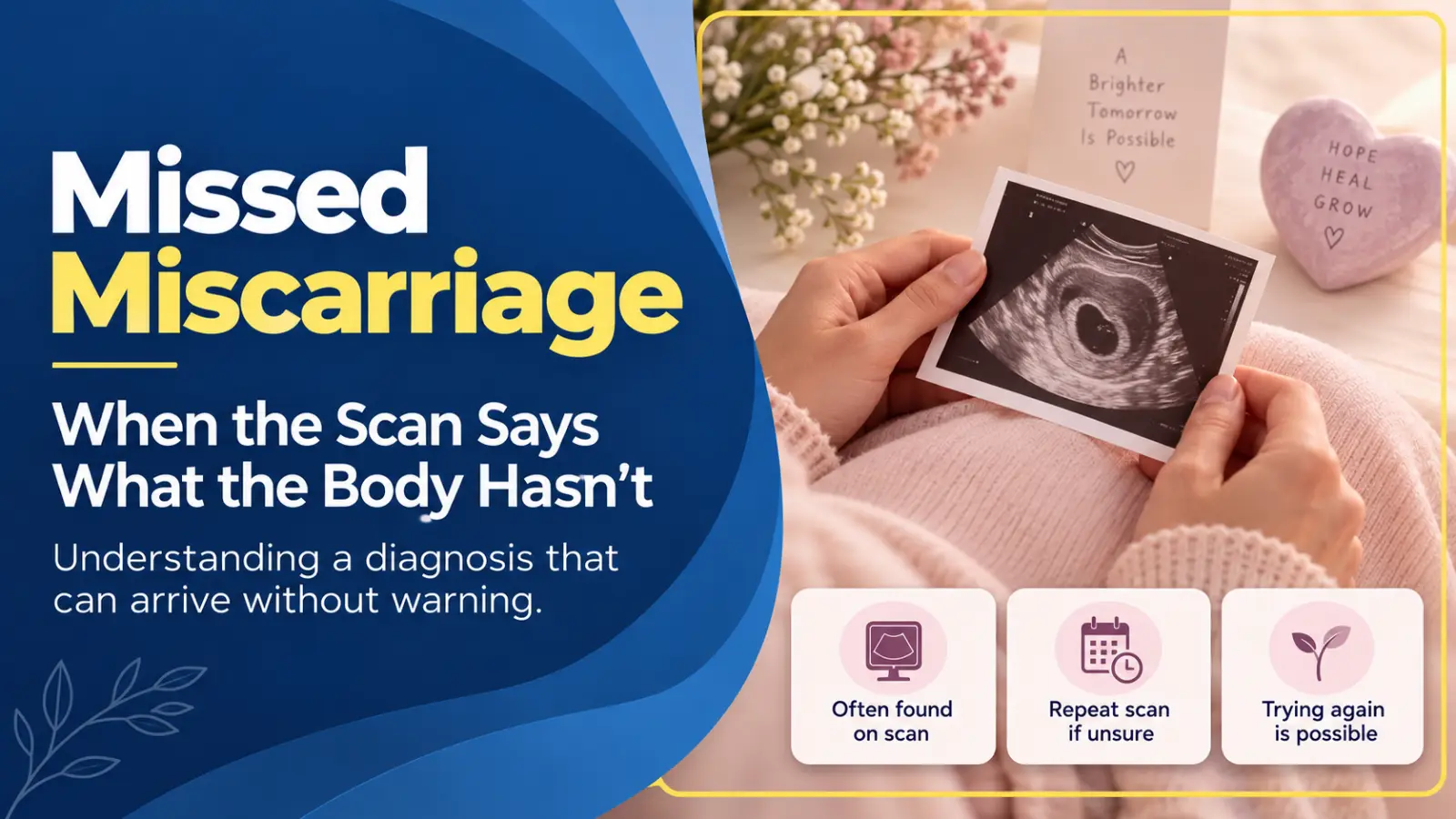
Many women walk into a routine dating scan feeling completely fine — no bleeding, no cramping, no sign that anything is wrong — only to be told the pregnancy has stopped growing.
This is called a missed miscarriage, and the gap between how your body feels and what the screen shows is one of the most disorienting moments in early pregnancy.
Here is what the evidence actually says about diagnosis, next steps, and trying again.
For personalised guidance, you can consult Dr. Neha Yadav, Infertility Specialist & IVF Consultant at Renew Healthcare.
Key Takeaways
A missed miscarriage means the pregnancy has stopped developing, but tissue has not yet been passed. It is confirmed on ultrasound, not by symptoms.
Diagnosis follows strict, internationally agreed criteria specifically to avoid mislabelling a viable pregnancy as lost.
Expectant, medical, and surgical management are all medically reasonable. The right choice depends on your circumstances and comfort, not a single “best” option.
Most causes are chromosomal and not something you caused or could have prevented.
What a Missed Miscarriage Actually Means
In a missed, or “silent,” miscarriage, the embryo or fetus has died, or never developed a heartbeat, but the body has not recognised the loss.
The cervix stays closed and no tissue is passed.
It is often picked up incidentally during a routine 6–8 week scan in a woman who may have:
No bleeding
No pain
No obvious warning signs
Even ongoing pregnancy symptoms
If you need broader support during early pregnancy, Renew Healthcare also provides Pregnancy Care in Kolkata. (Renew Healthcare)
How the Diagnosis Is Confirmed
Because a wrong diagnosis here could end a viable pregnancy, ultrasound societies use deliberately conservative, evidence-based thresholds.
Current international criteria described in the document confirm pregnancy loss when:
A gestational sac with no yolk sac or embryo has a mean sac diameter of 25 mm or more, OR
An embryo with a crown-rump length of 7 mm or more shows no cardiac activity.
When measurements fall short of these cut-offs, for example when the sac or embryo is smaller, the correct next step is not an immediate diagnosis.
A repeat scan is usually performed 7–14 days later.
This waiting period is intended as a safeguard rather than a delay in care. The document specifically flags the exact repeat-scan interval for verification against current SOGC, RCOG and local Indian protocol before publication.
Why This Happens: The Evidence on Causes
Chromosomal abnormalities in the embryo account for roughly 56–60% of missed miscarriages, particularly during the first trimester.
Other cases may relate to:
Uterine structural issues
Thyroid disorders
Clotting disorders
Infection
In many cases, no clear cause is ever found.
Importantly, a single missed miscarriage is not evidence of an underlying fertility problem.
For patients with repeated losses, Renew Healthcare offers a dedicated Recurrent Miscarriage Evaluation, which looks at possible chromosomal, uterine, hormonal, immune and other contributing factors. (Renew Healthcare)
Where genetic factors are relevant, PGT Counselling may also be discussed in selected fertility-treatment cases involving recurrent miscarriage. (Renew Healthcare)
Your Three Management Options
There is rarely one universally “correct” management option for every stable patient.
1. Expectant Management
The body is allowed to pass the pregnancy tissue naturally while the patient is monitored.
Typical timeframe: 1–2 weeks
Reported success range: 39–75% within two weeks, with approximately 50% average in the pooled ranges cited in the document.
2. Medical Management
Medication is used to help the uterus expel the pregnancy tissue.
The document describes misoprostol, often combined with mifepristone.
Reported success range: approximately 60–90%, depending on protocol.
3. Surgical Management
Vacuum aspiration or D&C involves a brief uterine procedure, usually under sedation.
Reported success: over 98%, with the most immediate resolution of the three approaches.
The document notes that these figures are pooled ranges from reviews and randomised trials and should be verified against the cited 2026 meta-analysis and Indian institutional data before publication.
The choice should reflect your preference and clinical stability, rather than the idea that there is one correct path for everyone.
Myth vs. Fact
Myth: “Bleeding or symptoms would have warned me something was wrong.”
Fact: A missed miscarriage can occur with no symptoms at all and may only be discovered during an ultrasound scan.
Myth: “Surgery is always the safest option.”
Fact: All three approaches are considered reasonable for clinically stable patients. Surgery is the fastest option, but not automatically the safest choice for every patient.
Myth: “I must wait several months before trying again.”
Fact: For one uncomplicated first-trimester loss, the document states that current guidance generally does not require a prolonged delay once you feel ready.
Trying Again: What the Research Shows
After one miscarriage, the risk in the next pregnancy remains close to the general population baseline of approximately 15%, according to the document.
Older advice often recommended waiting three to six months before trying again.
However, several studies cited in the document found no increased risk, and possibly a lower risk, among couples who conceived within six months, provided any recommended testing or post-D&C recovery had been completed first.
If you have experienced two or more losses, further evaluation is recommended before the next attempt.
You can learn more about this through Renew Healthcare's Recurrent Miscarriage Evaluation. (Renew Healthcare)
For planning another pregnancy, you may also find How to Prepare Your Body for Pregnancy relevant. (Renew Healthcare)
Action Checklist
Ask your sonologist which specific ultrasound criteria confirmed the diagnosis and whether a repeat scan was needed.
Discuss all three management options before deciding.
If products of conception are sent for testing, ask what the chromosomal result would and would not tell you.
Allow one normal cycle after a D&C, or follow your doctor's individual advice, before actively trying again.
Seek recurrent-loss evaluation after two or more consecutive miscarriages.
Frequently Asked Questions
Can a missed miscarriage be misdiagnosed?
It is uncommon when standardised criteria are followed correctly.
This is precisely why borderline scans are repeated rather than acted on immediately.
Does a missed miscarriage mean I have a fertility problem?
Not usually.
A single loss, particularly one associated with a chromosomal issue, does not predict difficulty conceiving again.
How soon can I try again?
For most women with one uncomplicated loss, the document says you may try again once you feel physically and emotionally ready, while discussing your individual situation with your doctor.
A Missed Miscarriage Diagnosis Deserves Clear Answers and Unhurried Care
Dr. Neha Yadav's clinic in Salt Lake, Kolkata offers confirmatory scans, management counselling and pre-pregnancy evaluation for couples navigating early pregnancy loss.
Book a consultation to discuss your results and your next steps.
References
SOGC Clinical Practice Guideline No. 460: Diagnosis and Management of Intrauterine Early Pregnancy Loss, Journal of Obstetrics and Gynaecology Canada, June 2025. Verification required before publishing.
ASUM/ISUOG-aligned Guideline for Ultrasound Diagnosis of Early Pregnancy Loss, based on Doubilet et al., NEJM 2013. Current revision year to be verified.
Comparative efficacy and safety of medical and surgical management for missed miscarriage: systematic review and meta-analysis, Frontiers in Medicine, 2026. Pooled figures to be verified.
Murugesu S, et al. Predictors of successful expectant and medical management of miscarriage: a systematic review. Acta Obstet Gynecol Scand, 2024.
ACOG Practice Bulletin No. 200: Early Pregnancy Loss, Obstet Gynecol, 2018, noted in the document as being under revision.
NICE Guideline NG126: Ectopic Pregnancy and Miscarriage — Diagnosis and Initial Management. Current version to be verified.