
By Dr. Neha Yadav | Infertility Specialist & IVF Consultant | Salt Lake, Kolkata
Many couples come to my clinic with a pharmacy ovulation kit, two apps that disagree, and sometimes a smart ring. All three promise to identify fertile days, but they measure different things. Understanding that difference can help you make informed decisions when planning a pregnancy.
Key Takeaways
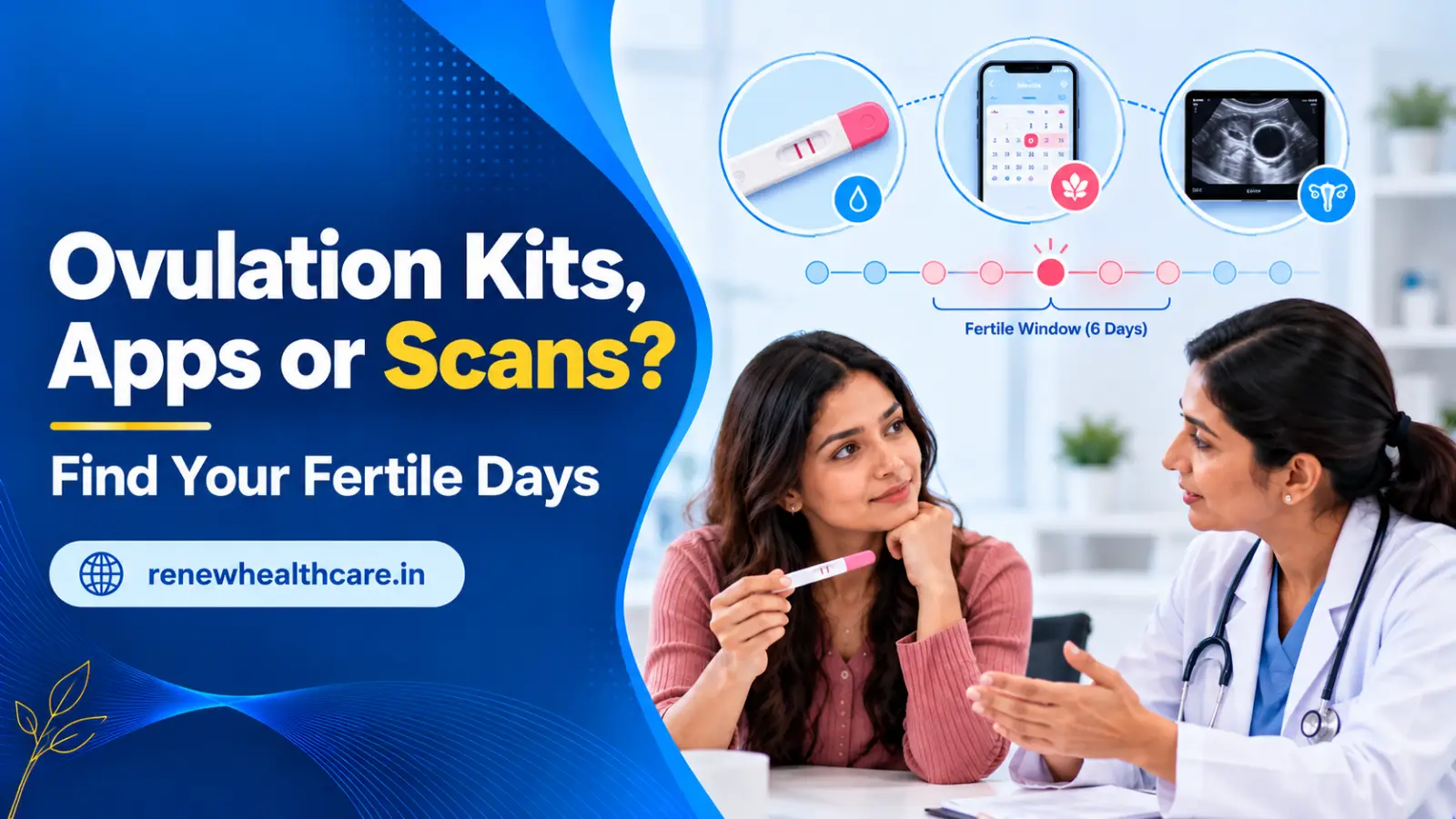
The fertile window generally covers six days: the five days before ovulation and the day of ovulation.
Urine luteinising hormone (LH) kits have the strongest evidence among commonly used home ovulation-prediction methods.
Calendar apps estimate fertile days from previous menstrual cycles.
Wearables measure temperature changes that usually occur after ovulation, making them more useful for recognising patterns retrospectively.
Ultrasound scans allow clinicians to observe ovarian follicles directly and are particularly useful during ovulation-induction and intrauterine insemination (IUI) treatment cycles.
What Does Each Ovulation Tracking Tool Actually Measure?
| Tool | What it measures | Honest verdict |
|---|---|---|
| Urine LH kit | Detects the LH surge, usually around one to two days before ovulation. | A well-studied home method for timing intercourse, but it cannot prove that an egg was released. PCOS can complicate interpretation. |
| Calendar app | Uses previous cycle lengths to estimate future fertile days. | Convenient, but predictions may be inaccurate because cycles can vary. |
| Wearable device | Records overnight temperature changes and other physiological patterns. | May help identify ovulation retrospectively, but independent evidence varies by device. |
| Ultrasound scan | Directly assesses ovarian follicles and their development. | Particularly useful during IUI and ovulation-induction cycles rather than routine home tracking. |
1. Urine LH Kits: What Do They Tell You?
Ovulation predictor kits detect a rise in luteinising hormone in urine. This LH surge usually occurs approximately 24–48 hours before ovulation, although timing varies between individuals and cycles.
A positive result can help you identify when ovulation may be approaching and plan intercourse accordingly.
However, detecting the surge does not guarantee that the follicle ruptured and released an egg. Women with polycystic ovary syndrome (PCOS) may also experience confusing or repeatedly positive results.
A kit advertised as 99% accurate may be referring to its ability to detect LH under specified testing conditions. It does not mean there is a 99% guarantee that ovulation occurred or that pregnancy will follow.
2. Calendar Apps: How Accurate Are They?
Calendar-based fertility apps estimate fertile days using previous menstrual cycle lengths. They can be useful for recording periods, tracking symptoms and identifying patterns.
Their main limitation is that past cycles cannot reliably predict every future cycle. Ovulation may happen earlier or later than expected, even when periods are usually regular.
A 2016 audit of fertility-prediction websites and smartphone apps found that only four out of 53 apps and websites correctly matched the expert-defined fertile window used in the assessment.
That audit is now a decade old, and apps have changed since then. Nevertheless, a calendar prediction remains an estimate rather than direct evidence of ovulation.
Use an app as a diary and planning tool, not as a guarantee that a particular day is fertile.
3. Smart Rings and Wearables: Can They Predict Ovulation?
Wearable devices, including smart rings and temperature-monitoring armbands, can record overnight temperature changes and other physiological measurements.
After ovulation, progesterone-related changes commonly cause a small increase in body temperature. A wearable may detect this pattern and help identify when ovulation probably occurred.
The limitation is timing: the temperature rise generally occurs after ovulation, so a wearable may be more useful for recognising ovulation retrospectively than predicting it in advance.
Some studies are promising, but the evidence varies by device. For example, a large study involving 1,155 cycles evaluated an Oura Ring-based approach, but it was authored by the manufacturer and benchmarked against LH kits rather than ultrasound confirmation.
Independent validation remains important before relying on any wearable as a definitive ovulation test.
4. Ultrasound Scans: When Are They Useful?
Ultrasound monitoring allows a clinician to observe ovarian follicles directly and assess their development over time.
It is particularly useful during ovulation-induction treatment and IUI cycles. Depending on the treatment protocol, ultrasound findings can help determine whether follicles are developing as expected and when further monitoring may be appropriate.
Ultrasound is not usually necessary for everyone trying to conceive naturally. However, if your periods are irregular, ovulation kits repeatedly give confusing results, or you are undergoing fertility treatment, a clinician may recommend monitoring.
What Does the Evidence Say About Ovulation Kits?
A 2023 Cochrane review pooled seven randomised trials involving 2,464 women who were trying to conceive.
The review found that urinary ovulation tests probably improve live-birth rates among women under 40 who have been trying for less than 12 months.
To understand the potential effect, consider the review's illustrative figures: if the chance of a live birth without a kit is 16%, using a kit may correspond to a chance of approximately 16–28%.
The certainty of the evidence was moderate, and many trials received manufacturer funding. The upper estimate should therefore be interpreted cautiously rather than treated as a guarantee.
Evidence for calendar apps, temperature tracking and cervical mucus tracking is less certain.
NICE's 2026 fertility guidance continues to advise couples trying to conceive to have regular intercourse every two to three days.
Two cautions deserve attention:
A positive LH test detects a hormonal surge, not confirmed follicular rupture. A small ultrasound study reported cycles in which an LH surge occurred without follicular rupture. A secondary summary reported three such cycles per 100, although this figure requires confirmation against the original study.
Wearable accuracy claims should be interpreted according to how the device was tested. Agreement with an LH kit does not necessarily establish agreement with ultrasound-confirmed ovulation.
The practical takeaway is that no tracking tool guarantees ovulation, conception or a live birth.
A Practical Example: When Fertility Tracking Becomes Stressful
Consider Meera, aged 31. This is a composite example, not a real patient.
Meera has regular menstrual cycles and uses a fertility app that highlights eleven potentially fertile days. She starts feeling that intercourse must happen every day during this period, turning each highlighted date into a deadline.
Instead of adding more tracking devices, she simplifies her approach. She and her partner have intercourse every two to three days and use an LH kit around the time the app predicts an approaching ovulation.
This gives them a practical way to time intercourse without depending entirely on the app or feeling that every day must be perfectly planned.
The lesson is not that everyone needs an ovulation kit. Tracking should support pregnancy planning rather than create unnecessary pressure.
Ovulation Tracking: Myths Versus Facts
| Myth | Fact |
|---|---|
| “My ovulation kit is 99% accurate, so I definitely ovulated.” | The advertised accuracy may describe LH detection, not confirmation that an egg was released. |
| “The green days on my fertility app are definitely my fertile days.” | Most calendar apps estimate future dates from previous cycles, and actual ovulation can vary. |
| “I should wait a day after a positive LH test before having intercourse.” | Ovulation may follow within one to two days. Intercourse on the day of the positive result and over the following one to two days may help with timing. |
| “A smart ring can tell me exactly when I will ovulate.” | Temperature changes generally occur after ovulation, making wearables potentially more useful for retrospective tracking. |
| “I need an ultrasound every month to conceive naturally.” | Routine ultrasound monitoring is not necessary for everyone. It is particularly useful when there is a clinical reason or treatment requires monitoring. |
Your Action Checklist: How to Identify Your Fertile Days
If your menstrual cycles are regular
Consider having intercourse every two to three days throughout the cycle.
Use a calendar app to record periods and observe patterns, but do not depend on its predictions alone.
Consider an LH kit if you want additional information about the approaching fertile window.
If you want more precise timing
Begin testing a few days before your expected LH surge, following the kit's instructions.
Depending on the product instructions and your cycle, testing once or twice daily may help detect a brief surge.
When the result is positive, consider intercourse that day and over the following one to two days.
Remember that a positive kit does not prove follicular rupture.
If you have PCOS, irregular periods or repeatedly positive LH tests
Do not assume that every positive result represents successful ovulation.
Seek medical assessment if the results remain confusing or your cycles are irregular.
Depending on your circumstances, your doctor may consider blood tests or ultrasound monitoring.
If you have been trying to conceive without success
Women under 35 are generally advised to seek a fertility evaluation after 12 months of trying.
Women aged 35 or older should generally seek evaluation after six months.
Earlier assessment may be appropriate when periods are irregular, PCOS or another reproductive condition is suspected, or there are other known fertility concerns.
Common Questions About Ovulation Kits, Apps and Scans
Can an LH ovulation kit prove that I ovulated?
No. It detects the LH surge that usually precedes ovulation, but it cannot prove that an egg was released.
Depending on your clinical circumstances, your doctor may recommend a mid-luteal progesterone blood test or ultrasound monitoring to assess whether ovulation occurred.
When is an ultrasound scan worth it?
Ultrasound monitoring is particularly useful during ovulation-induction treatment and IUI cycles. It may also be appropriate when ovulation kits are difficult to interpret, cycles are irregular or a clinician suspects an underlying reproductive issue.
For someone with regular cycles who is trying to conceive naturally, routine ultrasound monitoring is not usually necessary.
Are fertility apps accurate?
Apps can be useful for tracking periods and recording symptoms. However, calendar-based apps estimate fertile days from previous cycle lengths and may not accurately predict ovulation in every cycle.
An app is best used as a planning tool rather than proof that a particular day is fertile.
When should I take an ovulation test?
Follow the instructions provided with your specific kit. In general, begin testing a few days before the expected LH surge rather than waiting until the estimated day of ovulation.
If your cycles are irregular, identifying when to begin testing may be more difficult. A clinician can help you decide whether home testing or further assessment is appropriate.
What is the best way to time intercourse when trying to conceive?
The fertile window generally includes the five days before ovulation and the day of ovulation. Having intercourse every two to three days throughout the cycle is a practical approach that reduces the need to identify one exact day.
If you prefer more targeted timing, an LH kit may provide additional information about an approaching ovulation.
What to Do Next
If ovulation kits are confusing you, your cycles are irregular, or you have been trying to conceive for six to twelve months without success, further assessment may provide more useful information than purchasing another tracking device.
Depending on your history, a consultation may help determine whether you need a blood test, ultrasound monitoring or a broader fertility evaluation.
For more information about fertility care and available services, visit Renew Healthcare.
To learn more about your specialist, visit Dr. Neha Yadav, Infertility Specialist and IVF Consultant.
This article is for educational purposes and does not replace personalised medical advice. Your clinician can help you choose the most appropriate method of tracking ovulation based on your menstrual cycle, medical history and pregnancy plans.
References
Cochrane Database of Systematic Reviews. 2023;(9). Timed intercourse for couples trying to conceive.
National Institute for Health and Care Excellence (NICE). NG257. Fertility problems: assessment and treatment. March 2026. Recommendations 1.5, 1.18.7 and 1.18.9.
Setton R et al. Accuracy of websites and phone apps in predicting the fertile window. Obstetrics & Gynecology. 2016.
Thigpen N et al. Oura Ring ovulation detection. Journal of Medical Internet Research. 2025;27.
Tempdrop axillary sensor validation study, involving 194 cycles. Published October 2025. PMC12567647.
Urinary LH thresholds and ovulation prediction. Frontiers in Public Health. 2017;5:320.
Ultrasound-referenced urinary LH kit study. American Family Physician. 2001;64(5):858.