
Key Takeaways
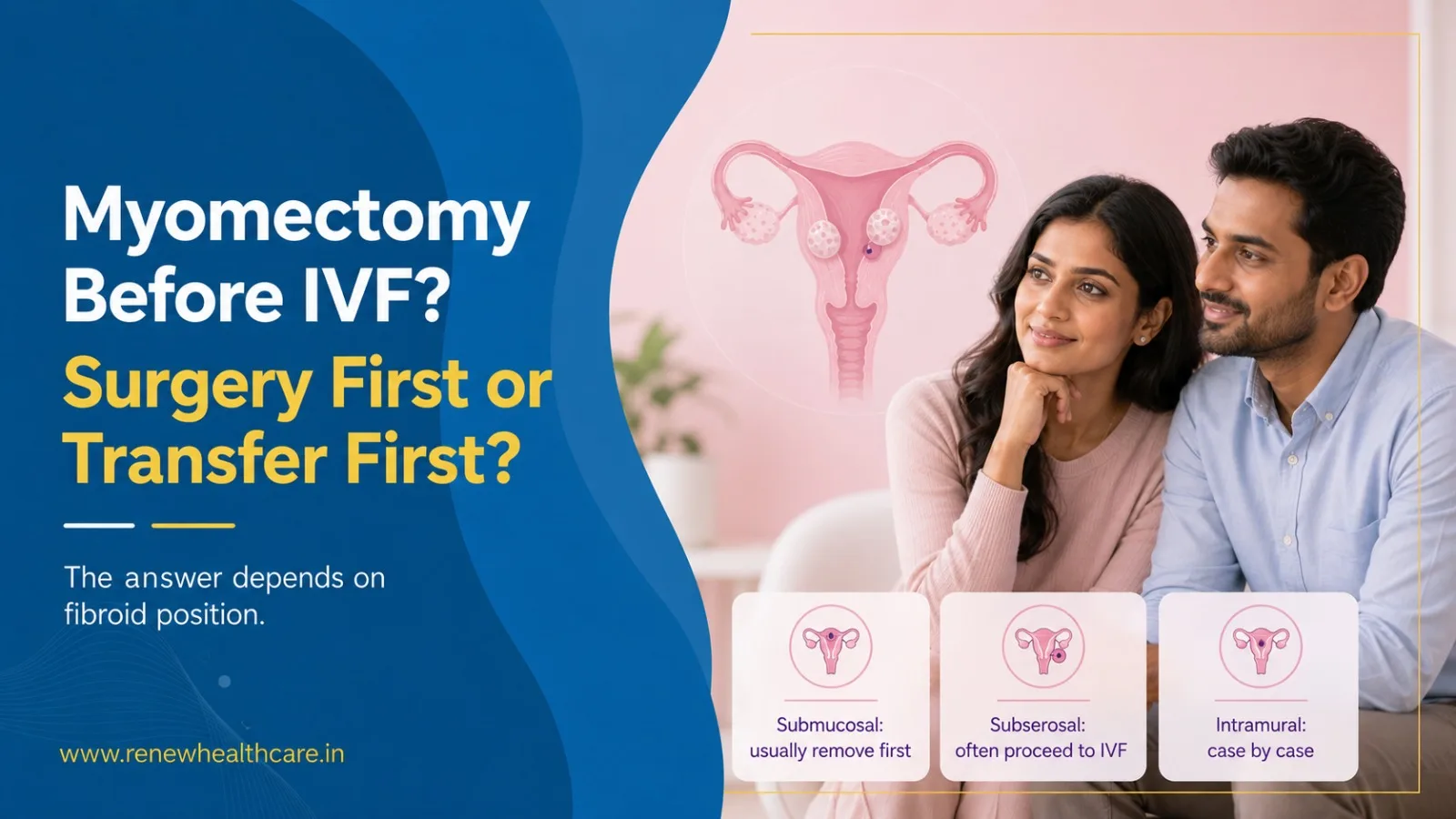
- Cavity-distorting (submucosal) fibroids should almost always be removed before IVF — they can cut implantation rates by roughly half.
- Small intramural fibroids that don't touch the cavity usually don't need surgery — the 3–4 cm "remove or wait" threshold is still genuinely debated in the fertility literature, not settled.
- Subserosal fibroids (outer uterine wall) rarely affect IVF outcomes and don't warrant pre-IVF surgery.
- Recovery after hysteroscopic myomectomy generally needs 1–3 months before transfer; open or laparoscopic myomectomy needs longer.
- The right decision weighs fibroid type, size, location, your age, and ovarian reserve together — not fibroids in isolation.
Fibroids are common — up to 70–80% of women develop one by the time they reach menopause. So when a fibroid turns up on a pre-IVF scan, the question isn't whether fibroids matter, it's whether this fibroid, in this position, is worth delaying treatment for. That answer depends far more on where the fibroid sits than on the fact that it exists at all.
The Fibroid That Almost Always Needs Surgery First
If a fibroid bulges into the uterine cavity — a submucosal fibroid — the evidence is consistent and strong. Cavity-distorting fibroids interfere with implantation directly, and studies have linked them to roughly a 50–70% drop in clinical pregnancy rates when left untreated. Hysteroscopic myomectomy, a camera-guided procedure done through the vagina without any abdominal incision, is the standard fix. Most patients need one to three months to heal before we proceed to embryo transfer. For this category, transferring first is rarely the right call — you're stacking the odds against yourself before you've even started.
The Fibroid That Usually Doesn't
Subserosal fibroids grow on the outer surface of the uterus and don't touch the cavity or the endometrial lining. Current evidence does not support removing these before IVF. If this is your only fibroid, we typically proceed straight to your cycle.
The Genuine Grey Zone: Intramural Fibroids
This is where couples get the most conflicting advice online, and honestly, it's where the science itself is still unsettled. Intramural fibroids sit within the muscular wall without distorting the cavity. A 2026 systematic review in the International Journal of Gynecology & Obstetrics described the question of pre-IVF myomectomy for these fibroids as, in its own words, still a "conundrum" — the available studies are limited in number and quality. ASRM's own Fertile Battle debate series is actively arguing both sides of whether intramural fibroids over 3–4 cm should be removed before IVF. Anyone telling you this is a settled 3-cm rule is oversimplifying.
In practice, I weigh size, proximity to the cavity on ultrasound or MRI, your age, ovarian reserve, and how many IVF attempts you've already had. A 3.5 cm intramural fibroid in a 32-year-old with normal reserve is a very different conversation than the same fibroid in a 39-year-old on her third failed transfer, where surgery may cost more time than it's worth.
Timing, If Surgery Is Recommended
Hysteroscopic removal typically allows transfer within 1–3 months. Laparoscopic or open myomectomy, which involves cutting into the uterine muscle, needs a longer healing window — usually three to six months — to let the uterine wall regain strength before it's asked to carry a pregnancy.
My Practical Framework
I don't treat "fibroid" as one diagnosis. I ask three questions: Does it touch the cavity? How large is it and where exactly does it sit? And what does the calendar cost of surgery mean for this particular patient's fertility window? Those three answers, not a single blanket rule, decide whether we operate first or transfer first.
Frequently Asked Questions
Can I skip surgery and just try transfer to see what happens?
For submucosal fibroids, this isn't advisable given the size of the implantation drop involved. For small non-cavity-distorting intramural or subserosal fibroids, many patients do proceed directly to transfer.
Will myomectomy affect my ovarian reserve?
A well-performed myomectomy that doesn't involve the ovaries shouldn't reduce ovarian reserve. Reserve is a separate consideration from the surgery itself and is best assessed with your AMH and antral follicle count.
If a fibroid has shown up on your pre-IVF workup, the right next step is a proper assessment — ultrasound or MRI mapping of its exact position — rather than a generic size cutoff. I discuss this in detail with every patient before we plan a cycle at my Salt Lake, Kolkata clinic.
References
Verma A, et al. Myomectomy for intramural fibroids prior to IVF/ICSI cycles: a conundrum — systematic review and meta-analysis. Int J Gynecol Obstet. 2026.
ASRM Fertile Battle: Intramural myomas more than 3–4 cm should be surgically removed before IVF. American Society for Reproductive Medicine, 2025.
Practice Committee of ASRM. Removal of myomas in asymptomatic patients to improve fertility and/or reduce miscarriage rate: a guideline. Fertil Steril. 2017 (updated review).
Pritts EA, et al. Fibroids and infertility: an updated systematic review of the evidence. Fertil Steril. 2009.
Dr. Neha Yadav is an Infertility Specialist and IVF Consultant practising in Salt Lake, Kolkata.