
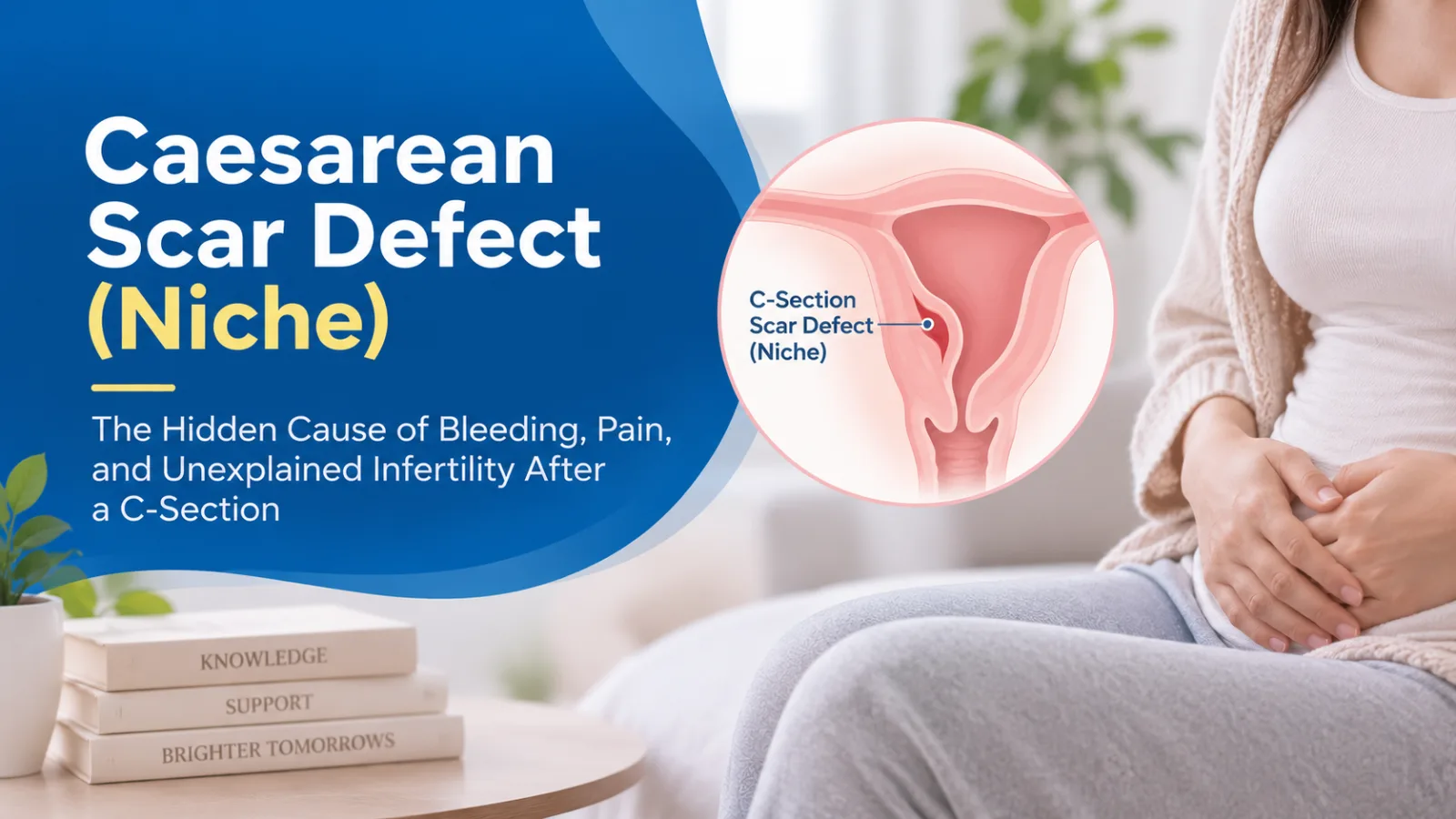
A woman comes in years after her caesarean, still getting a week of brown spotting after every period ends — or trying, unsuccessfully, for a second baby. The scar healed on the skin. Inside the uterus, it may not have.
This is the story of the niche.
Key Takeaways
- A “niche”, also called an isthmocele or caesarean scar defect, is a pouch-like gap where a previous C-section incision didn't fully heal.
- It's common — reported in roughly 1 in 5 to 8 in 10 women after a C-section, and more often after repeat surgeries.
- Most niches cause no symptoms and need no treatment; problems arise only in a minority.
- When symptomatic, the usual signs are prolonged spotting after periods, pelvic pain, painful sex, or unexplained secondary infertility.
- Treatment is matched to the defect: hormonal therapy for bleeding alone; hysteroscopic or laparoscopic repair when fertility is the goal.
What Exactly Is a Niche?
When a caesarean incision in the lower uterine segment doesn't knit back together fully, it leaves a small pouch or notch in the uterine wall — a caesarean scar defect, also called an isthmocele or niche.
Picture the wall of the uterus as a smoothly plastered surface; a niche is a dent where the plaster never fully filled in.
Menstrual blood and fluid can collect in this pocket instead of draining out normally.
Emerging research also points to a second mechanism: endometrial-type tissue trapped within the scar can trigger low-grade, cyclical inflammation in the muscle wall — a process that shares some biology with endometriosis, though this link is still being actively studied.
How Common Is It — And Why It Matters in Kolkata Practices
Estimates vary widely by how strictly a niche is defined, but published series report it in anywhere from roughly 1 in 5 to more than 8 in 10 women after a caesarean, with both frequency and size increasing after each repeat surgery.
This isn't a niche, pun aside, concern for India.
Nationally, caesarean deliveries rose to 21.5% of all births by NFHS-5 (2019–21) — and in West Bengal's private hospitals specifically, over 8 in 10 births are now by C-section.
A generation of women is accumulating multiple caesarean scars, which makes recognising a symptomatic niche — rather than dismissing it as “normal spotting” — increasingly relevant.
The Symptoms Worth Naming to Your Doctor
- Brown or dark spotting for several days to two weeks after a period has otherwise ended
- Pelvic pain or pressure, often worse around menstruation
- Pain during intercourse (dyspareunia)
- Secondary infertility, particularly when other causes have been ruled out
- Difficulty interpreting cervical mucus or spotting that disrupts fertility tracking
Importantly, a large proportion of women with a niche on ultrasound have none of these symptoms and require no treatment at all — the finding alone is not a diagnosis of disease.
How It's Diagnosed
Transvaginal ultrasound is the standard first step and can usually identify a niche and estimate the residual myometrial thickness (RMT) — the amount of healthy muscle wall left over the defect.
When more detail is needed, saline infusion sonohysterography outlines the pocket more clearly, and MRI is reserved for cases where surgical planning requires it.
RMT is the number your doctor will watch most closely, because it guides which treatment — if any — is appropriate.
How a Niche May Affect Fertility
The proposed links are mechanical and inflammatory.
Pooled fluid or blood in the niche can seep into the uterine cavity around the time of implantation, interfere with cervical mucus quality, or reflect chronic local inflammation.
A large randomised trial, the LAPRES study, is currently testing whether surgically repairing a niche improves pregnancy rates in otherwise unexplained infertility.
Results are awaited, and until then, this remains a plausible but not fully proven contributor rather than an established cause.
Treatment: Matched to Symptoms and Your Fertility Plans
A 2025 clinical consensus from the Society of Obstetricians and Gynaecologists of Canada frames management around three variables:
- Symptoms
- Residual myometrial thickness
- Whether future pregnancy is desired
Broad options include:
Expectant Management
Appropriate when the niche is asymptomatic, regardless of size.
Hormonal Therapy
Oral contraceptives or a levonorgestrel IUD, as first-line treatment when bleeding is the only issue and fertility isn't an immediate goal.
Hysteroscopic Resection
A day-care procedure that improves drainage.
It requires adequate RMT and does not rebuild the uterine wall.
Laparoscopic Repair
Reconstructs the uterine wall and is generally preferred when the wall is thin or pregnancy is being planned.
Reported symptom relief is high with both surgical approaches. Older pooled data suggests roughly 100% after laparoscopic repair versus 87% after hysteroscopic resection, and laparoscopic series consistently show significant gains in residual wall thickness afterward.
No treatment carries a guarantee, and the choice should be individualised, not templated.
Hysteroscopic Repair vs. Laparoscopic Repair
| Hysteroscopic repair | Laparoscopic repair | |
|---|---|---|
| What it does | Shaves down the defect's edge from inside the uterine cavity | Removes scar tissue and re-stitches the uterine wall from outside |
| Rebuilds wall thickness? | No — improves drainage only | Yes — reconstructs the myometrium |
| Typical candidate | RMT ≥ 2.5–3 mm; bleeding is the main complaint | Thinner residual wall, or fertility/future pregnancy is the goal |
| Recovery | Shorter, day-care procedure | Longer, requires abdominal keyhole access |
Myth vs. Fact
Myth: “A niche only matters if I want to have another baby.”
Fact: It can also cause spotting, pain, or period-like bleeding for years — independent of any pregnancy plans.
Myth: “Every woman with a niche needs surgery.”
Fact: Most niches are asymptomatic and are simply monitored — surgery is reserved for symptoms or fertility concerns.
Myth: “A repeat C-section can't make it worse.”
Fact: Risk and size of the defect tend to rise with each additional caesarean.
A Checklist Before Your Consultation
- Note the pattern of your spotting — how many days, and its relationship to your period.
- List all previous caesareans, with approximate dates and any healing complications.
- Bring prior ultrasound or sonohysterography reports, if available.
- Be clear about your fertility timeline before discussing treatment options.
- Ask specifically about your residual myometrial thickness (RMT) reading.
Frequently Asked Questions
Can a niche cause a missed period-like bleed for days after my period ends?
Yes — trapped blood pooling in the pouch and draining slowly is the classic pattern, and it's the symptom most consistently linked to a niche in recent reviews.
Does a niche mean I can never get pregnant again?
No.
Many women with a niche conceive without intervention.
A niche is one contributor among several to consider in an infertility work-up, not a verdict.
How is a niche actually diagnosed?
Transvaginal ultrasound is the first step; saline infusion sonohysterography sharpens the picture, and MRI is used selectively when findings are unclear or surgery is planned.
Will repairing the niche guarantee a pregnancy?
No treatment can guarantee that.
Repair aims to reduce inflammation, fluid pooling, and wall thinning that may be working against implantation — the evidence for a direct fertility benefit is still developing.
Is a vaginal birth after caesarean (VBAC) possible if I have a niche?
It depends on the residual myometrial thickness and overall scar integrity.
This needs individual assessment with your obstetrician, not a blanket rule.
A Note From Dr. Neha Yadav
If you've had a caesarean and are dealing with prolonged spotting, pelvic pain, or a second pregnancy that isn't happening as expected, a niche is worth ruling in or out — not fearing.
A focused ultrasound is usually enough to start the conversation.
Book a consultation at the Salt Lake clinic to have your scar properly evaluated.
References
Society of Obstetricians and Gynaecologists of Canada. Clinical Consensus No. 463: Diagnosis and Management of Cesarean Scar Niche. J Obstet Gynaecol Can. 2025.
Murji A, Sanders AP, Monteiro I, et al. Cesarean scar defects and abnormal uterine bleeding: a systematic review and meta-analysis (FIGO Committee on Menstrual Disorders). Fertil Steril. 2022;118(4):758–766.
Vissers J, Klein Meuleman SJM, de Leeuw RA, et al. Effectiveness of laparoscopic niche resection versus expectant management in unexplained infertility with a large uterine niche (LAPRES study protocol). BMJ Open. 2023;13(7):e070950.
Sultan S, Parvez KF, Khan MS. Emerging Manifestations of Cesarean Scar Defect in the Reproductive-Age Group. Cureus. 2025;17(11):e97287.
Reproductive and clinical outcomes after minimally invasive isthmocele repair: robotic-assisted vs laparoscopic approaches. University Hospital Bonn cohort, 2026. [Pre-publication data — verify final citation before publishing.]
Klein Meuleman SJM, Min N, Hehenkamp WJK, et al. The definition, diagnosis, and symptoms of the uterine niche — a systematic review. Best Pract Res Clin Obstet Gynaecol. 2023;90:102390.
International Institute for Population Sciences. National Family Health Survey-5 (2019–21), India Report. Ministry of Health and Family Welfare, Government of India.
Cleveland Clinic. Isthmocele (Cesarean Scar Defect): Symptoms, Diagnosis and Treatment. Patient education reference, 2026.
Verification flag: prevalence range 19–84%, RMT surgical thresholds, and the West Bengal private-hospital C-section figure should be re-checked against primary sources immediately before publication, as these draw on secondary reporting of NFHS-5 and single-centre surgical cohorts.