
Key Takeaways
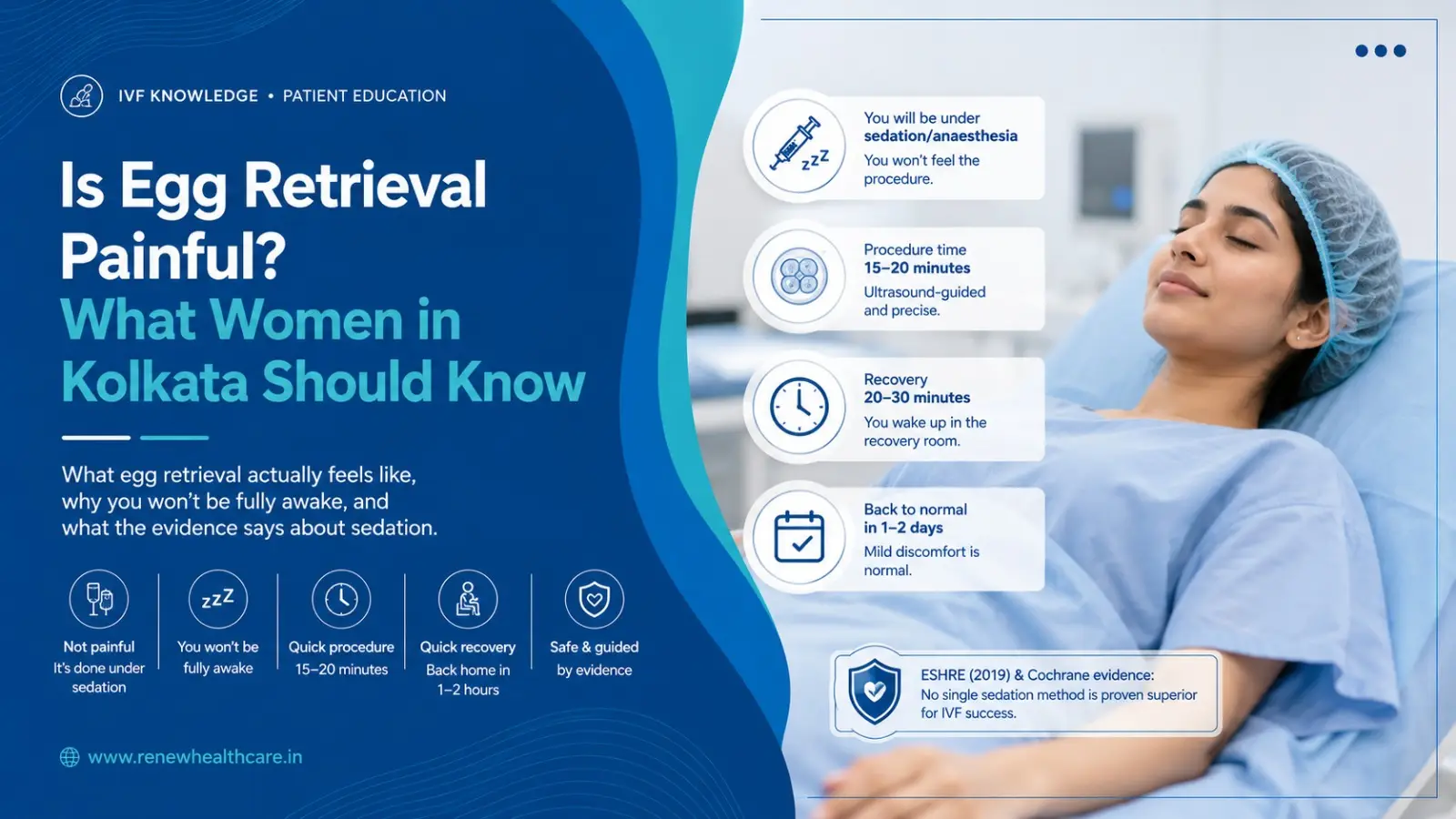
- Egg retrieval itself is not painful — it is done under sedation or short-acting anaesthesia, never while you are fully awake.
- Most Indian IVF clinics use conscious sedation or brief general anaesthesia for the procedure.
- You will not be intubated or unconscious for hours. Most women wake within 20 to 30 minutes, in a recovery room.
- Mild cramping, bloating or spotting afterwards is normal and usually settles within one to two days with simple painkillers.
- ESHRE (2019) and Cochrane evidence agree that no single sedation method is proven superior for IVF success — the choice is guided by safety, comfort and clinic resources.
If you are preparing for your first IVF cycle, egg retrieval is often the step patients worry about most. Let me answer this plainly, as I do with every patient in my clinic: you will not feel the procedure happening, and you will not be left to tough it out while fully conscious.
What Actually Happens During Retrieval
Egg retrieval, also called oocyte pick-up, takes about 15 to 20 minutes. Using ultrasound guidance, a fine needle is passed through the vaginal wall to gently aspirate fluid and eggs from each follicle. Done without any anaesthesia, this would be genuinely painful — which is exactly why anaesthesia is a standard part of the procedure and not an optional add-on.
Sedation or General Anaesthesia — Which Will You Get?
Across most Indian IVF centres, including ours, patients receive either deep sedation (commonly a combination of propofol with a short-acting painkiller) or brief general anaesthesia. Both keep you comfortably asleep and unaware throughout the retrieval, and both differ from major surgical anaesthesia — there is no breathing tube, and recovery is quick. A paracervical block, which numbs the area near the cervix while you stay awake, is used in some clinics, but patient satisfaction and comfort scores are generally lower with that approach than with sedation.
What You Will Feel Afterwards
Once the anaesthesia wears off, mild cramping, bloating or light spotting is common — similar to period cramps — and usually eases within one to two days with paracetamol. Severe or worsening pain, fever, or heavy bleeding is not typical and should be reported to your clinic promptly, as it may signal ovarian hyperstimulation or, rarely, bleeding that needs attention.
Plan to rest fully on the day of the procedure, and skip driving, exercise and work commitments. Most women feel well enough to resume normal work the very next day, though listening to your body matters more than the calendar.
What the Evidence Actually Says
This is where I want to be honest rather than reassuring for its own sake. ESHRE's 2019 good-practice recommendations and a Cochrane review of pain relief during oocyte retrieval both conclude that no single anaesthesia or sedation technique has been proven to improve IVF outcomes over another. The choice is guided by your safety profile, the clinic's monitoring capability, and your comfort — not by any technique offering a better pregnancy chance. I discuss this openly with patients so the decision feels informed rather than imposed.
Frequently Asked Questions
Will I be awake during egg retrieval?
No. You will be under sedation or short-acting general anaesthesia and will have no memory of the procedure.
Is it safe to have anaesthesia for such a short procedure?
Yes. For healthy women, the anaesthesia risk for a 15 to 20 minute retrieval is very low, and you will be monitored throughout by an anaesthetist.
How soon can I go home?
Most patients are discharged one to two hours after waking, once vital signs are stable. Arrange for someone to accompany you home, as driving is not advised that day.
Will the retrieval hurt the next day?
Expect period-like cramping and some bloating rather than sharp pain. Simple painkillers are usually enough, and symptoms typically settle within 48 hours.
If egg retrieval is your next step and you would like a clear, unhurried explanation of what to expect, I am happy to walk you through it at a consultation at our Salt Lake, Kolkata clinic.
References
ESHRE Working Group on Ultrasound in ART. Good practice recommendations for the use of ultrasound in assisted reproduction, including oocyte retrieval. 2019.
Kwan I, et al. Pain relief for women undergoing oocyte retrieval for assisted reproduction. Cochrane Database Syst Rev. 2018.
Rolland R, et al. Anaesthesia and sedation for oocyte retrieval: comparative outcomes review. 2017.