
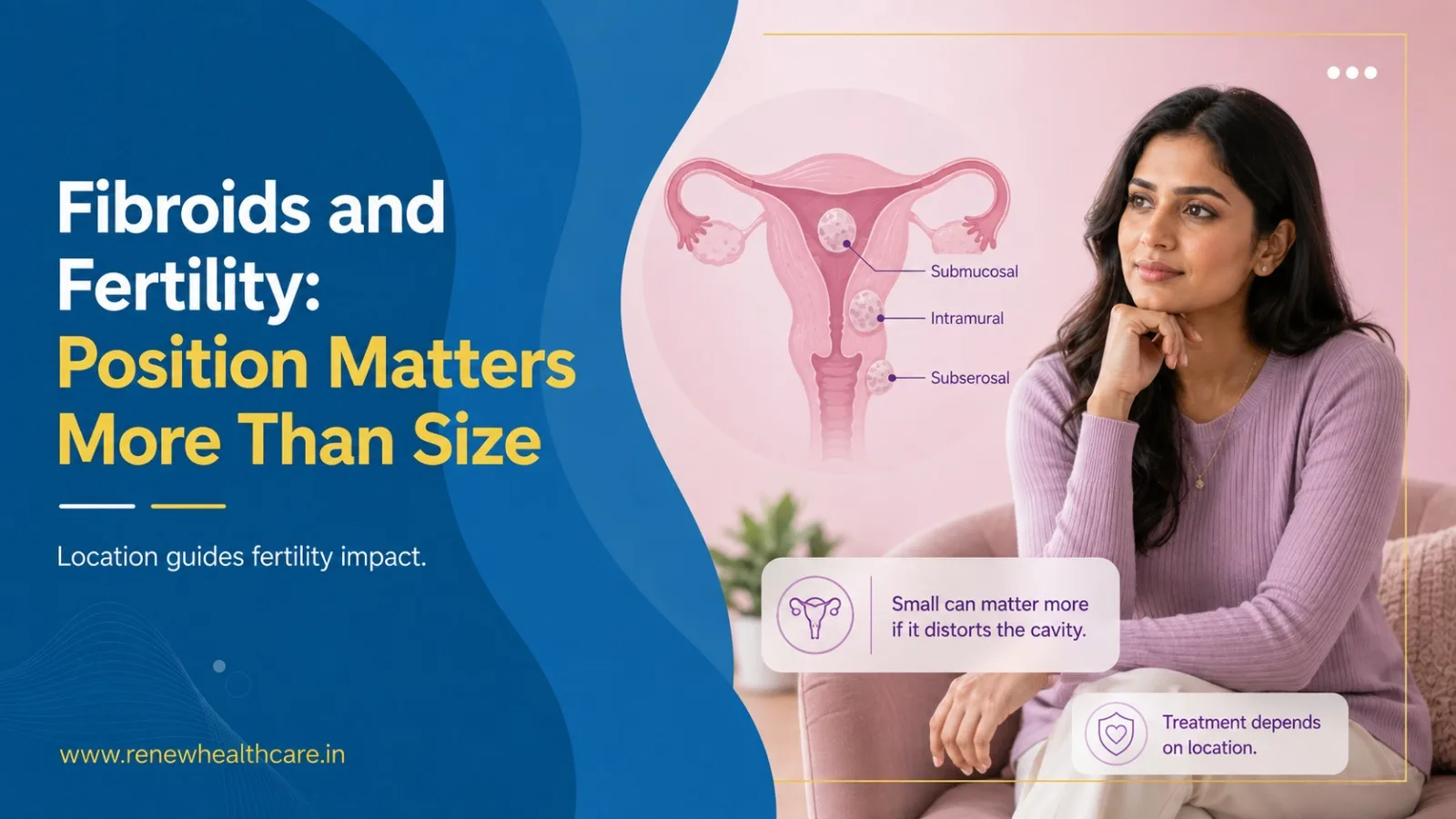
If you've been told you have a fibroid, the first question is rarely "where is it?" — it's usually "how big is it?" But when it comes to fertility, location tells us far more than measurement. A small fibroid in the wrong place can matter more than a large one in a harmless spot.
Key Takeaways
- Submucosal fibroids (growing into the uterine cavity) affect fertility the most — regardless of size.
- Subserosal fibroids (on the outer uterine wall) generally do not affect fertility.
- Intramural fibroids sit in a grey zone — their impact depends on size and whether they distort the cavity.
- ASRM guidance: there's insufficient evidence that size or number alone (without cavity involvement) lowers pregnancy chances.
- Not every fibroid needs surgery — the decision should be individualised, not automatic.
The Three Types That Matter
Gynecologists classify fibroids using the FIGO system, based on where they sit relative to the uterine cavity. Submucosal fibroids push into the cavity itself, like a pebble inside a water balloon — even a small one can distort the space an embryo needs to implant, interfere with sperm transport, or disrupt the uterine lining's blood supply. Subserosal fibroids grow outward, on the uterus's outer surface. Because they don't touch the cavity or the lining, most evidence shows they rarely interfere with conception, even when they're quite large.
Why Intramural Fibroids Are the Grey Zone
Intramural fibroids grow within the muscular wall itself. Their effect on fertility is genuinely uncertain — it depends less on a single size cut-off and more on whether they distort the cavity, how many there are, and where exactly they sit. This is why the ASRM has stopped short of recommending automatic removal based on size alone, reserving that recommendation for submucosal fibroids or intramural ones that visibly change the shape of the cavity. For women considering IVF, a case-by-case ultrasound or MRI assessment matters more than a number on a report.
How Are Fibroids Managed?
Submucosal fibroids distorting the cavity should be removed hysteroscopically before conception attempts — evidence supports improved pregnancy rates. Intramural fibroids without cavity distortion don't require automatic removal; size and number alone aren't sufficient justification per ASRM. Management is individualised, weighing age, ovarian reserve, and reproductive history rather than defaulting to surgery.
What This Means for You
If you've been diagnosed with a fibroid, the report should tell you its type, not just its size. Before assuming surgery is necessary — or dismissing a fibroid as irrelevant — ask your specialist three questions: Does it touch the uterine cavity? Is it distorting the lining? Is it likely to interfere with implantation or embryo transfer? These answers guide the decision far more reliably than centimetres do.
The Bottom Line
Most women with fibroids conceive without difficulty. When fibroids do matter for fertility, it's almost always about where they are, not how large they've grown. An individualised evaluation — not blanket surgery — is what current evidence supports.
Dr. Neha Yadav is an Infertility Specialist and IVF Expert practising in Salt Lake, Kolkata. If you've been told you have a fibroid and aren't sure what it means for your fertility, book a consultation for a personalised, evidence-based evaluation.