Key Takeaways
- Understanding how many days can sperm live in the female body can help couples make informed decisions about pregnancy planning.
- With the right timing, balanced lifestyle, and expert guidance, your journey towards parenthood can become clearer.
In This Article
For couples’ understanding fertility is not just about biology. It is a journey of hope, timing, and at times anxiety. One of the most frequently asked questions in reproductive health is How many days sperm live in female body and How long can sperm live in female body after intercourse. There are many myths surrounding this and misinformation can create unnecessary stress, especially for those couples who are actively trying to conceive.
Seeking guidance from a trusted
IVF Centre In Kolkata can help clear these doubts with accurate medical advice, personalized fertility assessments, and the right treatment options to support your parenthood journey.
The truth is that the lifespan of sperm in the female body is influenced by natural hormonal changes, the fertile window, and overall reproductive health. When you know how long sperm live in the female body after intercourse, it can help you better understand your pregnancy chances, avoid confusion about ovulation timing, and make informed decisions about your reproductive journey. In this blog, we’re going to give you a lowdown of sperm survival in the female body, what affects it, and what it really means for conception and beyond.
How Many Days Sperm Live in the Female Body?
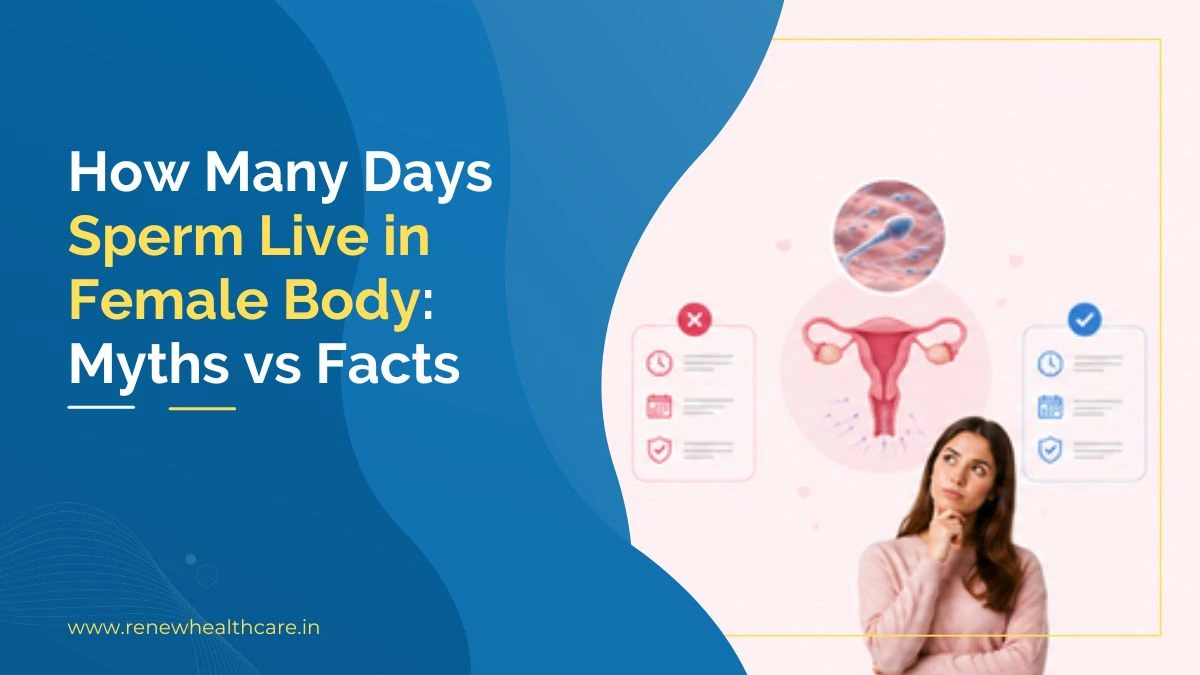
On an average, sperm can survive up to 3 days inside the female reproductive tract. However, under ideal conditions, especially around ovulation, the sperm lifespan in the female body can also extend to five days. This means that even if intercourse happens several days before ovulation, pregnancy is still possible.
That is because the sperm can remain alive in the uterus and fallopian tubes waiting for the egg to be released. If you are specifically wondering
How many days sperm survive in uterus, studies show that sperm can remain viable for up to five days in favourable conditions.
Lifespan of Sperm Explained by Fertility Experts
To understand the lifespan of sperm, let us take a look at what exactly happens after ejaculation.
Average sperm life after ejaculation
After intercourse, millions of sperm enter the vagina. However, not all survive this journey. Many die within hours due to the naturally acidic vaginal environment.
On average:
- Sperm can live up to 3 days inside the female reproductive tract.
- Outside the body, sperm usually survive only 15–30 minutes, especially if exposed to air and dry surfaces.
Maximum sperm survival time inside the female body
During ovulation, the environment becomes very favourable. Fertile cervical mucus becomes thinner and more alkaline. This protects the sperm and supports movement. In such conditions,
- The sperm survival time in female body can extend up to 5 days.
- The life span of sperm in the uterus increases due to cervical mucus and small cervical crypts that temporarily store sperm.
- If you are wondering how many days sperm lives in the uterus, the answer can be up to 5 days during the fertile window.
What Affects the Lifespan of Sperm in the Female Body?
The lifespan of sperm in vagina is not fixed. Several factors play a part in determining how long sperm will stay alive after intercourse.
Role of ovulation and fertile window
Ovulation is the biggest role in sperm survival time. The fertile window is five days before ovulation and the day of ovulation. Since sperm life in the uterus can last up to five days, having intercourse during this period increases pregnancy chances significantly.
Cervical mucus and reproductive health
Cervical mucus changes throughout the menstrual cycle. Around ovulation, it becomes clear, stretchy, and less acidic. This helps the sperm swim easily and consequently increases sperm lifespan in the female reproductive tract. If a woman has infection, hormonal imbalance, or unhealthy vaginal condition, the sperm lifespan in the female body may reduce drastically, sometimes to just a few hours.
Lifestyle and environmental factors
Many couples who are trying to conceive often come with the question of what kills sperm in the female body. Here are some of the factors that reduce the longevity of sperm from many days to a few hours:
- pH of the vagina is acidic, especially outside of gestation.
- Poor vaginal health or infections
- Cervical mucus that is thick or unfriendly
- Rarely, immune responses
- Using certain chemicals or lubricants
For How Long Can The Sperm Survive If You Freeze It
Sperm can last for many years without losing its capacity to fertilise when it is preserved using cutting-edge methods like cryopreservation also known as semen freezing. The process of semen freezing
- Liquid nitrogen is used to store sperm at extremely low temperatures (-196°C), this prevents ageing or degradation.
- All biological activity ceases at this temperature.
- Even after decades, frozen sperm has been used with success. Studies have confirmed successful pregnancies from frozen sperm for over 2 decades.
This technique is frequently applied in:
- IVF procedures and Intrauterine Inseminations (IUI Treatment)
- Preserving fertility prior to medical interventions
- Programs for sperm donation
If you are looking for
semen freezing centre in Kolkata, book an appointment with a fertility specialist in Kolkata at Renew Healthcare.
How Many Sperm Do You Need To Become Pregnant
It takes only one sperm to fertilise an egg however, millions are required for successful conception.
- 15 million to 200 million sperm per millilitre are found in a healthy ejaculation.
- The majority of sperm do not make it to the egg.
- Few hundred make it to the fallopian tubes.
- In the end, only one fertilises the egg.
For this reason, sperm quality, motility, and count are all important throughout pregnancy.
How Can Men Improve Sperm Health
With improved sperm health, the chances of couples trying to conceive increases. Here are some the factors that can help in improving the sperm health over a period of time:
- Continue living a healthy lifestyle, do not miss out on regular exercise.
- Consume an antioxidant-rich, well-balanced diet, while keeping a check on your weight.
- Say no to smoking and alcohol
- Minimise exposure to heat
- Steer clear of tight pants
- Avoid using laptops on your lap too much.
- Cut back on using hot tubs or saunas
- Try to get 7-8 hours of sleep per day
Keep a check on your stress levels, hormone levels are impacted by prolonged stress.
In the end if you are trying to conceive do not forget to take
Preconception counselling in Kolkata from experts at Renew Healthcare as routine consultations can help detect and address problems early.
Common Myths About Lifespan of Sperm in Female Body
Let us debunk some common misconceptions around the lifespan of sperm in the uterus.
Myth 1: Sperm die immediately after intercourse.
Fact: The sperm survival time in the female body can be up to 5 days.
Myth 2: Washing or urinating after intercourse removes sperm from the uterus.
Fact: Once sperm enters the cervix, they cannot be washed out.
Myth 3: Pregnancy can only happen on the day of ovulation.
Fact: Because of the extended lifespan of sperm in the uterus, pregnancy can happen from intercourse up to 5 days earlier.
Myth 4: Only one sperm matters, so count doesn’t matter.
Fact: While one sperm fertilises the egg, millions are needed to ensure a successful journey through the female reproductive tract.
When to Consult a Fertility Specialist
If you have been trying to conceive for 12 months and you’re under the age of 35, or 6 months and you’re over the age of 35, it may be time to seek expert help. You can consider preconception counseling or advanced fertility testing at Renew Healthcare, recognized as the best fertility clinic in Kolkata and a trusted IVF Clinic in Kolkata. Every consultation, including expert evaluation and
IUI Treatment in Kolkata, can help identify issues affecting sperm lifespan in the female body and improve your chances of a healthy pregnancy.
In the end, Knowing How many days sperm live in uterus and what impacts their survival can help couples make more informed fertility decisions.
How Renew Healthcare Can Help In Your Fertility Journey?
As a leading IVF Centre in Kolkata, Renew Healthcare is known for providing expert backed fertility solutions like IVF, IUI, ICSI, Genetic Counselling and more. Combining 20+ years of expertise and having delivered 6000+ babies, our multidisciplinary team led by Dr Rajeev Agarwal, the
best IVF doctor in Kolkataempowers your parenthood journey with expertise, compassion, and ethical care. We provide comprehensive care needed under one roof.
In the end, we believe in transparent guidance, ethical practices, and compassionate support at every stage of your journey, helping individuals and couples make informed decisions with confidence.
FAQs
1. How many days does sperm live in the female body?
The lifespan of sperm in the female body is usually three days, but it can extend to five days around ovulation, when the conditions are favorable.
2. Can sperm survive for 5 days and still cause pregnancy?
Healthy sperm can survive up to five days in the uterus, which means that pregnancy is possible even if intercourse happens a few days before ovulation.
3. What factors increase or reduce sperm survival time in women?
Ovulation timing, cervical mucus quality, vaginal pH, female reproductive health, and male lifestyle habits can affect how long sperm stay alive after intercourse.
Popular Searches
Icsi Treatment In Kolkata |
Egg Freezing Centre In Kolkata |
Painful Periods Treatment In Kolkata |
Infertility Specialist In Jamshedpur |
Gynaecologist In Kolkata |
Hysteroscopic Surgeon In Kolkata |
Laparoscopy Surgeon In Kolkata |
Embryo Freezing Service In Kolkata |
Andrology Treatment In Kolkata |
Tesa Pesa Treatment In Kolkata
Popular Blogs
Sperm Life Span in Female Body |
Foods To Avoid After Embryo Transfer |
Intralipid Infusion Uses |
Why IUI Fails: Reasons Explained |
How To Fix Low Sperm Count |
Ideal AMH Level For Pregnancy |
What Is Vasectomy And Tubectomy