Request Call Back

If you’ve been trying to conceive and have started looking into fertility treatments, you’ve mostly come across both the terms: IVF and test tube baby.
Most people assume they mean different things. Others think one is more advanced than the other. Neither is true, and the confusion is completely understandable.
The term “test tube baby” came first, back when the procedure was brand new, and the world was still getting to understand what it even meant. IVF or In Vitro Fertilization is the medical term for test tube baby.
At Renew Healthcare, an IVF centre in Kolkata, our patients ask this question almost all the time: “What is the difference between IVF and test tube baby?” Let’s understand it better.
Test tube baby means a baby born when the fertilization of sperm and egg happens outside the mother’s body, in a lab rather than inside the fallopian tube. The name came from the glass petri dishes used in early fertility labs. “In vitro” is Latin for “in glass”, which is exactly what IVF refers to.
Once fertilization happens, the embryo is placed back into the uterus.
So when people ask, “Is IVF and test tube baby same?”, the answer is yes. They are two names for the same concept. One is the popular name, and the other is the clinical name.
Medically, there is no difference between IVF and test tube baby. The only difference is only in language.
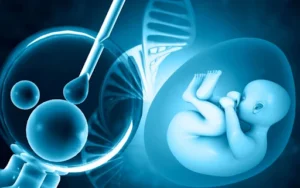
When fertilization happens naturally, it takes place inside the woman’s body, specifically in the fallopian tube. With IVF, this step is moved to a petri dish in a lab.
The phrase test tube baby caught on because it was easy to explain to a public that had never heard of assisted reproduction before. A test tube was something people recognized.
Over time, as IVF became more common, the medical terminology followed. But in India and much of South Asia, “test tube baby” remains the phrase most families use first.
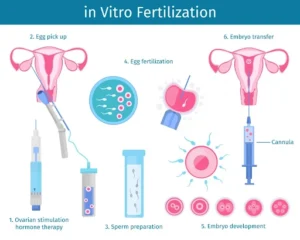
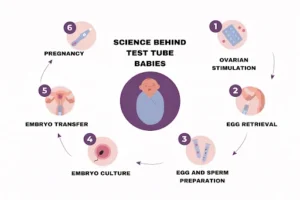
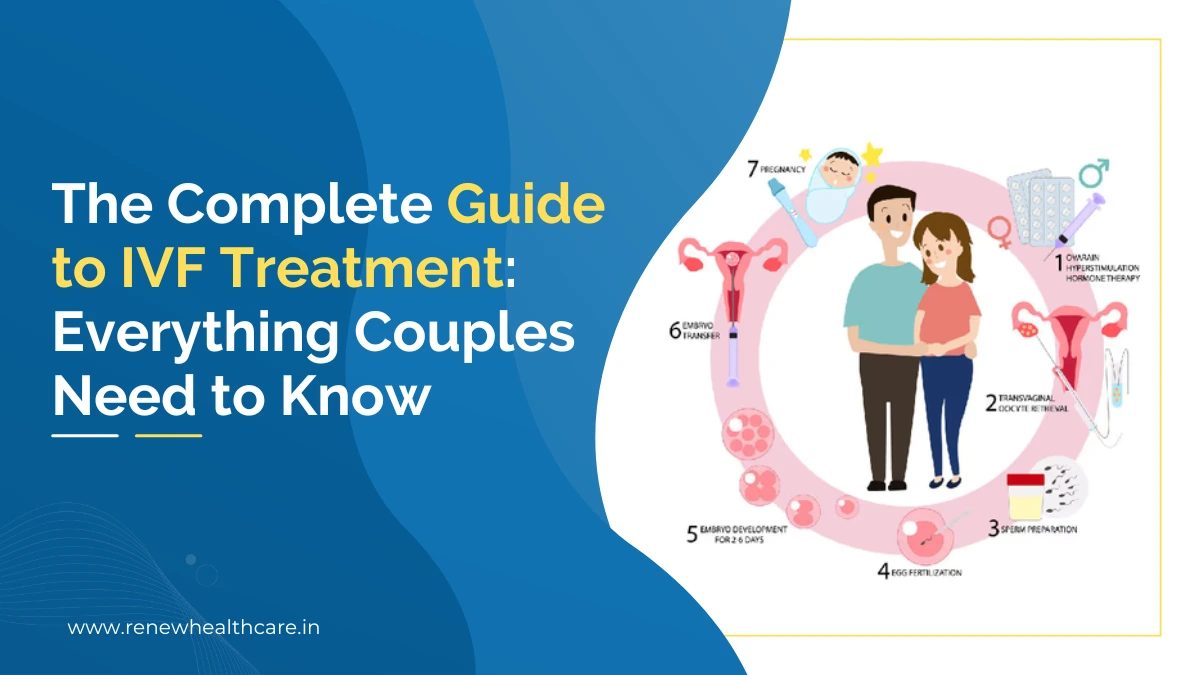
The process has several stages, and this is what most couples really want to understand.
The woman is given hormone injections over 10-14 days that stimulate the ovaries to produce multiple eggs rather than the usual one egg.
A minor procedure is done under sedation to retrieve the mature eggs from the ovaries.
Here, the test tube baby procedure from fertilization to pregnancy, actually begins.
The eggs are combined with sperm at this stage, either through standard IVF or ICSI (intracytoplasmic sperm injection), where a single sperm is injected directly into the egg.
Renew Healthcare also offers ICSI treatment in Kolkata for cases where male infertility is involved.
The lab keeps an eye on the fertilized eggs for 3 to 5 days as they grow into embryos.
One or two healthy embryos are transferred into the uterus. The rest can be frozen for future cycles at egg freezing center in Kolkata.
About two weeks after transfer, a blood test confirms whether implantation was successful.
IVF isn’t the first step for every patient. Many couples try other approaches first, including the best IUI treatment in Kolkata, before moving to IVF. But in certain cases, it becomes the best option for couples to experience parenthood.
You may be advised to undergo IVF if there:
Not every fertility journey follows the same path; some couples may explore options through a surrogacy centre in Kolkata. The first step, though, is always a detailed evaluation at an infertility clinic in Kolkata.
Success rates in IVF are never exactly the same for everyone. Age becomes an important factor, but so does egg quality, sperm health, and overall reproductive health of the patients.
In general, younger women tend to have better success rates per cycle. Women below 35 often respond better to treatment compared to women in their late 30s or early 40s. But these numbers are averages. We;ve seen cases where couples with difficult fertility histories still conceive after proper treatment planning.
What people don’t sometimes realise is that IVF sometimes takes more than one cycle. SOme couples conceive in the first attempt, while others may need additional cycles before getting a positive result.
There’s still a lot of confusion around IVF, mostly because of the phrase “test tube baby” sounds far more dramatic than the actual process.
Once the embryo is transferred and pregnancy begins, everything that follows is entirely natural. IVF babies develop in the mother’s womb, are born the same way, and grow up the same as any other child.
Transferring a simple embryo at a time is now standard practice in most fertility clinics. Multiple births happen when more than one embryo is transferred, and that decision is made with the patient’s consent and medical guidance.
Male infertility factors are involved in nearly half of all the infertility cases we see at Renew Healthcare. IVF, especially combined with ICSI, directly addresses issues related to sperm quality, motiliy and quantity.
IVF significantly improves the chances of pregnancy, but no fertility treatment offers a guarantee. What it offers is a structured, medically supported path with real possibilities.
The question of IVF vs test tube baby comes down to this, they are the same thing. One term grew out of popular culture, the other is what fertility doctors actually call the procedure.
More than terminology, what matters is whether IVF treatment process for infertility couples is the right path for you, and that’s something search engines can’t answer on their own. It takes a proper evaluation, a conversation with a fertility specialist.
If you’re at this stage, Renew Healthcare, a trusted infertility clinic in Kolkata, is a good place to start that conversation.
The phrase dates back to 1978, when the world’s first IVF baby was born, and the media needed a simple way to explain the procedure to the public. Lab petri dishes and not actual test tubes were used, but “test tube baby” was catchier, and it stuck. Medically, the correct term has always been IVF.
Outside the body. The egg and sperm meet in a lab rather than in the fallopian tube. Once fertilization happens and the embryo develops, it’s transferred back into the uterus, where the pregnancy continues normally.
Yes. Decades of data on IVF pregnancies show that children born through IVF develop, grow, and live just like any other child. The method of fertilization doesn’t affect what happens once the embryo implants and pregnancy begins.
Complete IVF treatment and fertility improvement process depend on age, the cause of infertility, and embryo quality. Women under 35 generally see the highest success rates, around 40-50% per cycle. Rates decline gradually with age. Your fertility specialist will give you a better answer based on your individual test results.
It can, if more than one embryo is transferred. Most clinics today recommend single embryo transfer, where possible, to reduce the risk of complications that come with multiple pregnancies.
If you’ve been trying to conceive for a year without success or are over the age of 35, it’s time to get an evaluation. Don’t wait too long, as timing is important in fertility treatment.


If you are here after another negative test or before your first IVF appointment you are in the right place....

“One conversation I have almost every week in my clinic is with couples who wish they had come six months...

Why Asking the Right Questions Before IVF Treatment Can Change Everything Walking into that first appointment with a fertility doctor...
ভূমিকা আজকাল অনেক দম্পতি বন্ধ্যাত্বের সমস্যা নিয়ে চিন্তিত হয়ে পড়ছেন। IVF, IUI, এবং ICSI-এর মতো অত্যাধুনিক বন্ধ্যাত্ব চিকিৎসার পাশাপাশি, বেশ...

ভূমিকা হস্তমৈথূন একটি স্বাভাবিক প্রতিক্রিয়া যেটা প্রত্যেক পুরুষ তার বয়স বা জৈবিক তাড়নার জন্য করে থাকে। তা সত্ত্বেও বহু মানুষের...

In vitro fertilization abbreviated as IVF is a popular and highly effective method of assisted reproduction. Over the years with the...

ভূমিকা যেসব নারী তাদের প্রজনন ক্ষমতা বা উর্বরতা যাচাই করছেন, তাদের ক্ষেত্রে প্রায়শই AMH পরীক্ষাটি করা হয়ে থাকে। যদি এই...
Even if you are not trying to conceive, your uterus is preparing itself for pregnancy every month. During that preparation,...
Pregnancy dating can be confusing. At 2 weeks pregnant, based on your last menstrual period, ovulation may just be happening....

How Thyroid Hormones Impact Women’s Health In India, nearly 42 million people are estimated to be living with thyroid conditions....
Disclaimer :- The content shared by Renew Healthcare is intended for informational purposes only and should not be considered medical advice. For accurate diagnosis and personalized fertility care, please consult a qualified healthcare professional.